Friday Flashback #38


Red Creates Cityscape for Kylie Minogue With Discreet Tools, Softimage XSI
(August 23, 2001)

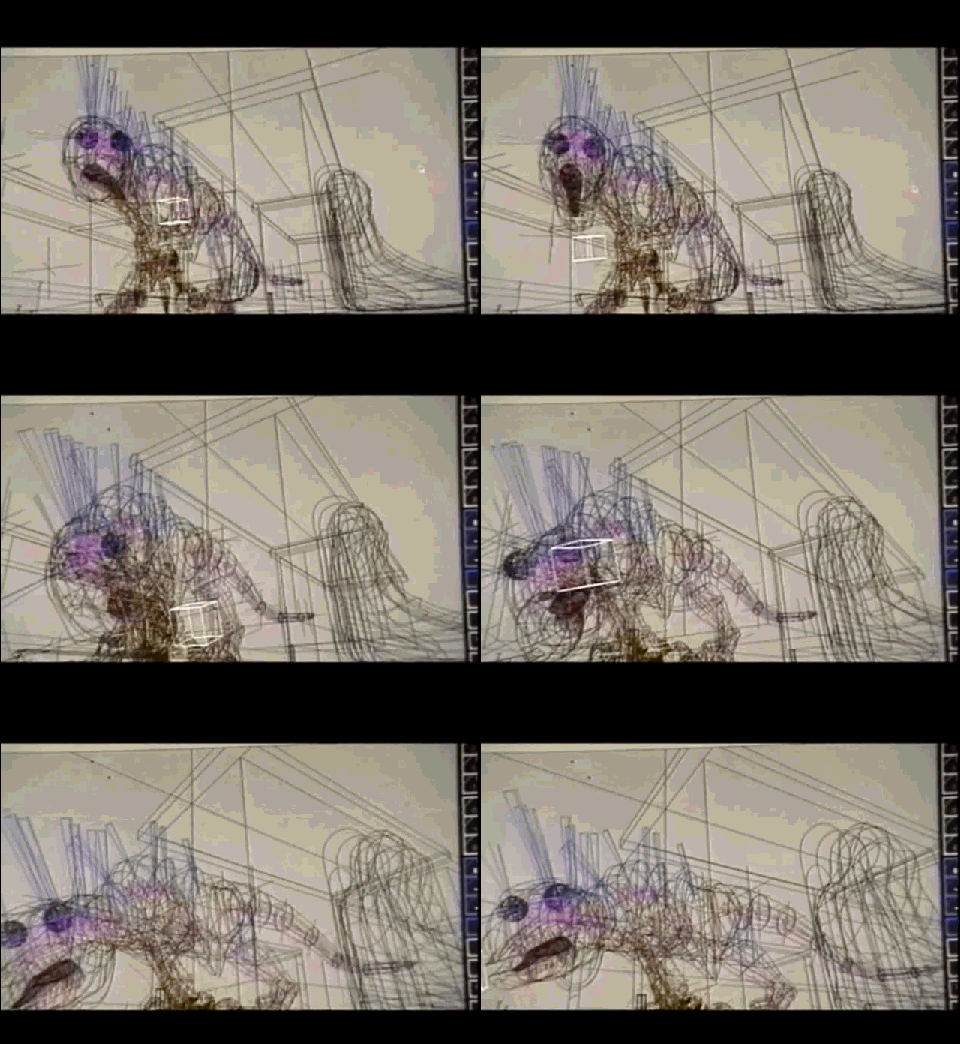
“Can’t Get You Out of my Head,” the first single to be taken from Kylie’s forthcoming album, features the pop princess driving and strutting her stuff in a futuristic Manga-esque city. Pretty run of the mill stuff until you discover that the only things that were shot for real were Kylie, a handful of dancers and a static car. Black Dog tasked Soho-based visual communications facility Red, with creating the rest from scratch to designs developed by director Dawn Shadforth.

Red utilised the full gamut of its Discreet arsenal – 3ds max, fire, flame and inferno – to create and animate the backgrounds with some SoftImage XSI thrown in for good measure.

The video:

The full article from Digital Producer Magazine
Continue reading

Friday Flashback #37


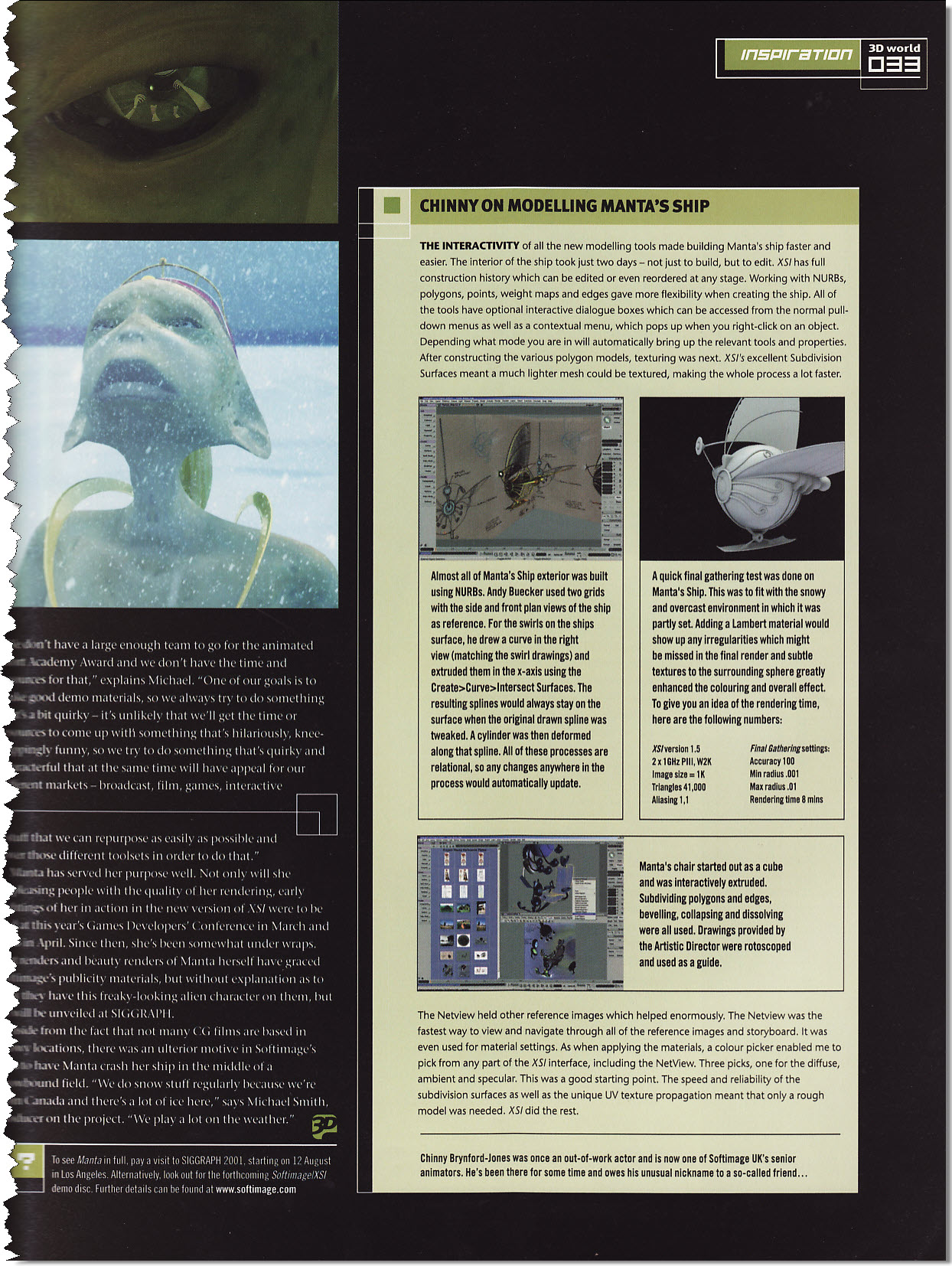
As I remember it, Eddie was one of the first Softimage products to have an HTML version of its documentation (the screenshot below is not from the first version that was ever converted, but a one a few years later). The Eddie doc team (Maryanne and Dominic) used a tool called Harlequin WebMaker to produce this [admittedly] primitive HTML doc, which included virtually no screenshots. In fairness, 1997 was just a few years removed from the no-website, print-only docs era 😉

The Eddie team may have asked me for help at some point, but somehow I got using WebMaker, maybe for the old DKit docs. Eventually I convinced the 3D team to let me convert their reference manual (a later version of that is shown below in a fancy new frameset). There was some resistance at first, because generating HTML was an unknown, un-scoped task with a lot of possible pitfalls. I convinced them by agreeing to take care of all the tedious labor involved. And there was a lot of tedious labor, more than you would think for such simple output, mostly because 1)you had to workaround a lot of limitations in the generator, 2) the source FrameMaker docs weren’t designed for HTML generation.

By the late 1990s, my HTML docs for Saaphire and the Softimage SDK looked like this. My menu tree was some JScript I downloaded from the web and adapted.

By 2000, the HTML user docs had improved markedly. At this point, the 3D doc team was using WebWorks Publisher (which had a fancy Java TOC/Index that won’t load into my IE8).

Finally, here’s a screenshot of the Object Models docs from just before the XSI 1.0 release. These docs were generated by a perl program that parsed XML markup embedded in comments in the source files, and then used XSLT to generate the HTML. When I set up that system, it was a requirement that the doc be embedded in the code. I used XML because I was a budding markup geek, and I wanted complete flexibility. It wasn’t my intention to have the devs edit the XML themselves. I figured I’d being doing most of that, but then I left Softimage and they got stuck editing XML markup.

If you’re curious, here’s what the XML looked like:

// <object id="Application" base="SIObject" introduced="1.0">
// 
// <description>
// The Application object is the base class for the <object idref="XSIApplication"/> object. This object 
// provides some general information about the Application and <object idref="XSIApplication"/> provides 
// additional Softimage-specific methods and properties.  Script writers normally do not deal with an instance 
// of Application; instead they use the global object called "Application", which is actually an instance 
// of XSIApplication. <br/>
// 
// From Netview there is no global object available of type XSIApplication so normally the script creates 
// this object (by creating the COM object with ProgID "XSI.Application") and then calls 
// <object idref="SIObject.Application"/> on the returned object to retrieve an instance of XSIApplication. 
// This approach is demonstrated in the examples in for the XSIApplication object.
// </description>
// 
// <seealso>
// <object idref="XSIApplication"/>
// </seealso>
//
// <properties>
//
//  <!-- property - - - - - - - - - - - - - - - - - - - - - - - - -->
// <property id="Application.StatusBar">
// <description>Sets the status bar text using a <link idref="String"/> value.</description>
// <examples>
// <example>
// <code lang="vbscript"><![CDATA[
// ' Change the display text in the status bar
// Application.StatusBar = "Hello world"
// ]]></code>
// </example>
// </examples>
// </property>
//
// </properties>

Friday Flashback #36


Last week’s flashback post and its historically-inaccurate screenshot spawned an XSI list discussion that included this mention of Softimage Eddie. Softimage® Eddie was an award-winning video compositing, editing and processing tool that ran exclusively on Silicon Graphics® Indigo workstations. Required 64MB RAM for video, 128MB for film. Approximate retail price was $7,995 (U.S.).

So I thought I’d pull together some Eddie screenshots, but it wasn’t easy to find any. All I turned up was the logo, some Eddie icons, and some install screenshots.

Eventually I found something on the Fuel for the Mind CD (thanks to Miquel Campos 🙂 that showed the node-based UI, but the image quality is pretty poor.

Softimage Eddie – a professional post-production studio at your fingertips:
http://vimeo.com/29476029

And here’s the Eddie brochure:

Friday Flashback #35


Customer story from IBC 2000 featuring Toonx, SOFTIMAGE 3D, and XSI.

FUNNY BUSINESS: ComicHouse Keeps Them Laughing
by Michael Abraham

I used to sneak comic books into class. That’s right, I admit it. More often than not, secreted behind my in-class copy of Lord of the Flies or The Decline and Fall of the Roman Empire would be the antics of Archie ‘n Jughead, the X-Men or, best of all, Mad Magazine. On occasion, while engrossed in my verboten reading, I would be discovered and scolded by teachers. It was worth it, of course, but I have to say that my regret today is more than palpable.

Don’t get me wrong. I feel no remorse for perusing comics when I was supposed to be studying the classics. No, my regret stems from the fact that, when my teachers told me comics wouldn’t pay the rent, I believed them. As it turns out, just as I was writing off all those panels of primary-colored excitement as the stuff of childhood, other people were planning a whole new world.

How’s this for timing? I graduated high school in 1984. In 1985, Hans Buying and Marcel Bosma – two aspiring comic strip artists living in Amsterdam – founded a cooperative especially for those underestimated and underappreciated comic strip artists and cartoonists. They called it ComicHouse.

Although Bosma elected to leave the company just a year after its inception, Buying worked hard to keep the dream alive. That faith has definitely paid off. Having recently moved to their new offices in Oosterbeek, ComicHouse is now the largest cartoon and animation agency in the Netherlands. Perhaps more importantly, however, is the fact that Buying and ComicHouse actively promote and protect the interests of over 30 prominent cartoon artists. In addition, the ComicHouse studio produces unrivaled traditional and digital animation for television and movie commercials, CD-ROMs, PSAs, computer games and Internet applications.

“We do somewhere around 10 commercials, 10 multimedia productions and 150 cartoon productions a year,” Buying says casually. “We also work a great deal with the art buying departments of all the major advertising agencies. We’ve been doing so much of that, in fact, that I seriously considered changing my first name to ‘Art.’ My wife wouldn’t let me though. She was too attached to Hans.”

Puns aside, the funny business of comic strips has changed since Buying set up shop a decade and a half ago: “

“In the beginning, using traditional animation for commercial purposes had some definite drawbacks,” Buying remembers. “Perhaps the biggest problem was establishing some sort of believable interaction between animated characters and the live-action product you were trying to sell. When SOFTIMAGE|3D was initially introduced to us, we saw that we could model, stage, light and animate products in a way that was completely unthinkable in a traditional environment. Keeping the dialectics of progress in mind, we came to a quick conclusion: ComicHouse had to invest in the best talent and state-of-the-art technology. As a result, our animation production process has changed dramatically in order to adapt both to new developments in the industry and to the heightened expectations of our clients. Working with Toonz and SOFTIMAGE|XSI, ComicHouse is better prepared than ever to compete with the world’s best-equipped studios. Both systems allow a company like ours to cut back on production time and budgets, keeping us competitive with similar European and Asian studios.”

In 1990, Buying partnered with Miriam van Velthoven, who now handles the agency’s daily production schedule. Recently, that schedule has included some striking work for well-known Pepsi Co. and Yazoo, a popular flavored milk kids’ drink in Europe. Both projects put ComicHouse and their technology to the test.


The Pepsi spot gave a new twist to an old theme. “Rudolph the Blue-Nosed Reindeer” offers a decidedly more hip version of the classic Christmas character. Forget all those reindeer games: this Rudolph finds his own fun, snowboarding to a grungy version of Jingle Bells, and using his boss’ house as a ski jump. This Rudolph is definitely the choice of a new generation.


“As with most of our projects, all the animation on ‘Rudolph’ was first done by hand, then processed by cleanup and ink artists,” Buying explains. “The inked artwork was then scanned into Toonz and painted using the Ink and Paint module. All the Pepsi cans were created using SOFTIMAGE|3D. We used the rotoscope to load all the pencil tests into perspective view then, using the pencil animation frames as a reference, we positioned, rotated and scaled each can frame-by-frame. We rendered the cans and the packshot with the SOFTIMAGE cartoon renderer, matching the cartoon style as close as we could.”

While not as well-known as Rudolph – at least on this side of the ocean – the Yazoo character adorning bottles of the beverage was created by ComicHouse in 1988. When Campina, the company that produces Yazoo, wanted to repackage and remarket the product for the new millennium, they decided to go back to the source.

Aiming to make Yazoo a friendly and likable character, ComicHouse realized the unique nature of the task at hand: “It’s very unusual to shift the marketing focus away from the product to an animated character,” Buying admits readily. “Right from the very beginning, however, everybody wanted to make Yazoo a well-known and loved character. If we could do that, we figured that establishing a secondary link with the product would then be a logical and simple next step.”

To create a Yazoo for the next generation, ComicHouse used their substantial contacts to create a team of international animation talent. Top animators from the Netherlands, Great Britain and Canada all came to the ComicHouse studios in Amsterdam, where they worked on some fourteen Yazoo commercials.

According to Buying, the biggest challenge on the Yazoo spots turned out to be not with the character, but with the beverage itself. Faced with the seemingly innocuous task of modeling a glass filling with milk, the ComicHouse team worked for days without success. After numerous failed attempts – and more than one system crash – Buying and his team arrived at a novel solution:

“In the end, it went something like this,” says Buying. “We started by modeling the milk itself, then split the model horizontally and applied some waves and animated the top half of the model. After creating a modeling relation, we extracted the top and bottom curves created and combined them into a believable milk flow. All other animation was done by keyframing and some minor tweaking of function curves. The character animation and all the inking of cells was done by hand. We then scanned all the artwork into Toonz and colored everything digitally. To get a good 3D look for the character, we animated an FX level for the shadows, then used the Toonz plug-in for the highlights.”

Whether it’s Rudolph or Yazoo, ComicHouse characters and animation have been delighting clients and garnering awards for many years now. The company is also a founding member of the Society of Artists Agents Holland (SAAH) and a member of the Dutch Designers Association (BnO). And the activity and adulation don’t seem destined to slow down anytime soon. ComicHouse seems ready to keep people laughing for many years to come.

Friday Flashback #34


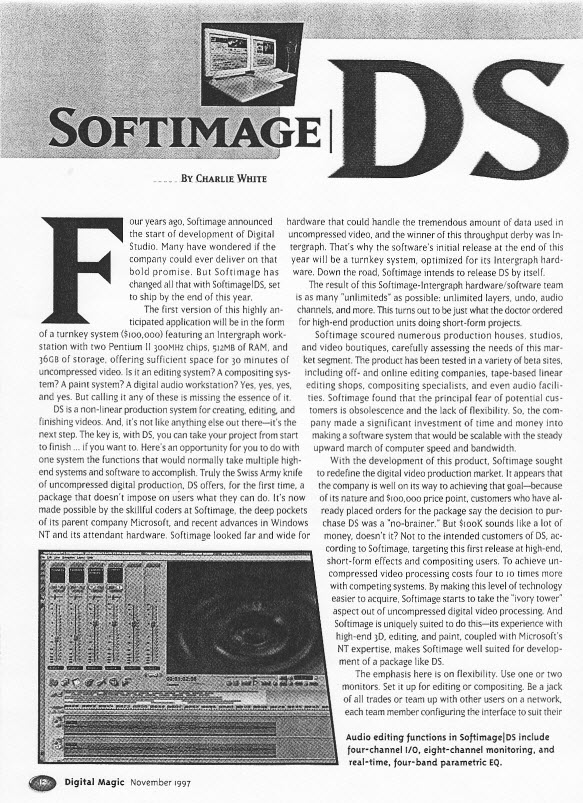
From 2001, the XSI 2.0 launch ad.

Now where’s that Final Frontier?

SOFTIMAGE|XSI v.2.0 GETS YOU THERE
XSI v.2.0 takes you beyond your boundaries. Imaginary. Or real. The newest version of XSI allows you to explore advanced dynamics with the seamlessly integrated photo realistic hair/fur simulation system. Discover the industry’s only fully-interactive renderer, powered with mental ray® v.3.0. And broadcast artists will find the super sophisticated 3-D text and logo creation tools a dream come true.

Want to fly further still?
How about an awesome new integrated compositor to unite your 2-D and 3-D worlds with
unprecedented speed and elegance. And our revolutionary interactive real-time shaders give artists the power to control game effects. All with mind-numbing performance and stability. Not to mention accelerated ROI.

Want to impress aliens – or even your boss?
Visit http://www.sofitmage.com/v2 where you can order the very hot XSI demo CD, sign up for the XSI newsletter – even arrange for a hands-on demo. Suddenly, that final frontier seems a whole lot closer.

Friday Flashback #33


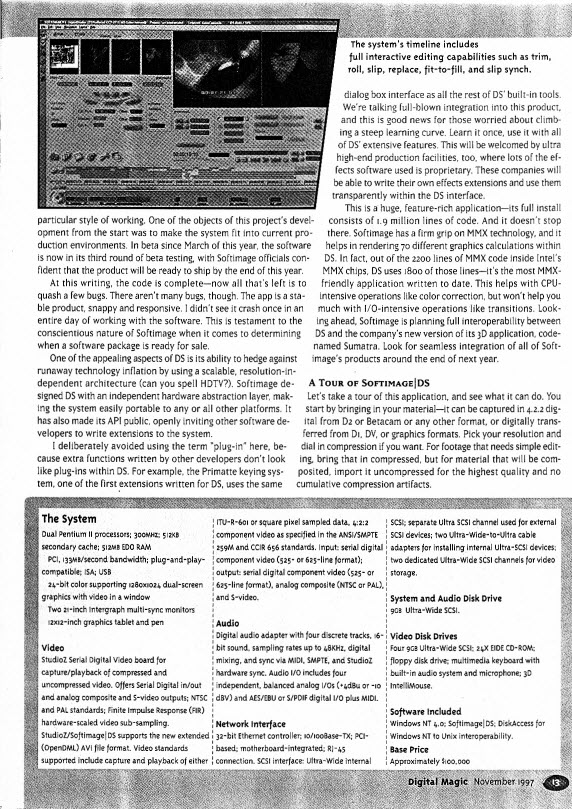
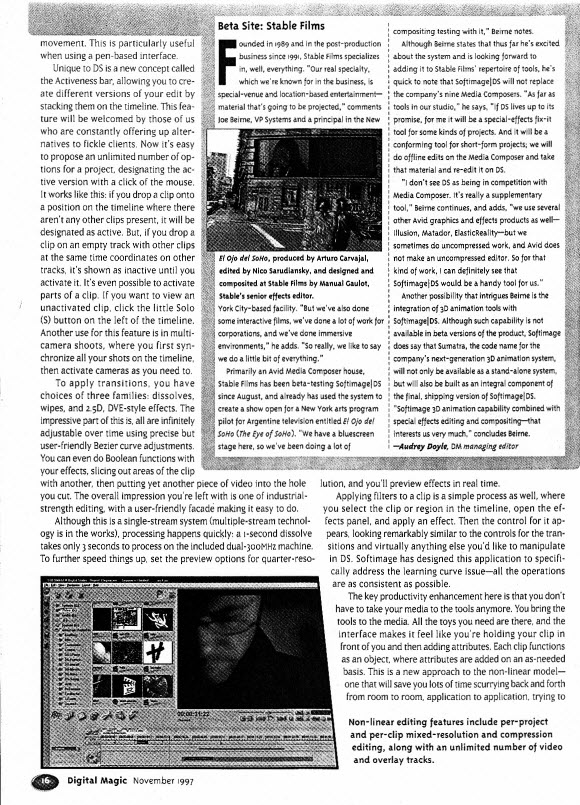
In looking through some old PDFs, I found the PDF for a SOFTIMAGE|3D brochure from 1996, which included this page with some [rather low quality] images from the Joe Fly spot from Spans & Partner.

I remember them showing Joe Fly during one of the staff meetings:

Here’s some info I got from the google cache:

Fly & Sanchez Mostly Sports Spans and Partner, Hamburg, Germany

This delightful animated short was first released in 1995 at the Siggraph electronic theatre, and has since garnered multiple awards including: People’s Choice Award and winner of the Fiction Category at Montreal’s Images du Futur festival; a World Silver Medal at the New York Film Festival; and a Best of 3D Animation award from Dr. Dotzler Medien-Institut in Germany. After its original release on film, the piece was shown on several European networks, including Premiere TV and Germany’s ZDF.

Technology Notes:

The original film was rendered in 2D and distributed on 35mm film, and was wholly developed by Peter Spans, who also developed and directed the re-creation for CyberWorld 3D. The approach and challenge during this production was to combine loveable character animation with the very complex backgrounds, all seen from an insect’s perspective. Almost one hundred percent of the original material was redone when re-creating the original data for presentation in the 3D 15/70 format for CyberWorld 3D.

The normal software packages used by Spans and Partner make up only 65of the Company’s resources, with the remainder being developed as proprietary technology by the Company itself. Joe Fly & Sanchez was wholly rendered with Mental Ray on seven Compaq ES40s with 4 gigs of memory each. Mental Images helped Spans and Partner to optimize the very large 3D databases so quality was not sacrificed. Compaq provided rendering advise and Softimage supported for the cyberworld 3D software component with special thanks to Dirk Weinreich. Part of the compositing was done on SHAKE from Nothing Real.

Joe Fly & Sanchez Mostly Sports principal filmmakers:

Creator/Director: Peter Spans
Producer: Martinique Spans
Animators: Sabine Lang, Ismail Acar

IMAX 3D recreation:

Director: Peter Spans
Executive Producer: Martinique Spans
Line Producer: Kathrin Juergensen
Senior Animators: Sabine Lang, Piotr Karwas, Jakob Schulze-Rohr, Matthias Wittman, Heiko Lueg
Post/Compositing: Stephan Remstedt, Anna Heine
System Admin./Programming: Sandy Mantel, Thorsten Schlüter

About Spans & Partner Computeranimation, Inc.:

After working as director / head of design for other companies, Peter Spans founded Spans and Partner in 1991. The Company creates character animation, as well as special effects animation for feature films and advertising. Cyberworld

Friday Flashback #30


The noIcon_pic shorts demo from the SIGGRAPH 2004 User Group:

Some background on how the noIcon shorts came to be:

Interview With Mark Schoennagel
by Raffael Dickreuter, Bernard Lebel, Tülay Tetiker
September, 23rd, 2004,

What about those noIcon boxers at the Siggraph 2004 User group? Any chance we can get some of these? Tell us how you came up with that idea.
How was that for ridiculous? Dropping my pants on stage… I never thought I’d do that… well, while working anyway! Actually Gino Vincelli’s wife made them. Gino works for us in Montreal and is the voice on many of the training materials we make. His wife works as a fashion designer and can print just about anything, so they made these boxers! I hadn’t really decided if I was going to actually drop through on stage, or how, but somewhere during the second demo I thought “heck, just use primitive man and put the “no icon” texture on it.. then … well.. drop your pants.” So that’s what I did. Nice ass I got there huh? I think Chinny thought so, because he forgot to play the next video clip. Maybe they’ll be on the web store by popular demand, or maybe a limited tradeshow edition – we’ll see.

From an interview with Gino Vincelli (ATC Manager and Senior Instructor of Softimage)
by Raffael Dickreuter, Will Mendez, Bernard Lebel
February, 10th, 2005

Can you tell us how you got the idea for the no-icon shorts?
Well when you work at Softimage and within the 3D community, you’re generally surrounded by weird people and it rubs off on you! Ha! Ha! In XSI, as you know, if you forget to save your images when creating a new database you will end up with characters or objects “wearing” the no-icon default texture. I just thought it would be cool to produce real no-icon clothes such as the shorts as if whoever was wearing them had forgotten his or her textures at home. I know… way too much time on my hands… I got a real kick out of seeing Mark Schoennagel drop his pants to show off the no-icon shorts at the Siggraph user group. The guy is gutsy!