Friday Flashback #34


From 2001, the XSI 2.0 launch ad.

Now where’s that Final Frontier?

SOFTIMAGE|XSI v.2.0 GETS YOU THERE
XSI v.2.0 takes you beyond your boundaries. Imaginary. Or real. The newest version of XSI allows you to explore advanced dynamics with the seamlessly integrated photo realistic hair/fur simulation system. Discover the industry’s only fully-interactive renderer, powered with mental ray® v.3.0. And broadcast artists will find the super sophisticated 3-D text and logo creation tools a dream come true.

Want to fly further still?
How about an awesome new integrated compositor to unite your 2-D and 3-D worlds with
unprecedented speed and elegance. And our revolutionary interactive real-time shaders give artists the power to control game effects. All with mind-numbing performance and stability. Not to mention accelerated ROI.

Want to impress aliens – or even your boss?
Visit http://www.sofitmage.com/v2 where you can order the very hot XSI demo CD, sign up for the XSI newsletter – even arrange for a hands-on demo. Suddenly, that final frontier seems a whole lot closer.

Friday Flashback #33


In looking through some old PDFs, I found the PDF for a SOFTIMAGE|3D brochure from 1996, which included this page with some [rather low quality] images from the Joe Fly spot from Spans & Partner.

I remember them showing Joe Fly during one of the staff meetings:

Here’s some info I got from the google cache:

Fly & Sanchez Mostly Sports Spans and Partner, Hamburg, Germany

This delightful animated short was first released in 1995 at the Siggraph electronic theatre, and has since garnered multiple awards including: People’s Choice Award and winner of the Fiction Category at Montreal’s Images du Futur festival; a World Silver Medal at the New York Film Festival; and a Best of 3D Animation award from Dr. Dotzler Medien-Institut in Germany. After its original release on film, the piece was shown on several European networks, including Premiere TV and Germany’s ZDF.

Technology Notes:

The original film was rendered in 2D and distributed on 35mm film, and was wholly developed by Peter Spans, who also developed and directed the re-creation for CyberWorld 3D. The approach and challenge during this production was to combine loveable character animation with the very complex backgrounds, all seen from an insect’s perspective. Almost one hundred percent of the original material was redone when re-creating the original data for presentation in the 3D 15/70 format for CyberWorld 3D.

The normal software packages used by Spans and Partner make up only 65of the Company’s resources, with the remainder being developed as proprietary technology by the Company itself. Joe Fly & Sanchez was wholly rendered with Mental Ray on seven Compaq ES40s with 4 gigs of memory each. Mental Images helped Spans and Partner to optimize the very large 3D databases so quality was not sacrificed. Compaq provided rendering advise and Softimage supported for the cyberworld 3D software component with special thanks to Dirk Weinreich. Part of the compositing was done on SHAKE from Nothing Real.

Joe Fly & Sanchez Mostly Sports principal filmmakers:

Creator/Director: Peter Spans
Producer: Martinique Spans
Animators: Sabine Lang, Ismail Acar

IMAX 3D recreation:

Director: Peter Spans
Executive Producer: Martinique Spans
Line Producer: Kathrin Juergensen
Senior Animators: Sabine Lang, Piotr Karwas, Jakob Schulze-Rohr, Matthias Wittman, Heiko Lueg
Post/Compositing: Stephan Remstedt, Anna Heine
System Admin./Programming: Sandy Mantel, Thorsten Schlüter

About Spans & Partner Computeranimation, Inc.:

After working as director / head of design for other companies, Peter Spans founded Spans and Partner in 1991. The Company creates character animation, as well as special effects animation for feature films and advertising. Cyberworld

Friday Flashback #30


The noIcon_pic shorts demo from the SIGGRAPH 2004 User Group:

Some background on how the noIcon shorts came to be:

Interview With Mark Schoennagel
by Raffael Dickreuter, Bernard Lebel, Tülay Tetiker
September, 23rd, 2004,

What about those noIcon boxers at the Siggraph 2004 User group? Any chance we can get some of these? Tell us how you came up with that idea.
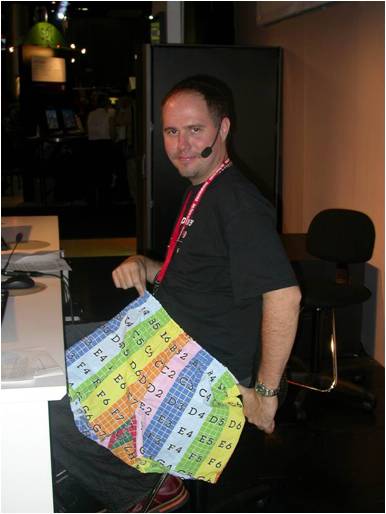
How was that for ridiculous? Dropping my pants on stage… I never thought I’d do that… well, while working anyway! Actually Gino Vincelli’s wife made them. Gino works for us in Montreal and is the voice on many of the training materials we make. His wife works as a fashion designer and can print just about anything, so they made these boxers! I hadn’t really decided if I was going to actually drop through on stage, or how, but somewhere during the second demo I thought “heck, just use primitive man and put the “no icon” texture on it.. then … well.. drop your pants.” So that’s what I did. Nice ass I got there huh? I think Chinny thought so, because he forgot to play the next video clip. Maybe they’ll be on the web store by popular demand, or maybe a limited tradeshow edition – we’ll see.

From an interview with Gino Vincelli (ATC Manager and Senior Instructor of Softimage)
by Raffael Dickreuter, Will Mendez, Bernard Lebel
February, 10th, 2005

Can you tell us how you got the idea for the no-icon shorts?
Well when you work at Softimage and within the 3D community, you’re generally surrounded by weird people and it rubs off on you! Ha! Ha! In XSI, as you know, if you forget to save your images when creating a new database you will end up with characters or objects “wearing” the no-icon default texture. I just thought it would be cool to produce real no-icon clothes such as the shorts as if whoever was wearing them had forgotten his or her textures at home. I know… way too much time on my hands… I got a real kick out of seeing Mark Schoennagel drop his pants to show off the no-icon shorts at the Siggraph user group. The guy is gutsy!

Friday Flashback #29


2001 – The FX Tree would be introduced in the soon-to-be-announced XSI 2.0, and this softimage.com banner gave a sneak peak (on the left side, in the background very faintly, you can see a some FX Tree nodes, and on the right, you can see some FX tree scripting).

Click through the image above for a better view of what they’re talking about in this July 2001 thread from the XSI list:

-----Original Message-----
From: Jean-Louis
Sent: Tuesday, July 31, 2001 8:46 AM
To: XSI@Softimage.COM
Subject: Re: 2.0 Rumour+Speculation


And it looks all scriptable too: on the right of that same red banner you can
make out "FxTree.FileInput".
If it all turns out to be true I'll be over the moon.
--
Jean-Louis Billard
Graphics Dept. - Imaj
http://www.imajonline.com/


----- Original Message -----
From: "Meils Dühnforth" 
To: 
Sent: Tuesday, July 31, 2001 2:18 PM
Subject: RE: 2.0 Rumour+Speculation


Look at the interface screenshot shining through the red background at their
homepage top - definitely looks like a compositing tree!

Guess this is XSI 2.0 and not DS 5.0...

Meils Dühnforth
nhb studios


---
Unsubscribe? Mail Majordomo@Softimage.COM with the following text in body:
unsubscribe xsi

Friday Flashback #28


13 years ago, at SIGGRAPH 98, Softimage announced its next-generation rendering system, code-named “Twister”:

First Component of “Sumatra” Provides Users With a Glimpse of the Future of 3-D Rendering

ORLANDO, Fla., July 20, 1998 — Softimage Inc., a wholly owned subsidiary of Microsoft Corp., announced today at SIGGRAPH 98 that its next-generation rendering system, code-named ” Twister ™,” is entering the beta test cycle with delivery to customers scheduled for the fourth quarter of 1998. “Twister” is the first module of the soon-to-be-released 3-D animation platform, code-named “Sumatra,” which provides a revolutionary new approach to character animation and introduces the concept of nonlinear animation (NLA).

Twister was considered at one time to be the “the first step toward the integration of 3D in Digital Studio”, and was basically the rendering component of Sumatra (XSI).

The last-ever version of “Twister” was beta 2.5, shipped in June 1999. By then, it had been decided to combine “Twister” and “Sumatra”, because “Twister”, as a standalone product that relied strictly on .mi2, posed too many workflow and performance problems.

Here’s the executive summary from the Twister v1.0 Product Brief:

Twister v1.0 is a standalone rendering product based on the Sumatra Architecture, designed to work in conjunction with Softimage v3.7SP1. The goal of the product is to provide a finishing and rendering solution which features next-generation render functionality , while providing a transition platform for our existing customer base onto the new generation of Softimage products. Twister fits neatly into the Softimage 3D v3.7SP1 workflow, providing an interactive toolset which complements and extends existing functionality.

Twister rendering is based on mental ray v2.0, incorporating a host of next-generation rendering features such as distributed tesselation, global illumination (radiosity), and caustics (light diffusion through transparent substance). Though Twister is not generally designed for the animation scene objects, it does provide full animation for any rendering parameters, as well as lights and cameras. All standard rendering properties may be applied, including shaders, motion blur, antialiasing, etc.

Twister imports scene data from Softimage 3D in several different ways. Firstly, Twister can read and use standard Softimage v3.7SP1 scene files. Secondly, Twister can work directly with .mi2 format. The mi2 data format is the next generation of the current mental ray mi format , used by Softimage 3D v3.x to communicate with mental ray. The mi format is actually a ‘stream’ of completely resolved geometry. The mi2 format greatly improves compression by only including what has changed between frames, rather than what is included in each frame. Twister will include a plug-in for Softimage 3D v3.7SP1 which will allow direct export of .mi2 format to disk. Twister will also include converters from several other industry standard formats (IGES, DXF, etc ).

Twister also contains an interactive plug-in for SI3D v3.7SP1, which allows users to dynamically ‘export’ their current working scene to Twister, and continue working on their scene in Twister (note that any changes made in Twister can not be propagated back to Softimage).

The Twister toolset is divided into two suites – the Main Suite, which includes scene and render viewing, interactive tuning, and light/camera manipulation, and the Renderfarm, which is used for distributed render control.

Now for some screenshots…

Here’s a mock up of the Twister main suite (back then, the term “layout” wasn’t being used to describe instances of “DS Suites”). Twister was originally spec’d to include three suites: Main, Renderfarm, and 3D Paint.
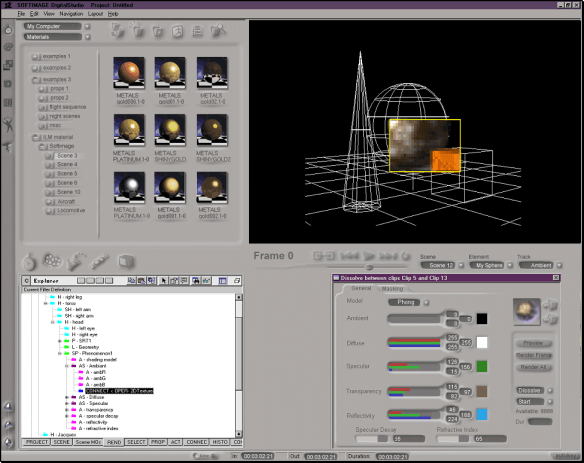
Mock up of the Renderfarm suite. The non-linear editor (NLE) at the bottom was intended to show rendering passes, and the mock up doesn’t show that yet.

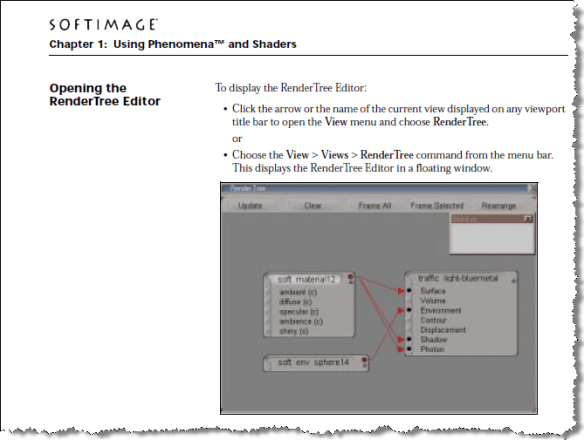
Snippet from the beta documentation:
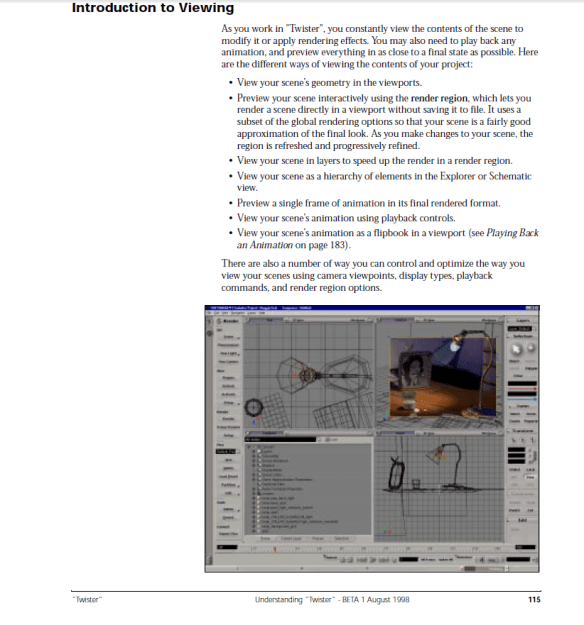
Screenshots of the Render Tree and Schematic View from the beta Twister docs.
Friday Flashback #27


Thanks to Darrin Hofmeyr, for sending in these screenshots from the SOFTIMAGE|Behavior section of the Production Series DVD:


First released back in November 2002 , Softimage|Behavior was a behavioral animation system for creating characters and choreographing 3D animated crowds that can respond to objects, other characters or changes in their environment. From the press release:

Softimage|Behavior lets an animator control individual characters in a simulation through a combination of graphical editing, scripting and debugging tools in addition to a library of pre-defined behaviors. Individual characters can be set to respond and interact in multiple ways to their environment and with other characters. The system’s integrated character engine features real-time IK, animation blending and warping, dynamic path planning, and automatic obstacle avoidance, which supports event-driven responses for characters in the simulation.

Softimage|Behavior is priced at $14,995

SOFTIMAGE|BEHAVIOR was used on the history-based mini-series Napoleon for the A&E Channel, and in James Wong’s feature film The One.
It was also used by Buzzimage for a Dollar Bank commercial. Here’s a collage of a few AVIs about this commercial that I found lying around:

http://vimeo.com/26475107

And there was a press release on xsibase too:

SOFTIMAGE HELPS MAKE MILLIONS FOR DOLLAR BANK
–Buzz Image relies on SOFTIMAGE|BEHAVIOR to populate the streets of Pittsburgh in the newest Dollar Bank commercial —

And finally, courtesy of the WaybackMachine, here’s the case study that was posted on softimage.com back in 2003:

Friday Flashback #26


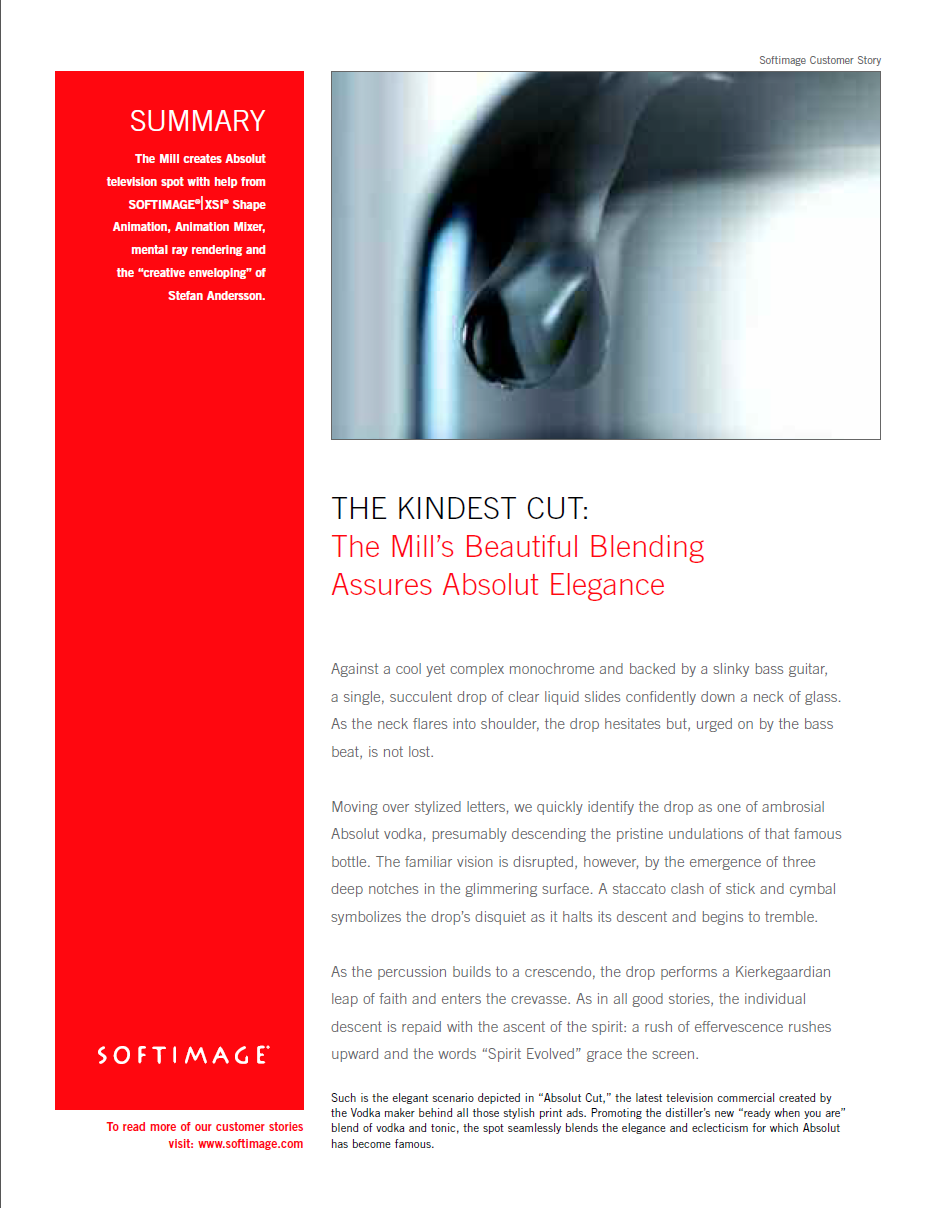
Softimage customer story from 2004/2005 for Drop, a television spot for Absolut Cut Vodka, done by The Mill. See the spot here.

Created for Absolut and McCann Erickson NY by The Mill New York, the striking spot relies heavily on the intricate CG work of Swedish artist Stefan Andersson, a long-time aficionado of SOFTIMAGE|XSI.

Friday Flashback #25


When I started at Softimage back in 95, the only machine on my desk was an SGI Indy. I had come from a hard-core UNIX software dev shop, so I was pretty comfortable with that. Eventually I got a Windows NT box too, but I held on to the Indy until 2000.

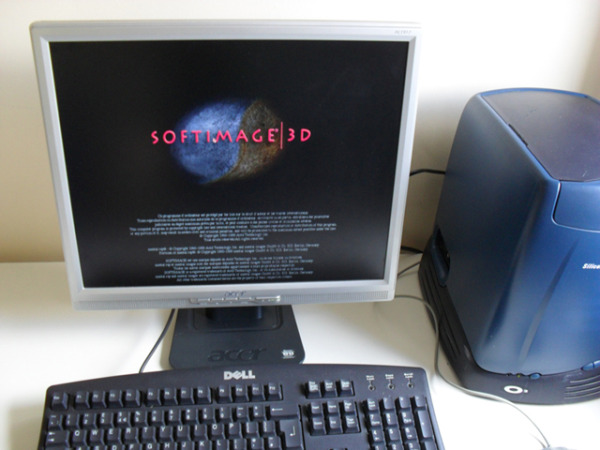
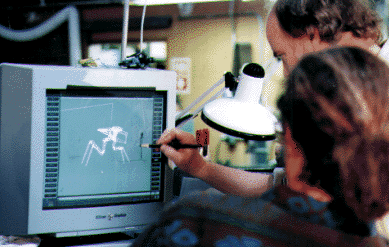
Here’s a few pics of SOFTIMAGE|3D running on SGI hardware that I found through google:


From the Summer 97 Softimage Resource Guide:

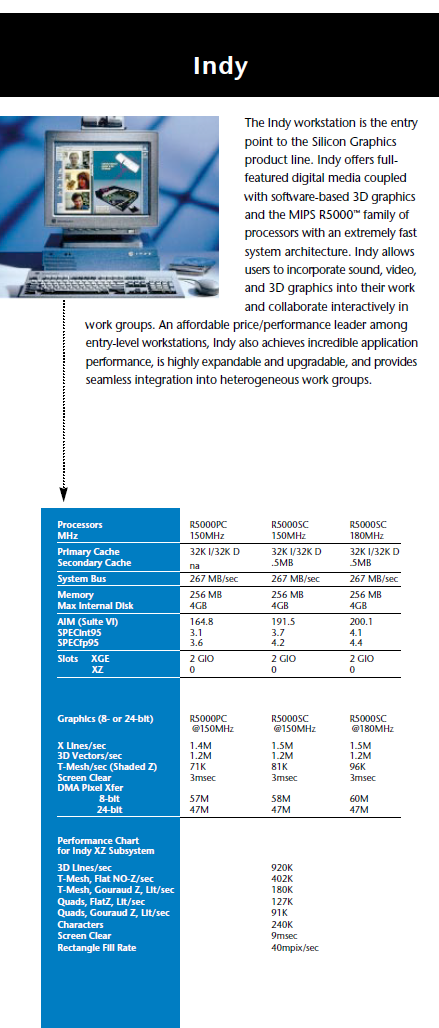
And the Indy specs from 96: