Friday Flashback #486


Academy Award Nominees Use Softimage to Create Stunning Visual Effects

February 11, 1998 |

https://news.microsoft.com/1998/02/11/academy-award-nominees-use-softimage-to-create-stunning-visual-effects/

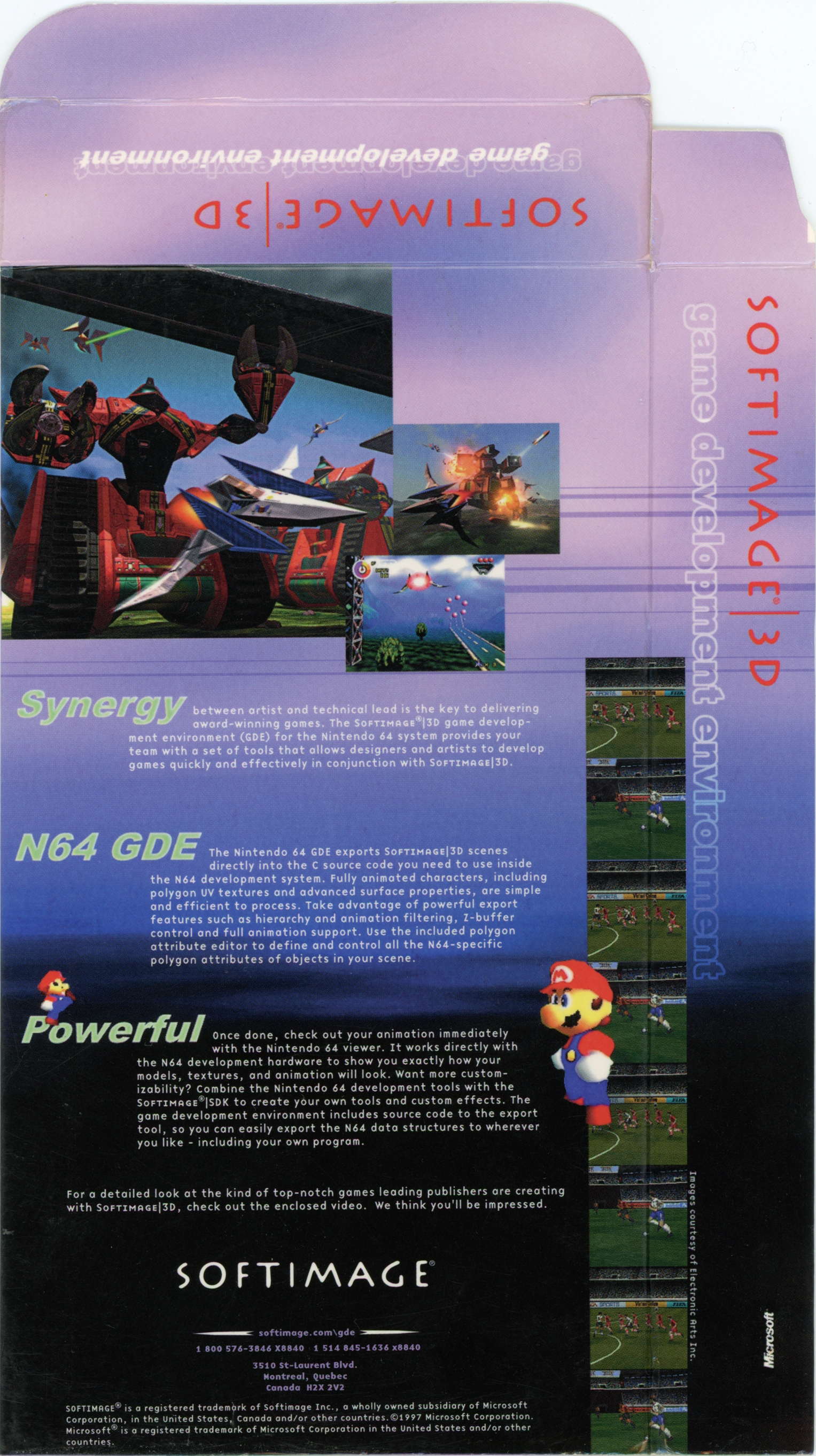
MONTREAL, Feb. 11, 1998 — Softimage Inc., a wholly owned subsidiary of Microsoft Corp., today announced that SOFTIMAGE® |3D was used for character animation in all three films nominated Feb. 10 in the category of Achievement in Visual Effects for the 70th annual Academy Awards. The special effects in “Lost World,” “Starship Troopers” and “Titanic” were made possible by the incredibly rich set of tools that SOFTIMAGE|3D provides for digital artists.

Industrial Light & Magic used SOFTIMAGE|3D to terrify and delight audiences with realistic animated dinosaurs in “Lost World”; Tippet Studios created futuristic ‘bugs’ with it for “Starship Troopers”; and Digital Domain made use of the software to create hundreds of digitally animated passengers aboard “Titanic.” The nominees were chosen from the Academy short list of seven films. The four other films under consideration – “Batman and Robin,” “Contact,” “The Fifth Element” and “Men in Black” – also took advantage of SOFTIMAGE|3D to create an amazing array of fantastic effects and character animation.

“This has been an exciting year for us at Softimage, and we’re thrilled that so many of our customers are being recognized by the Academy,” said Softimage President Moshe Lichtman. “Digital artists using SOFTIMAGE|3D have continually broken new ground in creativity and quality. The power of SOFTIMAGE|3D is stunningly portrayed in the special effects brought to life in these films.”

The winning film will be announced at the Academy Award ceremony, televised from Los Angeles on Monday, March 23, 1998, at 7 p.m. PST.

Softimage Technology Lauded by Academy

Softimage congratulates its founder, Daniel Langlois, who – along with Rejean Gagné, Richard Laperriere and Dominique Boisvert – received a Scientific and Engineering Award from the Academy on Jan. 7, 1998. This award honors outstanding contributions that have made a technological impact on the film industry. Langlois, Gagné, Laperriere and Boisvert received the Academy plaque for creating the Actor component of the SOFTIMAGE|3D computer animation system. This component provided breakthroughs in animation control and efficiency that led to the widespread use of Softimage in visual effects and animation production through the introduction of Inverse Kinematics into the animation industry.

About SOFTIMAGE|3D

SOFTIMAGE|3D, the flagship of the Softimage product line, has consistently set the benchmarks for fully integrated professional 3-D modeling, animation and rendering software. The choice of professionals who demand the highest-quality content, Softimage has consistently raised the bar from which other systems are measured. “Sumatra” is Softimage’s revolutionary, next-generation 3-D software. It is the world’s first non-linear animation system, extending the current work flow of 3-D animation more fluidly into the overall production process.

About Softimage

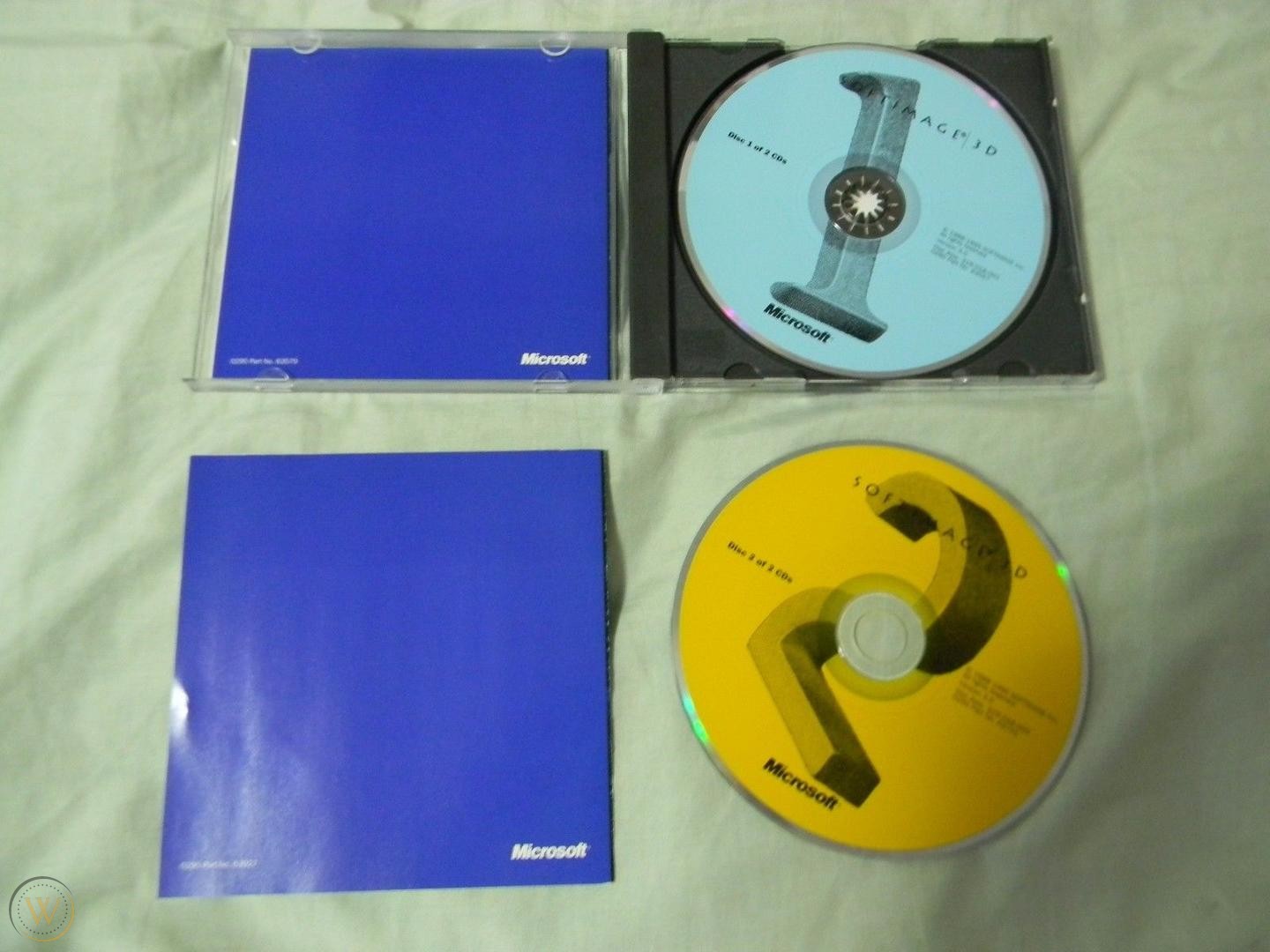
Founded in 1986, Softimage develops software for media-rich applications including video, film, interactive games and CD-ROM applications. Products include SOFTIMAGE|DS (video production); SOFTIMAGE|3D (3-D animation); SOFTIMAGE|EDDIE (compositing) and Toonz (2-D cel animation). The company was acquired in 1994 by Microsoft. Additional information about Softimage and Microsoft can be found via the Internet at (http://www.softimage.com/) and http://www.microsoft.com/ , respectively.

Founded in 1975, Microsoft (Nasdaq “MSFT”) is the worldwide leader in software for personal computers. The company offers a wide range of products and services for business and personal use, each designed with the mission of making it easier and more enjoyable for people to take advantage of the full power of personal computing every day.

Softimage is a registered trademark of Softimage Inc., a wholly owned subsidiary of Microsoft Corp.

Microsoft is either a registered trademark or trademark of Microsoft Corp. in the United States and/or other countries.

Other product and company names herein may be trademarks of their respective owners.

Note to editors: If you are interested in viewing additional information on Microsoft, please visit the Microsoft Web page at http://www.microsoft.com/presspass/ on Microsoft’s corporate information pages.

Friday Flashback #479


Part V
From a 2001 “industry backgrounder” published on softimage.com:

Misc. Pull Quotes

“At some point a company takes on a personality of its own and it’s about what it’s doing and the customers it’s serving. If we do our job well, Softimage will transcend all of us, and its vision will continue.”


“It’s easy to have passion in a company of 10 people; having that in a company of 300 is a different story. But, at the end of the day, we still have a group of people who share a belief in what Softimage represents, for its users, for the technology, for going after what they are after.”


“Softimage has always been at the heart of the creative process. This drives the quality of the product, it drives the quality of the service, it drives the behavior of the people down the line. It’s not just about developing technology, it’s about sharing the same passion as the people you’re developing tools for, so that you’re in synch with what they need; it isn’t just for good business, it actually helps all of us progress.”


“One of the reasons why we’ve remained Softimage is because people have something larger than just a business interest, which is the passion for the people we are working for.”


“When you work in an environment where people are passionate about their jobs, about their product, and about their customers, you get it too – it’s contagious.”


“We’ve built an amazing team of bright individuals, with state-of-the-art practices but the overall motivation here is that we’re allowing artists to do their thing and it’s a little bit of our thing. This is what really matters: knowing that you’re contributing to this effort.”


“We’re not kids anymore, though we still like to play a lot!”


“It’s motivating building tools that other people use to create. There are very few companies who can do that, especially at the level we do, working for and with the people that we do. That’s a privilege.”


“In creating, you’re using everything you have, everything you are and whatever tools are available to bring the process to another level. In the intense moments of creation we are using every part of who we are. An artist is someone who has committed themselves to bringing to the world something that didn’t exist before.”

Friday Flashback #478


Part IV
From a 2001 “industry backgrounder” published on softimage.com:

NEW LEVELS IN ANIMATION: “SUMATRA” (CODE NAME)& THE AVID YEARS

“Sumatra” reflects what’s happening to 3-D animation: as it’s evolving, it’s becoming available to more people in a more functional manner. And, Softimage is leading this transformation.

As SOFTIMAGE|DS was being released, Softimage was acquired by Avid Technology, Inc. and SOFTIMAGE|DS became part of Avid’s family of editing products, taking the “editing” process one step further by providing a complete integration of all functions – not only editing, but also paint, compositing and audio.

“Sumatra”: The Path toward the future

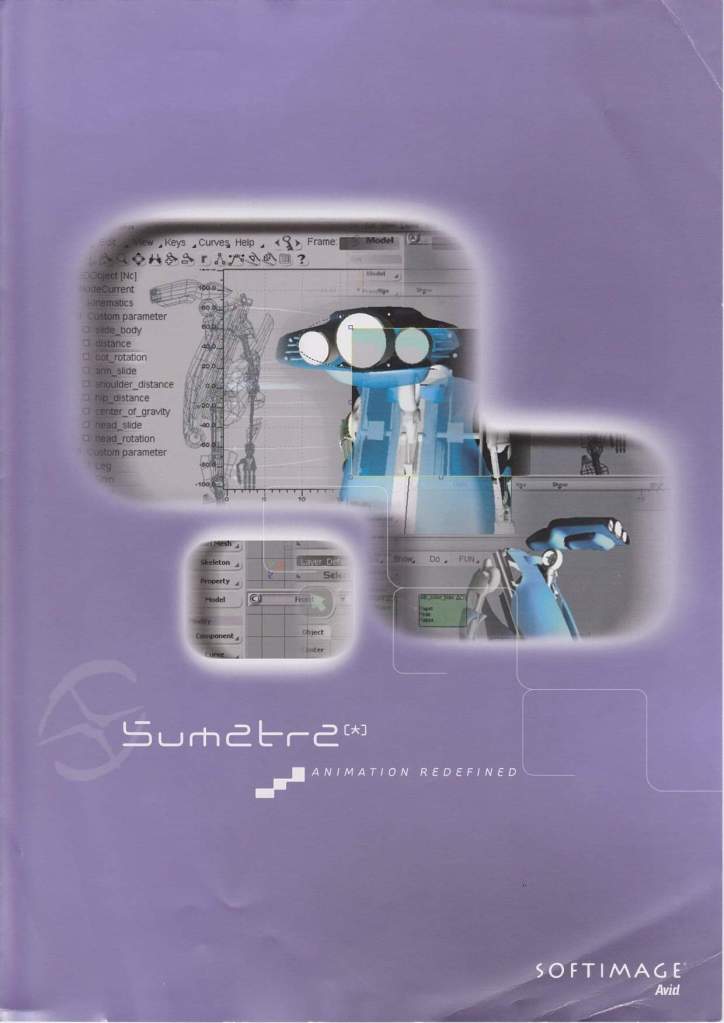
As the world begins moving to more pervasive 3-D content – on the Web, on advanced games consoles, on the home PC – Softimage is focusing on providing tools for these arenas. With SOFTIMAGE|DS completed, the Company began moving their 3-D animation package onto the Digital Studio framework. This became referred to under the code name “Sumatra”: the next incarnation of 3-D animation tools, based on the Digital Studio framework, offering the high-end SOFTIMAGE|3D animation toolset in a completely integrated nonlinear environment of post-production and production tools.

“Sumatra” heralds a revolution in the way people work in 3-D animation, taking a complex process to a new level, where not only is it readily available to more people but it is available in an easily-accessible and useable environment, providing a way to create images in a freer, more efficient fashion. “Sumatra” offers a modular environment where people can have access to whatever level of complexity they’re comfortable with, then move up from there to wherever they want to work.

The whole process of doing character animation is going from black box to mainstream. “Sumatra” is a major step in that direction moving towards a character animation system that can be used by virtually anybody. Any professional media-creation artist will be able to easily animate characters. If they want to dive into the nuts-and-bolts of 3-D animation, “Sumatra” is more powerful than ever. It also introduces high levels of control that allow motion to be re-used and, since it’s a nonlinear animation system, motion can also be easily layered using an existing walk cycle and adding any motion on top of it.

This ability to decompose and recompose motion is a critical element for productivity. In the same amount of time, users will be able to produce better quality animation, without having to start from scratch. This will make “Sumatra” ideal for demanding 3-D animation works, such as creating an army of CG characters and rendering them in a minimum amount of time. In addition, an animator, technical director, and lighting specialist can all customize “Sumatra” to best fit their own task.

Another innovation in “Sumatra” is a series of high-level tools that allow people with fewer skills and experience to do more complex tasks. Thus, “Sumatra” packages the underlying complexity of 3-D data into blocks that people can put together and transition between, including rendering with a variety of pre-sets. Such features, in conjunction with the underlying Digital Studio architecture will enable parts of “Sumatra” to be re-focused to emerging markets, such as interactive content on the Web and in games, while still catering to the high-end user.

Another feature of “Sumatra” is that the entire software is scriptable, meaning people can create their own tools and programs using Java script, Visual Basic or Python. And, it allows people to get data in and out of “Sumatra” with their own file formats, in ASCII, binary or whatever other format they choose.

On one level, this means that “Sumatra” will insert itself much more easily into a wider variety of pipelines. On the other level, as with the original SOFTIMAGE|3D, people can build their tools right into “Sumatra” through an SDK, further expanding the system’s and their own potential. In terms of performance, customizability and collaborative workflow, “Sumatra” reflects what’s happening to 3-D animation: as it’s evolving, it’s becoming available to more people in a more functional manner. And, Softimage is leading this transformation.

Friday Flashback #477


Part III
From a 2001 “industry backgrounder” published on softimage.com:

MORE TOOLS TO MORE PEOPLE: THE MICROSOFT YEARS

Windows NT: Expanding 3-D Production

With the arrival of the Pentium, workstation-class power became available to the PC. Softimage led the way in being the first to port a high-end product to the PC, moving the software out of the expensive workstation arena. This initiative overcame another big hurdle in the high-end 3-D animation world – the cost/availability factor – and brought more tools to a larger number of creative people. In order to accomplish this, the platform aspect of the tools had to be opened.

This meant moving to a more accessible platform, namely Windows NT, which occurred in-line with the Microsoft Corporation’s acquisition of Softimage in 1994. With the financial support and the ability to explore new software development, Softimage successfully became the first to bring 3-D to Windows NT, almost quadrupling its user base in a very short time and changing the face of the 3-D animation again by making its tools available to a wider range of creative people.

The move to Windows NT made the software and hardware to create 3D content much more accessible,and the number of people using Softimage’s technology expanded dramatically. Another important factor with Windows NT was that it became much more financially viable to set up a render farm, so rendering capacity also increased exponentially. Through Softimage, Windows NT became a truly accessible professional production platform and the 3-D market opened up significantly.

Digital Studio: The Architecture for a New Generation of Tools

At the same time as the initiative to make the tools accessible to more people, there was also a move to develop the next-generation tools for Softimage. In the same way SOFTIMAGE|3D software used to consist of a series of separate functions (modelling, animation, rendering), so 3-D production was also fragmented into animation, film, video, compositing and paint, editing. This meant that the same integration Softimage had brought to the 3-D market now needed to be brought to the entire production pipeline, integrating 3-D into a unified production environment.

To do this, a platform had to be developed to integrate these functions and toolsets. The idea was to ensure that the production pipeline would allow artists to work in a true nonlinear fashion between all the production steps. This led to the development of Digital Studio, a media framework (not a system), where all the tools could be plugged into, and users could work in a unified fashion on the content of any production. So, rather than moving the production from one tool to another, all material was available in one environment, with the tools working on top of it, readily available to the user. With the establishment of the Digital Studio framework, Softimage’s next-generation of tools could be supported.

As computers became powerful and fast enough to handle real-time video and 3-D, the Digital Studio architecture could successfully be supported and so Softimage began working on SOFTIMAGE®|DS, one of the first products to integrate the 2D/3D production pipeline offering audio, 2-D, video and 3-D in the same box. A true breakthrough, SOFTIMAGE|DS offered the first complete integration of production and post-production tools, uniting editing, compositing, audio – all the components of a traditional post-production process – which had previously been separated out onto different platforms and machines.

The first product based on the Digital Studio architecture, SOFTIMAGE|DS sold a record 600 systems in its first year of release. With SOFTIMAGE|DS, Softimage had returned to its roots, once again bringing the tools closer to those involved in the creative process. SOFTIMAGE|DS created more than just a system; it was an entire process, a completely new artistic medium.

Up next…Sumatra and the Avid years