Friday Flashback #635


PIXEL 92 July/August 2004
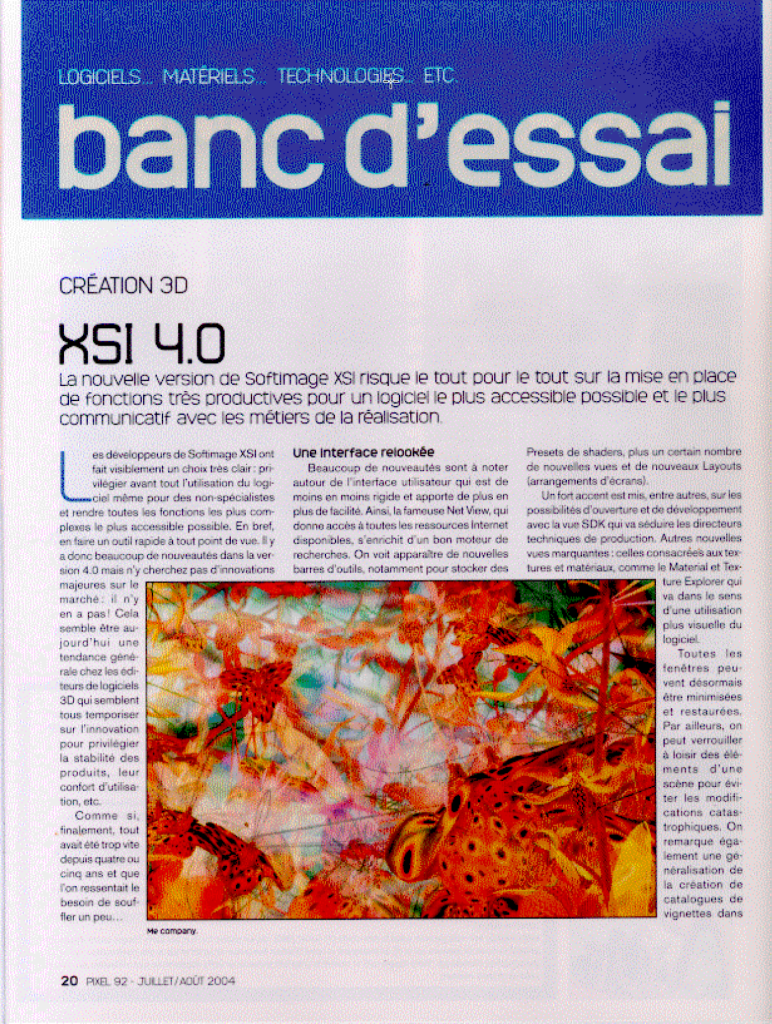
SOFTWARE… HARDWARE… TECHNOLOGIES… ETC.

test bench

3D CREATION

XSI 4.0

The new version of Softimage XSI is betting everything on implementing highly productive features to make the software as accessible as possible and highly collaborative with production professions.

The developers of Softimage XSI have visibly made a very clear choice: to prioritize user friendliness above all else, even for non-specialists, and to make the most complex functions accessible. In short, to create a tool that is fast from every point of view. There are therefore not many major innovations in version 4.0 on the market; there aren’t any! This seems to be a general trend today among 3D software publishers, who all seem to be slowing down on innovation to prioritize product stability, user comfort, etc.

It is as if, ultimately, everything had gone too fast over the last four or five years and there was a felt need to take a little breather…

A Redesigned Interface

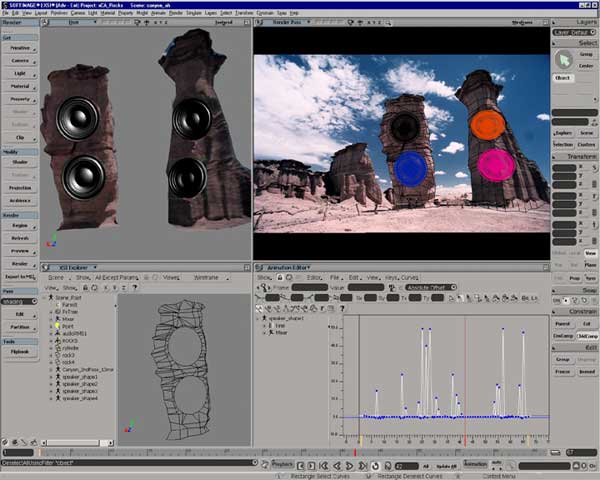
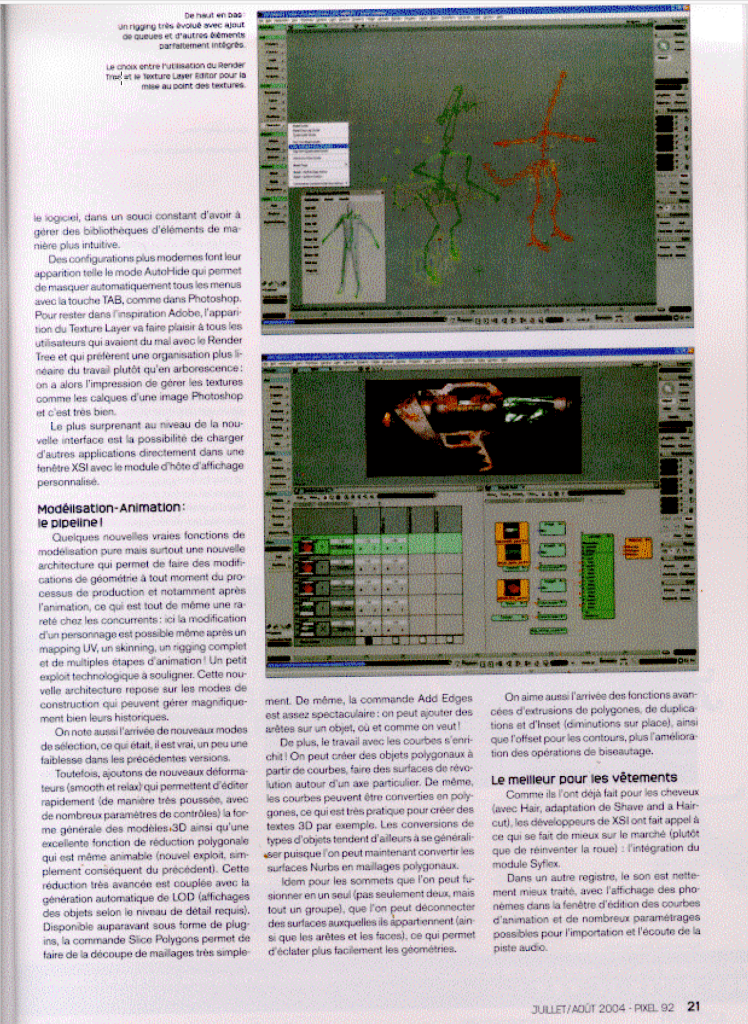
Many new features are worth noting around the user interface, which is less rigid and brings more ease of use. For instance, the famous Net View, which gives access to all available internet resources, is enriched with a good search engine. We see the appearance of new toolbars, notably to store shader presets, plus a certain number of new views and new Layouts (screen arrangements).

A strong emphasis is also placed on openness and development possibilities with the SDK view, which will appeal to technical directors of production. Other notable new views: those dedicated to textures and materials, like the Material and Texture Explorer, which aligns with a more visual use of the software.

…the software, in a constant effort to manage libraries of material elements in a more intuitive way.

More modern configurations make their appearance, such as the AutoHide mode, which allows you to automatically hide all menus using the TAB key, just like in Photoshop. Staying with Adobe inspiration, the addition of the Texture Layer is sure to please all users who struggled with the Render Tree and prefer a more linear organization of work rather than a tree structure: you then have the impression of managing textures like layers of a Photoshop image, and it works very well.

The most surprising thing about the new interface is the ability to load other applications directly within an XSI window using the custom display host module.

Modeling-Animation: The Pipeline!

A few new true modeling features, but above all a new architecture that allows for geometry modifications at any time during the production process, and especially after animation—which is quite a rarity among competitors. Here, modifying a character is possible even after UV mapping, skinning, a complex rigging setup, and multiple animation steps! This is a minor technological feat worth highlighting. This new architecture relies on construction modes that can, however, severely penalize their histories.

We also note the arrival of new selection modes, which was admittedly a bit of a weakness in previous versions.

However, let’s add new deformers (smooth and relax) that allow for quick editing (in a very advanced way, with numerous control parameters) of the general shape of 3D models. XSI also features an excellent polygon reduction tool that is even animateable (a small exploit, fully complementing the previous one). This highly advanced reduction is coupled with the automatic generation of LODs (Level of Detail displays depending on the required level of detail). Previously available as a plugin, the Slice Polygons command allows you to cut meshes very easily. Similarly, the Add Edges command is quite spectacular: you can add edges to an object, wherever and however you want!

Furthermore, working with curves is enriched! You can create polygon objects from curves, make surface-of-revolution objects around a specific axis. Likewise, curves can be converted into polygons, which is very practical for creating 3D text, for example. Conversions of these types of objects tend to generalize, as you can now convert Nurbs surfaces into polygon meshes.

The same goes for vertices, which can be merged into a single one (not just two, but a whole group), or disconnected from the surfaces they belong to (along with the edges and faces), allowing you to break apart geometries more easily.

We also like the arrival of advanced polygon extrusion, duplication, and Inset (reductions in place) features, as well as offsetting for contours, plus the improvement of beveling operations.

The Best for Clothing

Just as they did for hair (with Hair, an adaptation of Shave and a Haircut), XSI developers have called upon what is best on the market (rather than reinventing the wheel): the integration of the Syflex module.

In another register, audio is handled significantly better, featuring the display of phonemes in the animation curve editing window, and numerous parametric options for importing and listening to the audio track.
Friday Flashback #571


An interview with Andrew Proctor from The Mill

From a 2004 issue of RenderNode magazine…

Andrew, could you please introduce yourself to our readers and tell us about your background, where you work and what your daily tasks are?I graduated from Nottingham in Fine Art in 2001, were I began my course as a painter. During my second year I went to see the multimedia show onedotzero at the ICA and was amazed at the possibilities and diversites in computer animation and digital effects, to me it offers the same freedoms as painting, in that you start form blank canvas and create a world within the frame of the image. I currently work at The Mill doing 3d animation for commercials and music promos. As for daily tasks I don’t really have any. Every job throws up different challenges.

Please tell us what lead you to CGI animation? Why do you find it more interesting over other CGI fields? My role at in Mill3D is a bit of an all rounder, in fact we all are. Because we work in small, close teams and not on massive feature length projects you have to be able to deal with anything that’s thrown your way, it really keeps you on your toes.

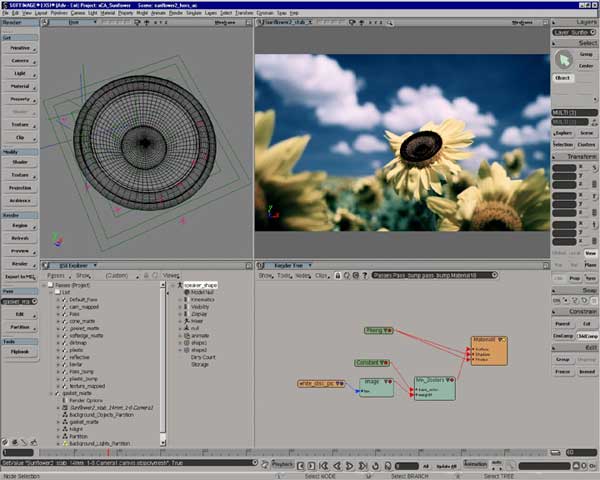
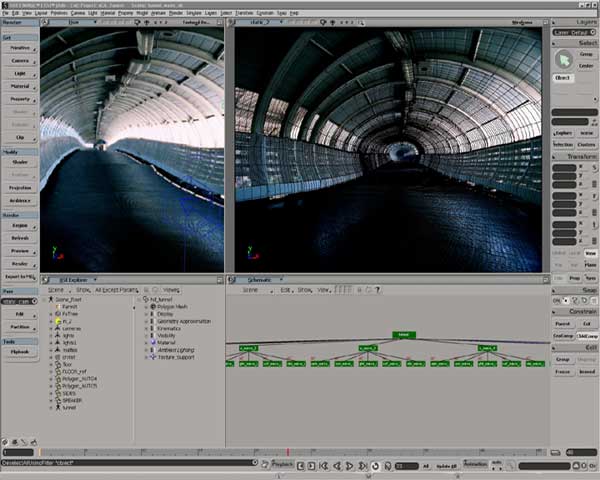
Which is your favorite animation software and which one did you find the easiest to learn? I use SOFTIMAGE|XSI now, I think it’s got some great tools, but it’s the speed of the Softimage workflow that makes it as usable as an artist, and it’s very intuitive. I don’t really use much other software other than Photoshop and AfterEffects, which are both essentials.

Tell us how it is to work with Mill in general and how important the animator’s role is in the production process at Mill.The Mill is a fantastic company. There’s a great sense of team effort on all the jobs we do. As the 3d team we have a very important role, we are supplying elements to a job that we have to make from scratch and is as important as the film neg that comes in from the shoots. This means that we get involved in jobs right from the start, often attending the shoot and being involved in pre-production and the creative process.

How difficult was it to go from being a runner at Mill to becoming a full-blown animator?

For me it wasn’t too much of a struggle moving on from being a runner. The Mill is very keen for new people to come through and everyone in Mill3D was really helpful with giving me time to train and setting me projects of my own to do. Nobody expects you to be a runner for ever, and if you work hard and train and have lots of enthusiasm then there are some great opportunities.
 
What was your role in the creation of the latest O2 advert (Digital Music Player)?

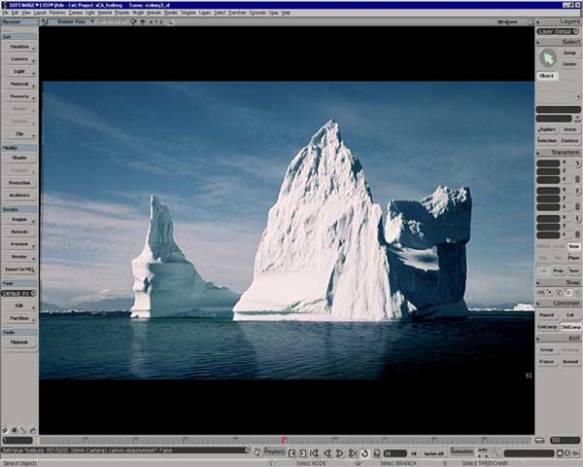
I was involved in most of the shots where speakers were integrated into the environment, such as the iceberg and the roof top. It was our job to design and develop the look of what these things would be, taking them from there pencil drawn storyboard state to the final shot.

And again, what role did you play in the production process of the Mercedes advert, that in the end brought you the “Boards” award?

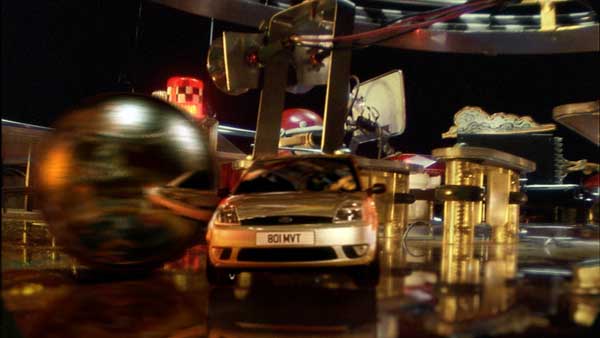
I worked on all of the car shots, animating motion trails, constructing the environments that the cars were in. I also did the motion trails on the diver and helped with the fencer shots.

The teamwork among animators and the animation supervisor can be tricky and problematic, how does it work in Mill? If you are using different software how do you bring all the work together on the production stage?

There aren’t any problems working with the supervisors, in fact the not even called that, there just members of the team. Russell Tickner was the lead animator and effects supervisor on Mercedes. He’s very open to ideas and letting animators take control of there shots and making them there own. As for software, we have a really good setup and renderfarm that renders everything through Mental Ray. That is our most important tool, it doesn’t matter if you’re using XSI or Maya, and it’s the quality of the final image that is paramount. The software you used to get there is not important.How important receiving the ‘Boards’ Award was for you? Could you tell what this award means to an animator producing commercials?

It feels really great to receive the award, it was a huge surprise. Now I’ve got to maintain the same standards and keep making good work.
 
What do you think about the work of the other two finalists in the ‘Animators’ category – Justin Harder and Michael Overbeck?I’d never seen there work before so it was great to see. I thought that both of them had really cool styles and I think that the variety of the work in this category shows just how diverse and exciting animation is.Tell us about your plans for the future. Are you going to continue with the commercial animation or do you have plans to produce something on your own?I definitely have plans to do my own work, I try to keep little ideas on the go all the time. But I enjoy commercials so much and am constantly being challenged with new and exciting projects. I look forward to every new job. And I know there will be many more great projects to work on in the future.

How do you feel when, while watching TV, you run into one of your own commercials that you’ve been working on for weeks or months?You never get tired of seeing your work on air when it’s something you’re especially proud of. I know I love to watch “mercedes movement”, I always see something new in it. And it’s great to get a reaction from someone who hasn’t work on it and looks at it in a completely different way from you, unaware of where the effects overlap with reality.

What is your source of motivation? Where do you go for inspiration?I get most of my inspiration from films and great directors. People like Chris Cunningham have had a huge influence me. Kubrick, Scorcese, Hitchcock, the list goes on. But generally just from popular culture, TV, books, magazines. You can’t help getting inspiration from the world around you.

If anyone could fix the existing tools (software-wise) or create a new tool especially for you, what would it be? A make this look good button would be especially useful.

Your favourite animation technique? Do you find it the most effective? Don’t have a favourite animation technique. I think it’s silly to categorize animation. Animation can be about problem solving to get ideas across to the viewer in the most exciting and interesting way possible. Often mixing different styles of animation gets the bests results. For me if I know something can be done in 2D better then that’s how I want it to be done and am not precious about being purely 3D.

What would your advice be to all those who want to follow in your footsteps and become animators? Experiment like crazy. Don’t be afraid to try new things, often its accidents that produce the most exciting work. Also don’t worry about the technical aspects of the industry or the specifics of learning one 3D package over another. Also don’t be afraid to do a bit of running. I know loads of people that said they’d never run and were too well qualified but they are still nowhere. It gives you a great incite into the company and the industry in general, and you have a good laugh at the same time. Thank you, Andrew, for your time and patience with answering these questions, we wish you all the best with your work and good luck. Also, all of us at Render Node would like to congratulate you on the ‘Boards’ award, well done!.