Friday Flashback #353
Freedom. Go home early. XSI 3.0

Friday Flashback #352
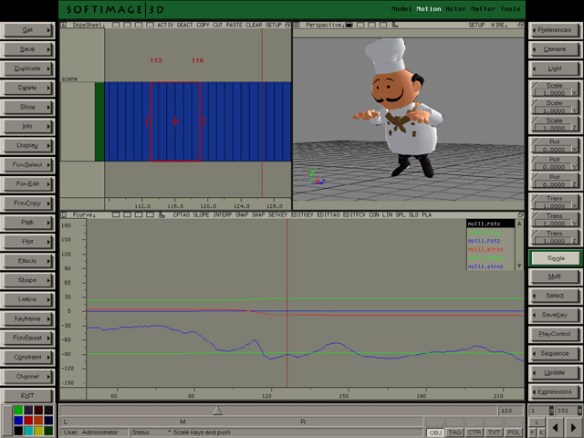
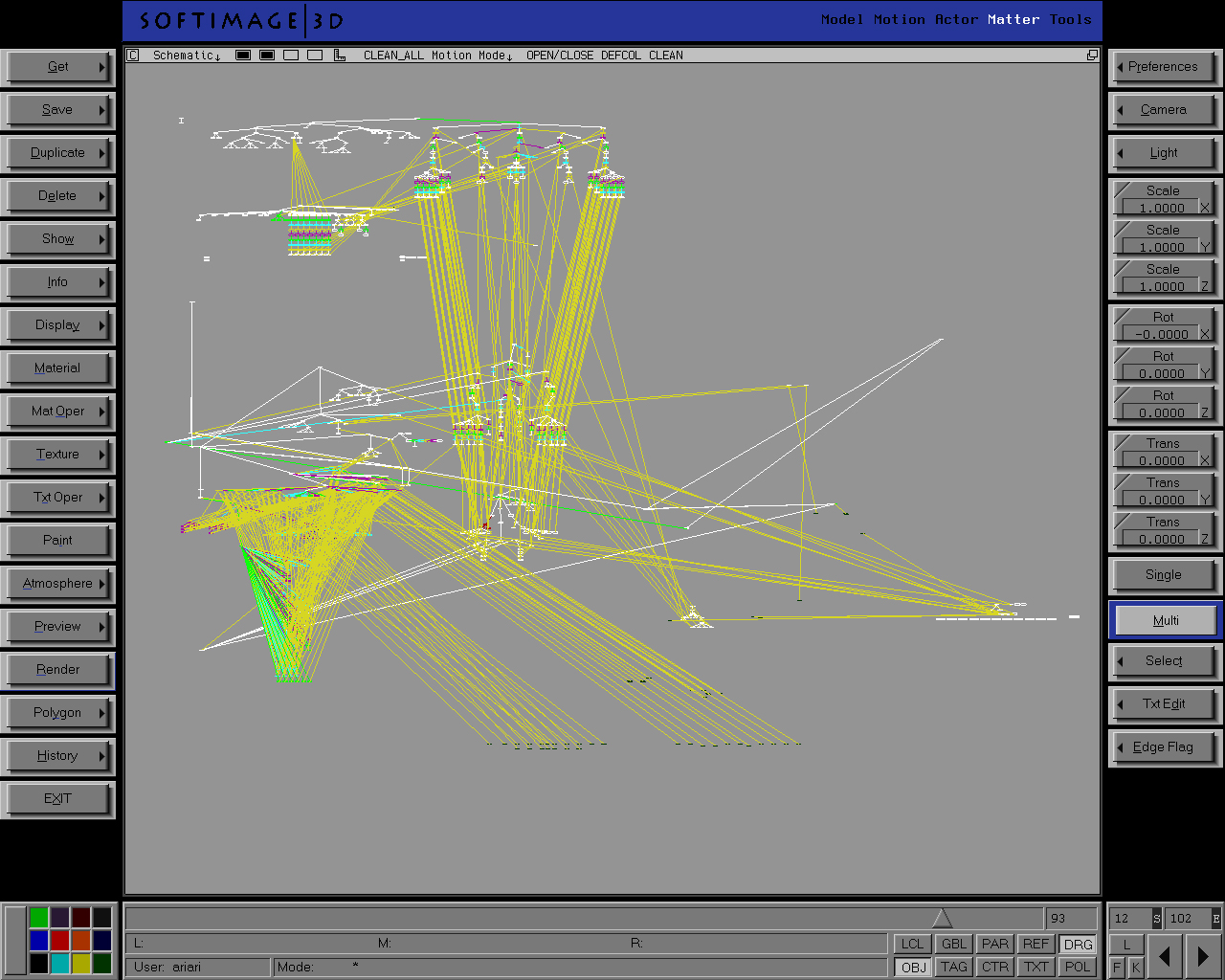
SOFTIMAGE | 3D 3.9.2 and SOFTIMAGE | XSI 1.5
From the “making of Pico” by Avant Co Japan
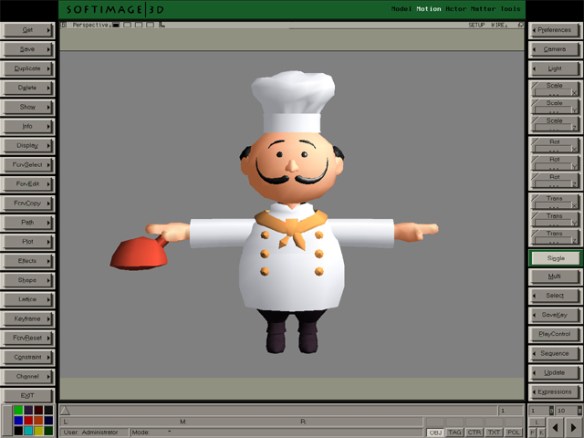


Via the wayback machine and Google translate:
Since we were using SI at the time at that time, we started production at SI.
I tried things using shaders written by the company programmer · Things that used SpeedRender etc, but because it is unlikely that the required quality can be reached in the expression that can be done with shader, I will do Global Illumination I decided to try it. Although GI can be done with SI, I will use XSI for the first time because it seems that the setting using XSI seems to be finely set.
At this point there is not even even touching XSI (it is before the PV of m – flo ), it is difficult to conclude with XSI suddenly, so I will use it together with SI.
We will proceed with “schedule” that we will complete all the basic scenes such as modeling, animation and weight adjustment at SI and attach texture only at XSI.
So when we finished modeling we preliminarily converted to XSI and tried to render using global illumination. It seems that it is very difficult and time-consuming to adjust, but I have decided to proceed with the method SI → XSIm live-action shooting to final combination. Well then. To be continued …
— Hiroyuki Kashima
Friday Flashback #351
“Non-realistic” rendering with Softimage|XSI 1.5A2.0
Friday Flashback #350
1995…Softimage used in TV’s first 3D animation series
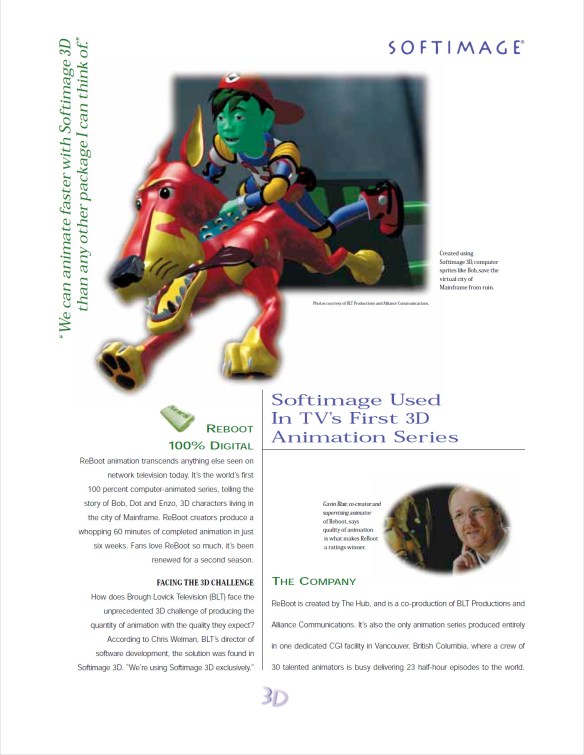

REBOOT 100% DIGITAL
ReBoot animation transcends anything else seen on network television today. It’s the world’s first 100 percent computer-animated series, telling the story of Bob, Dot and Enzo, 3D characters living in the city of Mainframe. ReBoot creators produce a whopping 60 minutes of completed animation in just six weeks. Fans love ReBoot so much, it’s been renewed for a second season.
FACING THE 3D CHALLENGE
How does Brough Lovick Television (BLT) face the unprecedented 3D challenge of producing the quantity of animation with the quality they expect? According to Chris Welman, BLT’s director of software development, the solution was found in Softimage 3D. “We’re using Softimage 3D exclusively.”
SOFTIMAGE_A NATURAL CHOICE
HIGH-QUALITY CHARACTERS
“We can animate faster with Softimage 3D than with any other package I can think of,” states Welman, “Because we’re dealing with a lot of character animation, we’re using the skeletons with path animation, inverse kinematics, flexible skin and envelops extensively.” Using Softimage 3D to endow characters with fluid motion, including natural facial expressions, hand movements and lip-synch is what makes ReBoot a ratings winner in the Saturday morning toon market.
RENDERING AT FULL THROTTLE
And what about the unique challenges in producing the weekly CGI series? Christopher Brough, the show’s producer says, “It’s getting an enormous volume of animation out of the computer and onto digital tape.”
Welman concurs, stating, “There are few people producing the quantity of 3D animation with the quality that we are today. With 21 minutes of footage to produce every few weeks, rendering time is obviously of concern. The Softimage renderer is really pretty quick, and with their mental ray renderer, it looks like they will stay ahead of the
competition in terms of photorealistic and customizable rendering.”
COMBINING TOOLSETS
BLT at times, finds it convenient to combine toolsets by writing their own software because “it’s nice to be able to write our own effects to extend the package if we have to,” states Welman. Softimage 3D tools in the hands of talented ReBoot animators delivers network television’s first highly-rated 3D animation series.
Friday Flashback #349
Friday Flashback #348
Friday Flashback #347
Getting SOFTIMAGE|3D up and running at SIGGRAPH 2006


Friday Flashback #346
From 2003…
Integrated rendering with mental ray v.3.2
Only SOFTIMAGE|XSI has a shared memory architecture with mental ray, which maximizes the use of mental ray’s award winning technology. This core integration of mental ray allows for increased rendering speed as well as greater memory management.

Friday Flashback #345
Softimage “Twister” Enters Beta at SIGGRAPH
ORLANDO, Fla., July 20, 1998 — Softimage Inc., a wholly owned subsidiary of Microsoft Corp., announced today at SIGGRAPH 98 that its next-generation rendering system, code-named Twister™, is entering the beta test cycle with delivery to customers scheduled for the fourth quarter of 1998.
Twister is the first module of the soon-to-be-released 3-D animation platform, code-named “Sumatra,” which provides a revolutionary new approach to character animation and introduces the concept of nonlinear animation (NLA).
Twister is well-suited for use in combination with SOFTIMAGE® |3D version 3.8, now shipping to customers, which allows users to perform interactive rendering in a next-generation environment. Combining the power of mental ray® version 2.0 with the architecture and interface of the “Sumatra” next-generation 3-D platform, Twister fits neatly into the SOFTIMAGE|3D 3.8 workflow with an interactive tool set that complements and extends the functionality of the current-generation software.
Twister takes advantage of the forthcoming “Sumatra” user interface, which provides much smoother workflow and data access while maintaining the familiar and intuitive Softimage user environment that has become integral to much of the animation industry.
“Twister will revolutionize the way people handle production-level rendering,” said Dan Kraus, product manager for Softimage. “Not only does Twister provide the next generation of mental ray, but it also makes tuning and editing scene-rendering parameters a completely interactive process. We fully expect Twister to set a new benchmark in the industry as the first truly interactive renderer.”
“As a beta test site for mental ray 2.0, we’ve been extremely pleased with the truly interactive nature of the tool set and we eagerly await the opportunity to put ‘Twister’ to use in our facility,” said Dave Throssell, head of 3-D animation at London-based The Mill FX.
“Twister seamlessly integrates mental ray 2.0 into the rendering environment, thereby taking full advantage of new functionality for both interactive and batch rendering.”
Interactive Renderer Delivers Improved Creativity and Workflow
Twister allows users to render directly in the 3-D view, with instant feedback that shows how parameter changes affect the final rendering quality. Whereas rendering was once a time-intensive process, it will now become essentially another viewing mode. This interactive view evaluates the entire scene-rendering tree, and it allows users to view and modify all rendering effects, including motion blur and shadow mapping.
Twister also integrates many production conveniences, such as scene-level renderpass definition, allowing users to predetermine all of the computer graphics passes to be used in a production.
Next-Generation Photorealism Sets New Standard for Quality and Workflow
Twister is based on mental ray version 2.0, a next-generation renderer that will set new standards for quality and workflow. In addition to significantly improved performance, mental ray version 2.0 offers a host of new features, such as depth-map shadows, scanline motion blur and polygon displacement, as well as support for caustics, which allows the renderer to accurately calculate and render the light diffusion around a scene.
Twister allows users to distribute jobs quickly and easily across multiple CPUs, both locally and remotely, using new techniques such as distributed tesselation and local texture caching for significantly improved distributed performance.
Pricing and Availability
Twister is scheduled to be available in the fourth quarter of 1998. Licensed users of the extreme version of SOFTIMAGE|3D under a valid maintenance contract will receive
Twister at no charge. Customers with the base version of SOFTIMAGE|3D will receive an approximately 50 percent discount on Twister.
About Softimage
Founded in 1986, Softimage develops software for media-rich applications including video, film, interactive games and CD-ROM applications. Products include SOFTIMAGE|DS (video production), SOFTIMAGE|3D (high-end animation), SOFTIMAGE|EDDIE (compositing) and Toonz (2-D cel animation). The company was acquired in 1994 by Microsoft. Additional information about Softimage and Microsoft can be found via the Internet at http://www.softimage.com/ and http://www.microsoft.com/ , respectively.
Founded in 1975, Microsoft (Nasdaq“MSFT”) is the worldwide leader in software for personal computers. The company offers a wide range of products and services for business and personal use, each designed with the mission of making it easier and more enjoyable for people to take advantage of the full power of personal computing every day.
Softimage is a registered trademark and Twister is a trademark of Softimage Inc., a wholly owned subsidiary of Microsoft Corp.
Microsoft is either a registered trademark or trademark of Microsoft Corp. in the United States and/or other countries.
Mental ray is a registered trademark of mental images Geselleshaft fur Computer Film und Maschinenintelligenz mbH & Co. KG, Berlin, Germany. All rights reserved.
Other product and company names herein may be trademarks of their respective owners.
Softimage general information:
United States and Canada: (800) 576-3846
International: (818) 365-1359
Note to editors: If you are interested in viewing additional information on Microsoft, please visit the Microsoft Web page at http://www.microsoft.com/presspass/ on Microsoft’s corporate information pages.