Give it up for…SOFTIMAGE|Face Robot 1.5
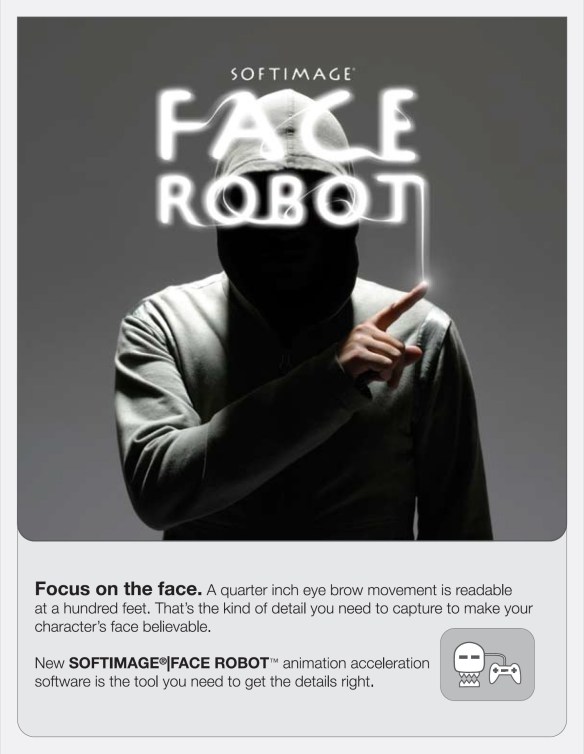


Give it up for…SOFTIMAGE|Face Robot 1.5
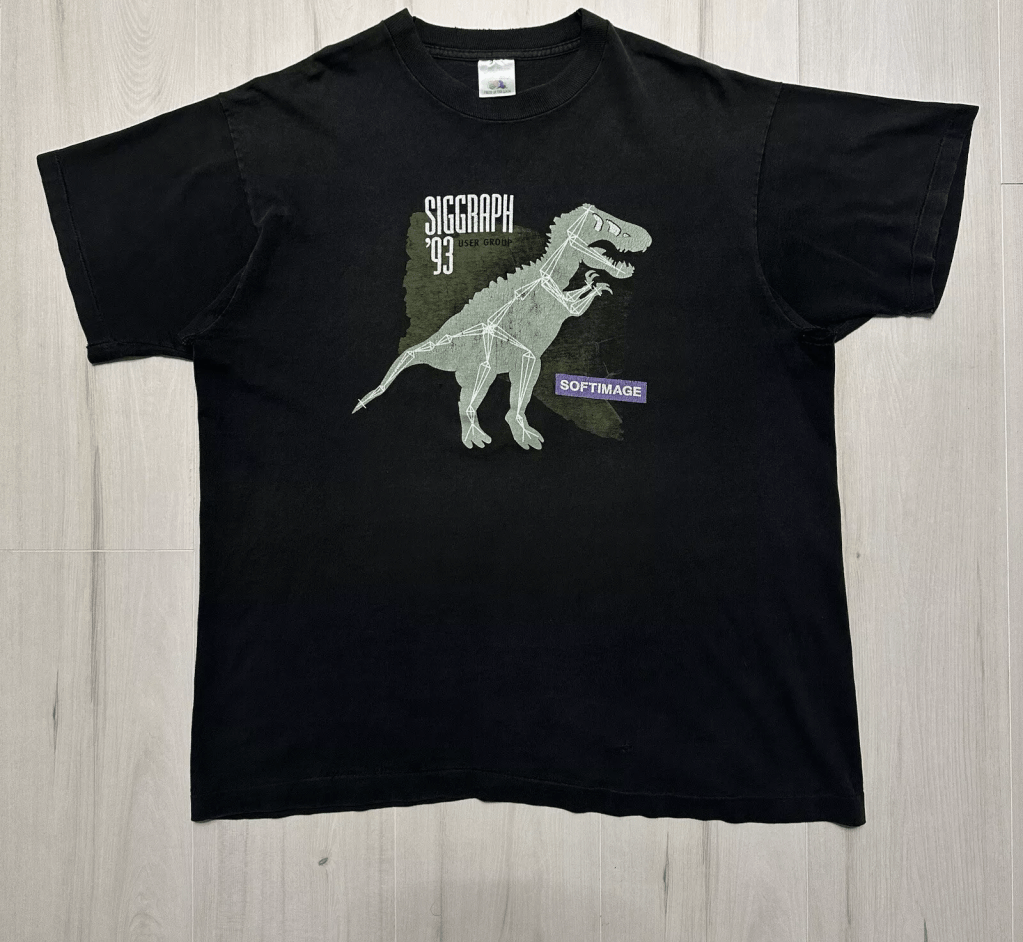
SIGGRAPH ’93 User Group tshirt



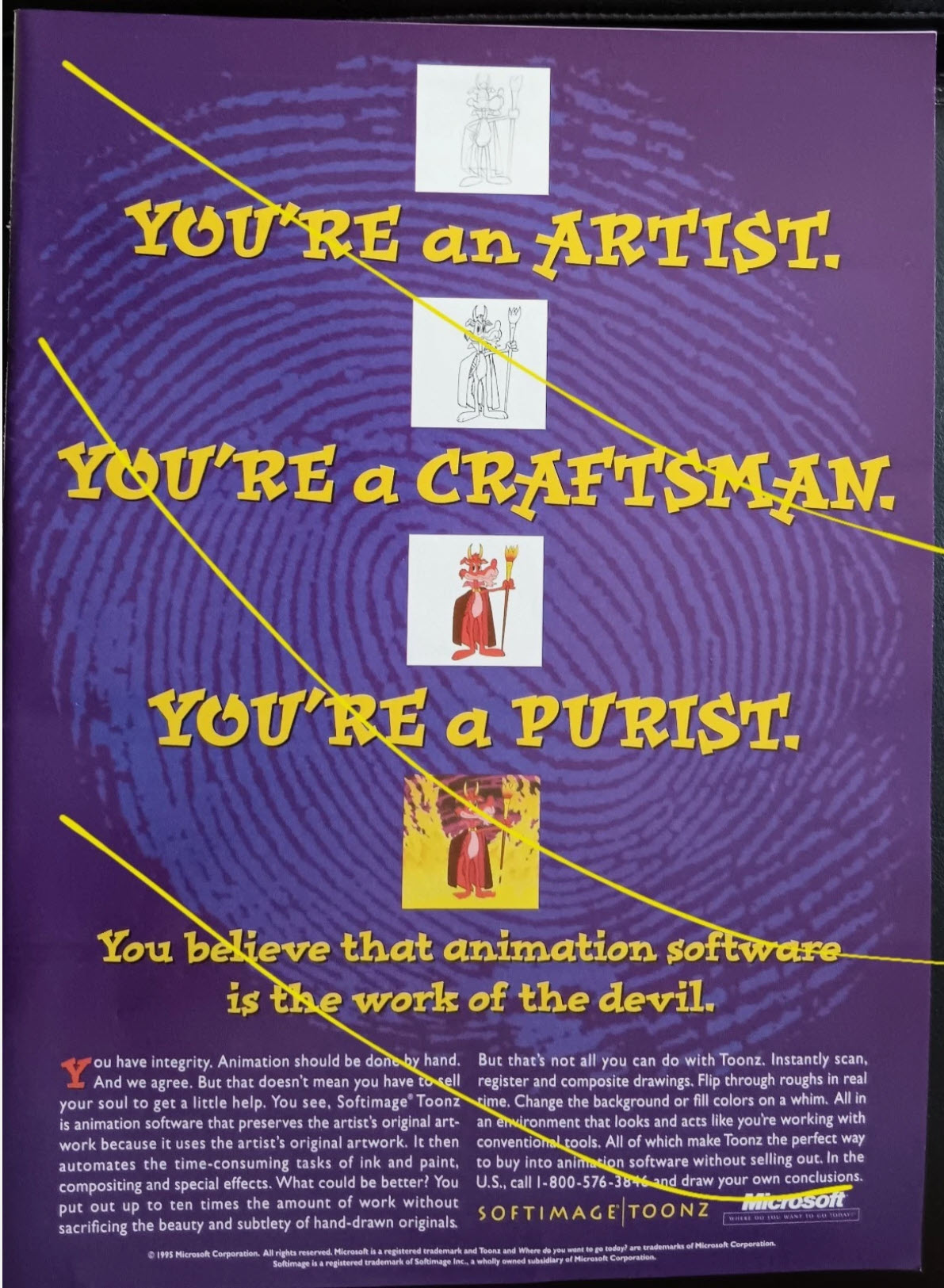
1995 magazine ad for SOFTIMAGE|Toonz
SOFTIMAGE Experience 2.0


By Michael Abraham
Westwood, California-based studio uses “kick-ass” SOFTIMAGE|XSI modeling, texturing, advanced normal mapping, real-time shaders, non-linear animation tools and customer service to blow the games world away.

“I don’t clean up messes, I make ‘em.”
Such is the response of independent soldier and ExOps agent Chris Jacobs upon being asked to covertly “clean up a mess” in North Korea. His response nicely summarizes the vicariously violent world of Mercenaries: Playground of Destruction, a new third-person shooter adventure from LucasArts and Pandemic Studios. So, how does one go about creating some sort of coherence in a game based almost entirely on mayhem, maniacs and messes? In LucasArts’ case, you hire Pandemic. In Pandemic’s case, you assemble a huge amount of animation talent and you get them to use SOFTIMAGE|XSI.
To create the sort of mesmerizing environment and characters that has earned Mercenaries some of the best game reviews that this reporter has yet seen, Pandemic relied heavily on SOFTIMAGE|XSI’s modeling, texturing and animation tools for creating the game’s pulverizingly playful world.
“SOFTIMAGE|XSI’s excellent modeling and texturing tools, advanced normal mapping and realtime shaders, and non-linear animation were all just extraordinary on Mercenaries,” says the colorful Carey Chico, Executive Art Director at Pandemic. “More than that, however, the clarity and simplicity of the XSI interface has provided our company with a fast, solid and streamlined set of modeling, texturing and animation tools that have significantly increased our iteration time in development. No doubt about it, SOFTIMAGE|XSI has been a great fit for us.”
PLAYGROUND OF DESTRUCTION
Created simultaneously for Sony PlayStation 2, Microsoft Xbox, Nintendo GameCube and PC, Mercenaries allows players to assume the role of one of three mercenaries attempting to control chaos by creating it following a coup in a future North Korea. In addition to the enigmatic American embodied by Jacobs, players can also choose the role of hyper-efficient, highly controlling, irredeemably insecure Briton Jennifer Mui, or that of the emotionally erratic, belligerently brutal Swede Mattias Nilson.
Backed by an incredible array of weaponry and military resources, the ExOps trio is battling evil genius and erstwhile North Korean General Song, described simply as “the most dangerous man on earth.” In addition to being ruthless and highly-disciplined, Song just happens to be in possession of his country’s considerable collection of nuclear weaponry.
As if that isn’t enough, the ExOps team must also deal with series of other fighting forces, any of who could prove to be friend or foe depending on the circumstances. The South Korean and Chinese armies, the Russian Mafia, and even the Allied forces are potentially vulnerable to the chaos that pervades the country and the region.
It is up to ExOps to stop Song and bring things under control. Ironically, their mission to restore calm will require that they blow the living snot out of all kinds of building, vehicles and opposing forces. And they haven’t got a lot of time to spare. In more ways than one, the very real task encountered by the Pandemic team of animators mirrored the contradictory challenges facing the fictional ExOps team.
“The biggest challenge we faced on Mercenaries was completing an ambitious project on a very tight deadline,” says Chico without hesitation. “Luckily, the consensus amongst our animators is that they can work much faster using SOFTIMAGE|XSI. Softimage has worked really hard to meet the requirements of next generation technologies as quickly as they arrive. With the advent of XSI’s Real-Time Shaders and Normal Mapping tools, Softimage has kept us at the forefront of what we can do in today’s games. Being able to previsualize our normal maps and see the effects of our realtime shaders has significantly benefited the iteration time on our projects. It allows us to see our work earlier in development, so any mistakes or potential problems can be taken care of early on. This gives us a big boost when it comes to getting the look we want, prior to actually investing the necessary time in writing our code for the engine. We have the experience and talent, and the software just works. That’s all we need to get the job done.”
POWERFUL ANIMATION TOOLS
“For me and my team, SOFTIMAGE|XSI’s animation tools are extremely powerful, especially on a project like Mercenaries,” says Austin Baker, Lead Animator on Mercenaries. “Simply put, XSI has improved the quality and quantity of our 3D work by providing stable, intuitive animation tools to work with together with the ability to create our own specialized tools through the intuitive UI, scripting tools and Net View. Personally, I use XSI for keyframe animation, IK, constraints and expressions, and I am currently exploring the possibilities of shape animation for our next project. Net View has eased the creation of custom interfaces by allowing me to create tools using WYSIWYG HTML editors. This has increased productivity by giving me a means to create a hub for tools and utilities that is easily accessible by anyone on my team. Relational views have reduced the time required to get the information that I need.Even more than all of that, the performance increases have meant faster interaction with characters, tools and scripts, and the open construction history has gone a long way toward opening the bottleneck that often builds up between artists and animators by allowing revisions to characters to easily and quickly propagate straight through to the envelope. This alone has greatly reduced our production time.”
More specifically, Baker joins the growing number of converts in pointing out the non-destructive strengths of the SOFTIMAGE|XSI Animation Mixer:
“The Animation Mixer has allowed me to quickly and easily create mockup animations as proof of concept for game mechanics,” says Baker matter-of-factly. “We also use it to speed up the process of lip sync and for applying key poses across multiple looping animations. What’s great is that we can copy poses from one animation to another, blend between two or more animations at one time and easily change the sequence of events in an animation. The fact that the Mixer is so similar to a traditional NLE means a reduction in the learning curve and a further increase in productivity. In particular, the Mixer’s non-destructive nature is very important to me. I am able to keep a database of animations that are used by multiple characters without ever worrying about further work in the Mixer forever altering those saved animations. It does a lot for my peace of mind.”
In addition to the Mixer, Baker proves to be quite keen on the Animation Editor:
“I rely heavily on the Animation Editor,“ Baker emphasizes. “It is my primary means of creating and editing individual animations. The High-Level Editing tools saved me a great deal of time on Mercenaries. In addition, the marking sets have allowed me to quickly set keys for only the attributes I want, keeping my f-curves clean and the Animation Editor uncluttered. These tools have virtually eliminated the various headaches associated with character setups. With these tools, I am able to explicitly control how each rig component is used, manipulated and keyed. I am also able to create rigs that can accommodate multiple animation styles while being consistent and easy to work with. I really do believe that SOFTIMAGE|XSI to be the best character animation system there is.”
TEAM PLAYERS
Even the most efficient team, of course, needs support from time to time. For Pandemic, the team behind the team is Softimage’s unrivalled customer support crew. Says Chico:
“I’ve said before that Softimage has excellent customer service. We periodically interface with their LA studio as well as the Montreal home office. This allows us to make requests, get quick fixes on issues we may have, and generally understand the software better. Softimage has always addressed our needs in consecutive releases. Softimage customer service is, bar none, the best that I’ve experienced with any company. Softimage makes you as a user feel part of a community of users; part of the team, you might say.”
And we hope to be part of the Pandemic team for a long time to come.
Customer story from the SIGGRAPH 2005 Softimage Magazine

CG artists at Hybride work eleven months, contribute 735 shots, 54 minutes, and go “A to Z” with SOFTIMAGE|XSI to achieve Frank Miller’s darkly surreal world on film. Hybride handled modeling, texturing, animation and more.
By Michael Abraham
“Hybride has brought yet another of my fevered dreams to life,” says director Robert Rodriguez breezily. “We’ve been working together for a while now, but this project was unique. For SIN CITY, we had to be faithful to the bold imagery of Frank Miller’s graphic novels, but we had to take that cutting-edge look several steps beyond. Time and again, the Hybride artists are able to create images that we mere mortals can only imagine.”
For about seven years now, Rodriguez – the mad mind behind such films as the now legendary El Mariachi (1992), Once Upon A Time In Mexico (2003) and the Spy Kids trilogy (2001-2003) — has been having his unique imaginings realized by the equally daring creative minds at Hybride, the Piedmont, Quebec-based animation and effects house that is showing Hollywood how things can be done. In recent years, Hybride has made extensive use of SOFTIMAGE|XSI in bringing Rodriguez’s visions to the screen, and the largely black and white world of SIN CITY is no exception:
“For our work on SIN CITY, we used XSI from A to Z,” says Hybride Visual Effects Producer Daniel Leduc. “We created 735 shots in 45 environments for SIN CITY and all the modeling, animation, textures, lighting and so on were completed in XSI. Only this system gave us the flexibility and versatility we needed on a truly diverse project like this one.”
And what a project! Unless you are extremely unlucky, the world of Miller’s SIN CITY will bear little resemblance to your own. This is a world of lead-hearted hookers and bone-crunching behemoths; of woman-beating cops and girl-eating priests; of mouth-breathing monsters and…well…politicians. There are no good people in SIN CITY; there are only the bad and the slightly-less so.
THE HARD GOODBYE
Take Marv, for instance, the central character of “The Hard Goodbye”, the first of the three Miller books that comprise the film as a whole and the main portion of the film (together with the open and close) to which the Hybride team dedicated their considerable talents. With his square jaw, buzz-cut and strength of ten and then some, Marv might seem at first like hero material, but his beast-like visage and booze-addled brain have made him decidedly anti. Make no mistake: there is no heart-of-gold beating beneath this barrel chest.
“Robert initially approached us about doing the entire movie,” says Leduc. “As it happened, we were just hitting the crunch on another film, Racing Stripes, so our schedule wouldn’t allow us to take on the whole movie. That turned out to be a good thing because Marv ended up keeping us very busy all on his own. I think Robert probably felt that this mostly black and white, very graphical movie would be easier to do than something that needs to be photoreal, like the Spy Kids movies. Robert usually believes things will be easier than they turn out to be, of course. Maybe that’s why his movies are always so ambitious.”
As “The Hard Goodbye” opens, Marv explains his current murderous motivations. Played with astonishing pathos by Mickey Rourke (an actor I personally wrote off over a decade ago), Marv is out to avenge the murder of Goldie, a high-priced call girl with whom he shared a single night and a blood-red, heart-shaped bed. Sounds sort of sweet, I guess, until Marv gets busy. Through a blood-spattered odyssey that would make even Quentin Tarantino blush, Marv blithely butchers his way through virtually every corner of Sin City. Indeed, one of the most distinguishing features of “The Hard Goodbye” is its multiple environments: hotel rooms, a church, alleys, buildings, statues, an electrocution chamber, a hospital elevator, a bathroom, a guarded fortress, and more.
“Creating and working with that many shots in that many different environments was a big challenge,” admits Marc Bourbonnais, Lead 3D Technical Director at Hybride. “On occasion, we had the same environment over as many as 30 shots, but usually we were changing sets every 10 shots or so. We had to find a way to optimize the production while knowing the workload would be so diversified. The versatility and flexibility of XSI let our artists work the way they felt most comfortable. Some of the CG backgrounds were matte paintings with a few 3D elements; others were completely 3D with full textures, modeling and lighting done in XSI.”
BLACK AND WHITE IN COLOR
Compounding the challenge of creating so many environments was the distinctive monochrome, with occasional accents of vibrant color, which essentially defines the film’s tone.
“We started our 3D work in black and white, but we quickly found out how tough that is,” explains Leduc. “We were trying to get all the details in black and white without losing the shading in the skin tones and other details. We did some preliminary tests in XSI to figure out the light and dark of the final look. You don’t want to spend too much time on the details of a portion that might be blocked out in the final cut. Eventually, we decided it was easier for everybody to work in color. When we turned the color shots into black and white, they created a much richer grey scale image. Sometimes, Robert complained that our backgrounds were too photoreal. We used XSI’s lighting tools to create non-realistic lighting.”
“It was that kind of blending of different styles that made SIN CITY such a challenge and such a successful project,” says Bourbonnais. “All the way along, we were trying to strike a balance between a realistic, film noir feeling and the harsh contrasts of the graphic novel. Throughout, we needed to keep the approach sufficiently flexible to know on a scene-by-scene basis what the 3D was going to look like.”
Bourbonnais pauses for emphasis, before continuing:
“The greatest thing about XSI on SIN CITY was the versatility it offered on all these different shots,” he says by way of conclusion. “On a unique project like SIN CITY, we had to give a lot of creative room to our artists. Usually when you start a new project, you need to set up a definite pipeline where certain artists working on certain areas. When you’ve got 40 people working on 700 very different shots, you need to give them tools like the XSI FX Tree that allow them to really stretch their imaginations and abilities. Some of the artists were more comfortable doing matte paintings, and they could do that in XSI. Some are more technically inclined, so they could use XSI to build their own scenes and sets and go right ahead with textures and lighting. The FX Tree allowed us to perform important pre-comp work. With the adaptability of XSI, it is easy to select different approaches for a scene, and you don’t need an army of technically-inclined staff to get the very best results possible.”
And no one, but no one, can argue with the results. Right now, Hybride is completing work on The Adventures of Shark Boy & Lava Girl in 3D, ready to add another Rodriguez project to their already astounding resume.
With the arresting artistry of SIN CITY alone, however, Hybride appears destined for CG sainthood.
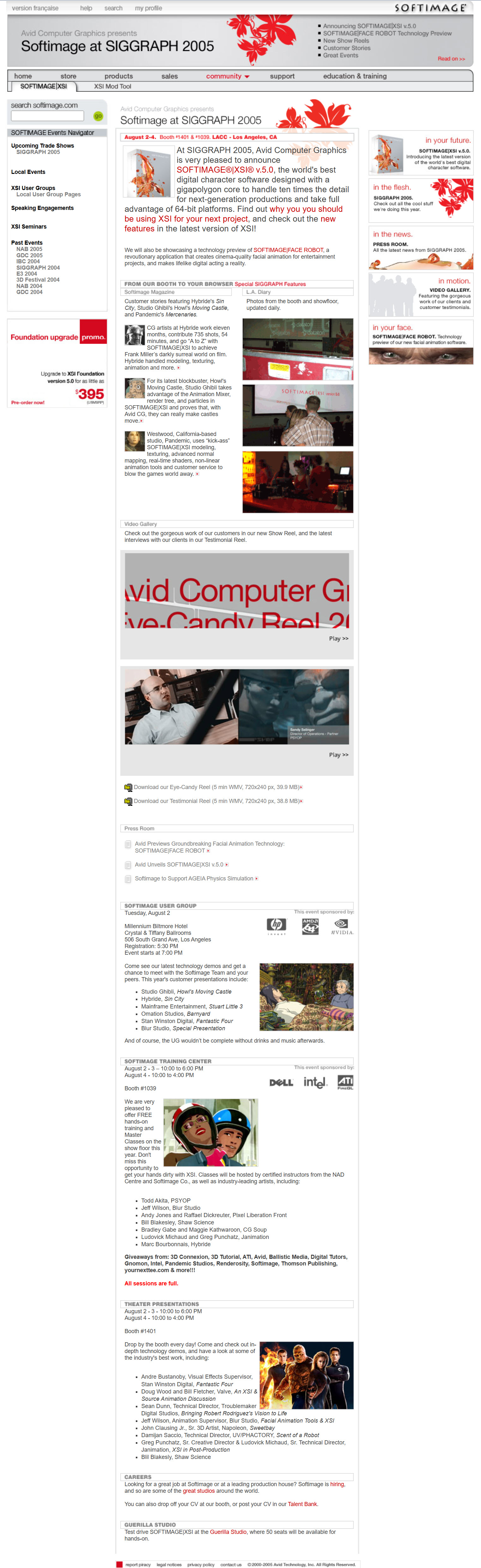
Softimage at SIGGRAPH 2005
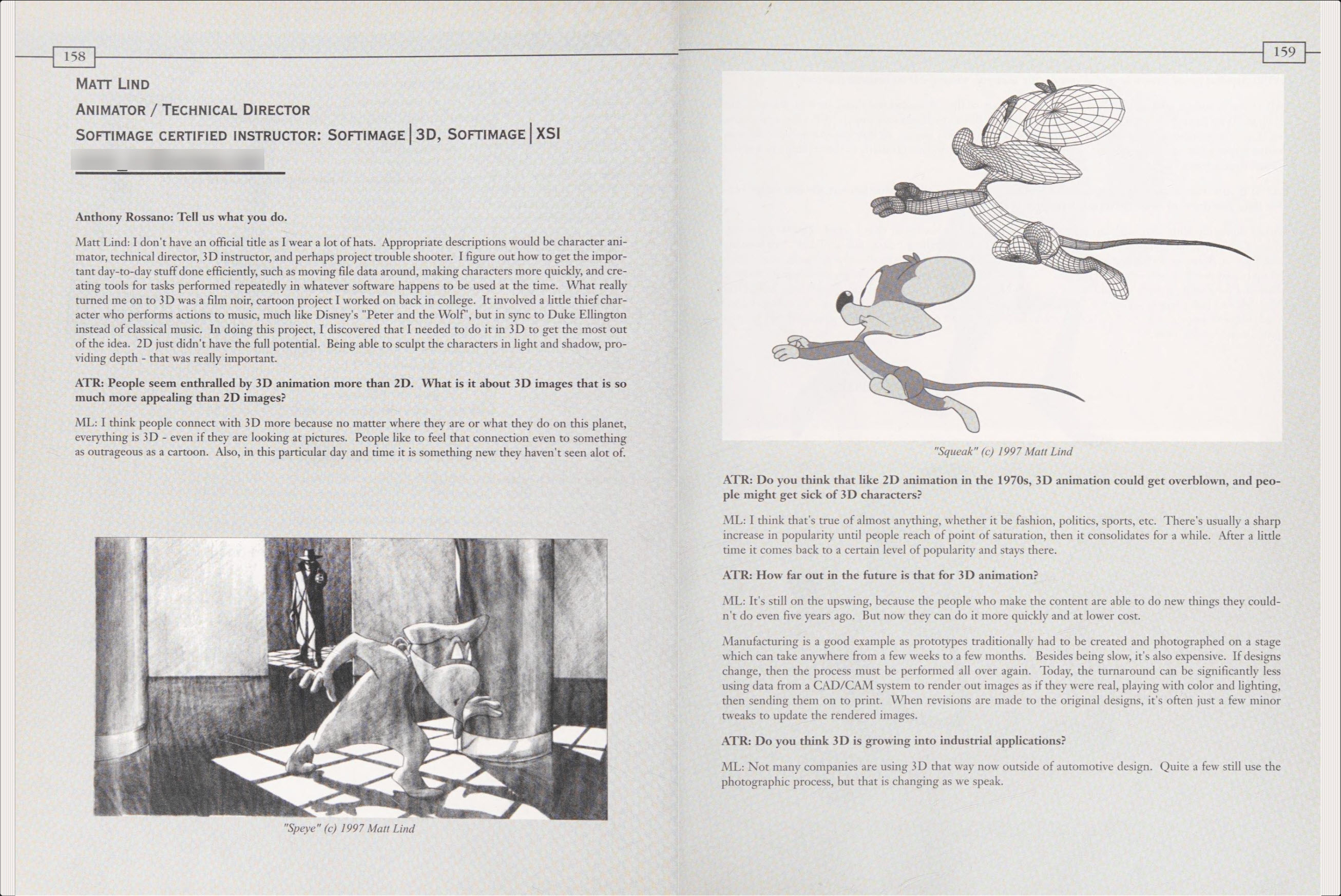
From XSI Illuminated: Character, the Matt Lind interview:

Following up on the previous post about the Blue Sky Studio Bunny, here’s the Blue Sky “Our Story”, retrieved from way back in 2012…

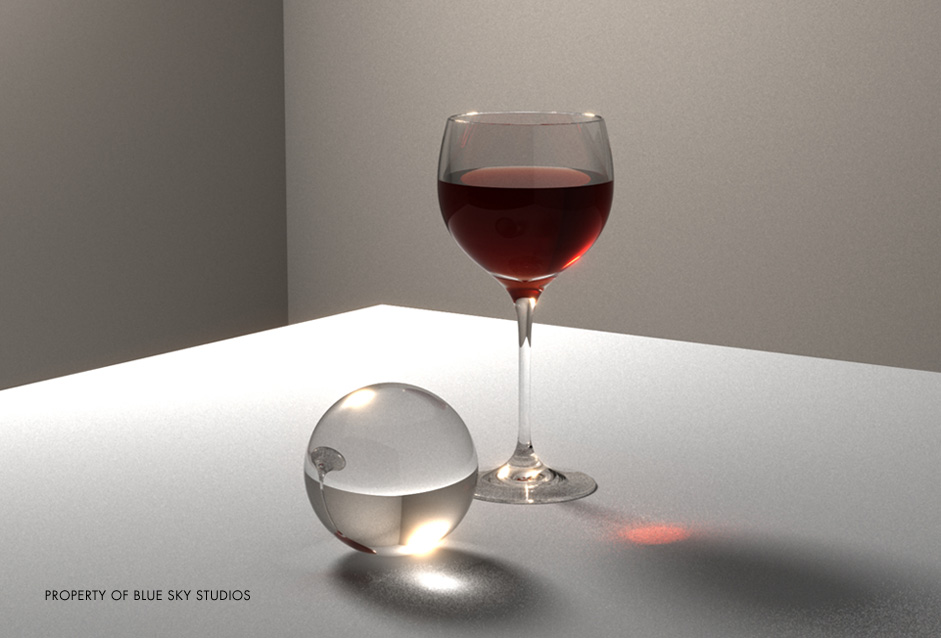


Bunny mockup from 1999…

 eX-SI
eX-SI 