Private Revolution
SOFTIMAGE Animation Software Breaks New Ground
Some facts from this April 1992 article:
- The beta version of the SOFTIMAGE 4D Creative Environment made its debut at the 1988 SIGGRAPH show, and SOFTIMAGE Version 1.0 was released in January, 1989.
- A basic SOFTIMAGE software package is priced around $34,000; the full-blown system may cost up to $56,000 for the software alone.
- SIGGRAPH 1991 in Las Vegas, NV, saw the debut of the SOFTIMAGE Actor module
Private Revolutlon
SOFTIMAGE Animation Software Breaks New Ground
BY HELEN SHORTAL
Last summer, James Cameron’s Terminator 2 was widely hailed for revolutionizing the use of computer animation in the production industry- at a cost of about $80 million. But a quieter- and more cost-effective revolution in computer animation has been underway for some time in Montreal, Canada, which is home to software manufacturer SOFTIMAGE Inc.
In the four years since the introduction of the modular SOFTIMAGE Creative Environment, more than 230 companies around the world have licensed the 3D animation software, which also offers options that provide paint and compositing capabilities. Now, two recent developments have enabled SOFTIMAGE to offer previously-unprecedented animation capabilities to tele-production facilities and corporate communicators alike: the release of the SOFTIMAGE Actor module for character animation and the recent announcement of support for the economical Silicon Graphics IRIS Indigo Elan
platform.
In The Beginning
SOFTIMAGE founder and president Daniel Langlois began developing the SOFTIMAGE Creative Environment in 1986. A graphic designer who received wide acclaim for his codirection of the animated film Tony de Peltrie in 1985, Langlois dreamed of creating a software package that would free computer graphic artists from the tedium of programming. The beta version of the SOFTIMAGE 4D Creative Environment made its debut at the 1988 SIGGRAPH show, and SOFTIMAGE Version 1.0 was released in January, 1989.
“Right from the outset, Daniel designed SOFTIMAGE with the artist in mind- especially in terms of its user interface,” says SOFTIMAGE marketing coordinator Elizabeth Jones. “He wanted artists to feel like they were working with a powerful set of tools, not a computer.”
SOFTIMAGE runs on all Silicon Graphics workstations, from the IRIS Indigo and the Personal IRIS to the highpowered 310 VGX and 340 GTX platforms. The Silicon Graphics IRIS 4G35GT is currently the most popular platform among SOFTIMAGE users. A basic SOFTIMAGE software package is priced around $34,000; the full-blown system may cost up to $56,000 for the software alone.
“I believe I was the first licensed SOFTIMAGE user in the world,” says graphic artist Sam Hadley of Fast Cuts Inc. in Washington, DC, who currently runs SOFTIMAGE on the IRIS 4G35GT. Hadley began working with SOFTIMAGE in 1989, when he was a graphic artist at Vox-am Associates in Silver Spring, MD.
“The user interface is still pretty much the same- really intuitive- but SOFTIMAGE has gotten a lot more powerful in the last few years,” says Hadley. “The system I have now runs about 15 times faster than it could a few years ago.” A Betacam SP facility that caters to the government, corporate and association markets, Fast Cuts purchased its SOFTIMAGE system about eight months ago.
“The Pan-American Health Organization wanted us to do three 30-second animated PSAs showing people how to prevent the spread of cholera by boiling their water and cooking their food,” Hadley recounts. “The hardware and software for the system arrived in boxes one morning, and by night I had the first three seconds of animation on tape. In two and a half weeks, all three spots were on the air.”
Multiple Choice

Designed to provide artists with flexibility as well as creative freedom, SOFTIMAGE can output images at multiple resolutions to a wide range of formats,, including NTSC, PAL, HDTV, 35mm film and 4 X 5 transparencies. Both technical support and services for SOFTIMAGE users are available through the Customer Support Department at SOFTIMAGE headquarters in Montreal; its services include rendering and outputting to both film and video. With the PostScript option, SOFTIMAGE can also output line work to Post- Script-compatible printers, for applications such as storyboards or conventional cel animation. This versatility has contributed to SOFTIMAGE’s popularity as a tool for architectural and industrial design, education and scientific visualization.
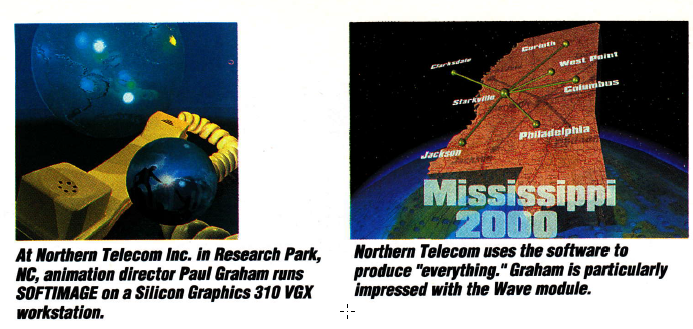
At Northern Telecom lnc. in Research Park, NC, animation director and marketing specialist Paul Graham uses SOFTIMAGE to produce “everything from brochure covers and videos to high-res images for trade show display panels,” says Graham. Running on a Silicon Graphics 310 VGX workstation, the SOFTIMAGE system at Northern Telecom includes the Nefertiti paint program and the Eddie compositing module, which provides in-computer integration of live action and special effects.
“SOFTIMAGE lets me do everything Irom logo spinning to visualizing the concepts behind the services we market,” says Graham, who is particularly impressed with SOFTIMAGE’s Wave module.
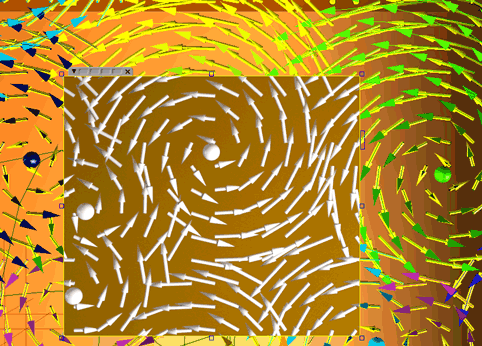
Wave allows the artist to automatically animate multiple deformations of ob jects, such as raindrops falling on a pond or flags rippling in thewind. “Wave makes it a million percent easier to create ripple and water effects, and it allows me to use as many waves as I want in the same obiect,” says Graham. “Other programs limit you to a single wave.”
Graham recentlY used Wave to animate the background for a threescreen video presentation at the ITVA Silver Reel awards. “With Wave, I created lour or five water ripples that ran into each other and bounced back and forth across the three screens,” says Graham’ “Since you can actually see the deformations as they take place at the wireframe level, you have a tremendous amount of control over the effect.”
Enter Actor
SIGGRAPH 1991 in Las Vegas, NV, saw the debut of the SOFTIMAGE Actor module, which automates many of the oncecumbersome processes required to create detailed animation sequences.
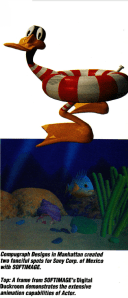
Actor uses inverse kinematics to pre vide complex and realistic skeletal animation. The artist uses a “skeleton editor” to construct a hierarchical chain and specify the range of motion in each of its joints. When the artist moves one end of the chain, Actor automatically calculates the subsequent movements of the entire chain. The artist can specify environmental conditions such as wind or gravity, and the system will automatically assimilate them into its calculatiens. Deformable envelopes created with Actor automatically match the movements of an underlying hierarchical chain, allowing for the speedy creation of remarkably detailed characters.
The graphic artists at Manhattanbased Compugraph Designs, a division of MTI subsidiary The lmage Group, were among the first designers to work with Actor. “I had a storyboard that really required Actor, so SOFTIMAGE sent us a beta version,” says creative director Mike Saz.
“Professional animators appreciate SOFTIMAGE for features like latticebased deformation of shapes and skeletal control of figures through inverse kinematics,” notes Saz. “Other software isn’t addressing these features. And to have animation software that’s fast enough to use in production is even better. You know how the production industry is- if you can’t have it done by Tuesday, then it doesn’t matter.”
Compugraph designer/animator Lisa Suzuki used SOFTIMAGE to create two fanciful spots for Sony Corporation in Mexico. “Sony is moving into the VHS VCR market, so the spots take you inside a Sony VHS machine and show that there’s an entire world in there,” says Suzuki. “You see a fish scurrying through an underwater scene full of waving plants. Then the body of the fish changes into the body of a bird, through shapeto.shape animation, and Actor animates the bird’s flap ping wings.”
Mixed Media
At Manhattan’s VSC Post, computer animator Dave Throssel uses SOFTIMAGE on high-end commercial proiects where animated characters are composited with live-action sequences. In the past few months, Throssel has completed spots for Warner Cable, Norelco, Fixodent and the New York Lottery.
“I run SOFTIMAGE on a Personal IRIS, which is perfect for the kind of work I do,” says Throssel. “I usually don’t render whole scenes- just the heroes in the scenes. And SOFTIMAGE has a’drawover’ option that lets you see the live action behind your wireframe model.”
The New York Lottery campaign uses an animated champagne cork ricocheting around the home of two lotterywinners to make the point that, “‘You’d better be careful, because you might just win the lottery’,” says Throssel. Duringthe liveaction shoot, vases and cookie jars on the set were rigged to break on cue. Working with this footage, Throssel then used SOFTIMAGE to animate a cork that flies out of its champagne bottle and wreaks good-natured havoc on the room.
“Our clients like SOFTIMAGE because it has a single interface and they understand the terminology it uses,” says Throssel. “Our system paid for itself in just four months. SOFTIMAGE is the best animation package you can get your hands on, and the Silicon Graphics workstations keep getting cheaper and more powerful. Once you start using SOFTIMAGE , you don’t want to work with anything else.”







 eX-SI
eX-SI 