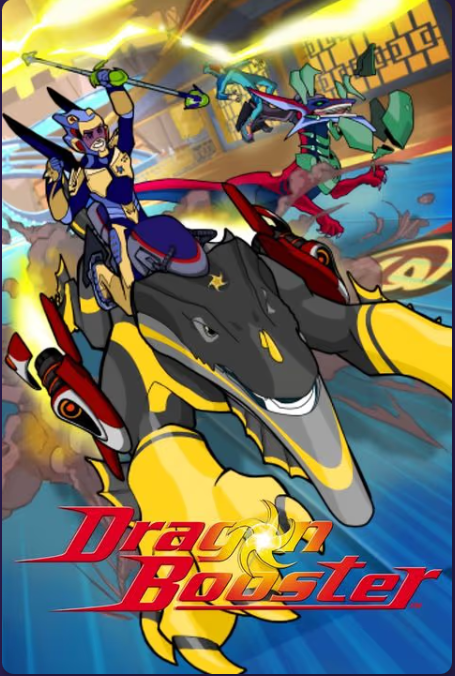
RENAISSANCE OF THE NERDS Nerd Corps Gets Busy On Dragon Booster
Vancouver’s Nerd Corps uses SOFTIMAGE|XSI’s Compositor, Net View, Synoptic View, Toon Ink lens shader, partitions, passes, overrides, FX Tree and lots more on 39 episodes of Dragon Booster.
By Michael Abraham
Some of you reading this might just be old enough to remember when being a nerd was, at least ostensibly, a bad thing. For the rest of you, just keep playing with your Tonkas and Barbies and let the old folks talk for a minute. If you simply can’t amuse yourselves, just scroll down until you see SOFTIMAGE|XSI.
We still know the stereotype: tape on the bridge of the coke-bottle glasses, pocket protector full of pens and the obligatory slide ruler (remember those?), pants hiked to reveal an inch or so of pasty white skin, and an uncomfortably ardent passion for Carrie Fisher. The image may still be there, but the stigma sure ain’t. The last two decades have seen the smart guys getting the fame, the money and the girls. It has been a truly retributive renaissance for those eternally forward-thinking people who endured wedgies and noogies to reach the top of the heap.
Case in point: Nerd Corps Entertainment in Vancouver, B.C. clearly represent the new nerds:
“We’re more like neo-nerds,” says Chuck Johnson, Dungeon Master (or Senior Vice President of Production for the hopelessly square readers out there) at Nerd Corps. “We’ve got the same enthusiasm and affinity for technology, but we’re more comfortable and more accepted than our earlier versions. We really represent the evolution of the nerd in a lot of ways.”
The evolution of Nerd Corps would have made Charles Darwin — himself a nerd by all accounts, and just look what he did! — very proud indeed. Three years ago, Nerd Corps Supreme Commander (a.k.a. President) Asaph “Ace” started up his own development and production shop. Shortly thereafter, Ace was approached by distributor Alliance/Atlantis and creators of The Story Hat to produce a cutting edge television series called Dragon Booster. So enticing was the project that Fipke convinced Johnson to start up CG production at Nerd Corps.
Two years of natural selection later, Nerd Corps is now 70 nerds strong and well into production on Dragon Booster which is airing weekly on ABC Kids in the US and CBC in Canada. From storyboards straight through to final delivery, Nerd Corps provides all animation production services for the series. For all that activity, however, Johnson insists that the last two years have moved along surprisingly smoothly, thanks in part to SOFTIMAGE|XSI:
“It started with just Ace and I and handful of very talented nerds,” he says nostalgically. “We worked out of a small office for the first eight months or so, during which time our goal was to convince Alliance Atlantis that we could give them the best show for their money. One of our primary objectives was to figure out the most efficient 3D animation pipeline that would still allow the creative process to flow freely. Our initial pipeline test came in January 2003 when we used SOFTIMAGE|XSI to create a two-minute trailer for Dragon Booster. In December 2003, we got the green light for 39 episodes and by March 2004, we had seventy employees. When we were starting out, we had, what many considered to be, a pretty radical pipeline plan, but with the help and expertise of our top notch crew we managed to realize our vision and now we’ve got a highly efficient pipeline, a talented crew and a visually groundbreaking series in production. The Softimage Support gang has really been integral to this whole process. They’ve more than lived up to our expectations of a software partner. They really invested time with us, and it had a significant impact on our success.”
Johnson also points to SOFTIMAGE|XSI’s fully integrated Compositor as a key benefit to Nerd Corps work on Dragon Booster:
“Dragon Booster is really graphically styled, and we try to make everything as efficient as possible on a job this big,” Johnson explains. “Traditionally, television animation required so much in-scene 3D work that artists had tons of heavy work and rendering to do. SOFTIMAGE|XSI’s Compositor has enabled our animators to integrate more post-type effects and compositing into their animations. It has also taken things like camera shake and other time-consuming tasks and made them easy and fast. The Compositor saves us all kinds of time while also getting us the spectacular looks we need for this show.”
Special effects and compositing itself falls into the realm Sandro Di Segni, Nerd Corps’ Lord of Illusions (a.k.a. VFX Supervisor). In addition to heaping more praise on Softimage support, Lord Di Segni singles out the FX Tree, Compositor, Particles and more for special praise on Dragon Booster:
“The FX Tree was very useful,” says Di Segni. “We have also been working very closely with Softimage to further enhance the Compositor and we believe it’s only going to get stronger. SOFTIMAGE|XSI Particles and ease of modeling broken pieces of geometry and textures has been a great help to us. Partitions, passes and overrides are really strongly built in XSI, and that made all the difference when we were trying to get all these layers rendered for effects. Net View and the Synoptic Views have allowed us to organize our production in a way never before seen. We have also used Net View to organize our rigs and to make extensive documentation about them. Simply put, SOFTIMAGE|XSI provides features that, once you’ve used them, you can no longer live without them.”
For Michael Monks, Nerd Corps’ Lord of Digital Massing (a.k.a. Modeling Supervisor), SOFTIMAGE|XSI holds still more benefits for Dragon Booster:
“I considered our biggest challenge on the show would be to achieve a truly unique look,” says Monks thoughtfully. “Getting the look meant producing a huge volume of models in a relatively short amount of time. I found the Toon Ink Lens Shader really powerful, with sufficient control to draw good outlines around and inside the characters that have held up to the scrutiny of all of our episodes to date. One of the most useful aspects of SOFTIMAGE|XSI involved Scripting. With the help of our software team, we’ve been able to create a lot of productivity-based programs through Net View that handle many time-consuming tasks that would have otherwise bogged down production. That gives us more time to focus on the artistic rather than the technical.”
Supervising Animator Rex Ahn is quick to agree with Monks regarding SOFTIMAGE|XSI Scripting before describing a few favorite features of his own:
“I believe the flexibility of SOFTIMAGE|XSI has helped us immeasurably,” says Ahn. “Through its scripting capabilities, XSI is so customizable that we can really make the software cater to our needs. Instead of fighting against the software, which I was very accustomed to, the system actually helped us battle our deadlines. It helped all of us to fully realize our unique visions. We know that if we run into a problem, there is always a solution.”
Ahn pauses for thought before continuing:
“I really like SOFTIMAGE|XSI’s rendering philosophy with Passes and Partitions,” he says matter-of-factly. “Instead of breaking up layers into separate scene files and spending so much time loading, deleting and saving, layering shots can be done in one single scene. If there’s an error, it can be repaired and set-up to be fixed on every layer in one pass instead of having to fix multiple scene files. The concept is wonderful and the execution is solid. Having a built-in compositor that is as powerful as XSI’s FX Tree is a great boon to our production. Instead of having comps that are just ‘overs’, we can spice up shots and make each one look that much nicer. Simple features like Child Comp and Constraint Comp make rigging things very easy and quick. Pose Constraint is my favorite, actually: I use it all the time.”
And speaking of time, the Nerd Corps will be spending much of their time on Dragon Booster over the next couple of years. Much, but definitely not all, according to Johnson and Fipke, who have tailored their pipeline and company philosophy to ensure their cadre of nerds live balanced lives.
“One of the biggest challenges that Ace and I anticipated at the beginning of this project was how to ensure we could keep the work looking great without burning out our crew,” he says philosophically. “Sometimes, episodic television can seem like it never stops and the amount of content that needs to be produced is just astronomical. We knew from the beginning that we were instituting a radically different pipeline and approach to production, so we were a little anxious about it working the way we hoped. Essentially, we’ve spread responsibility for the creation and execution of this project across a wider group of people than usual. We’ve tried to take down the walls between departments and utilize different people throughout the various stages of production. What’s more, we were absolutely adamant about one thing: we wanted our artists to have a good balance in their lives. We did a great deal of planning on the front end to make sure that our employees are able to perform their jobs in a standard workweek. We want our artists to work hard during the day to produce work they’re proud of and then go home and live their lives.”
Suffice it to say that these nerds made it their way, and now they’ve got it made!
“XSI is just a lot faster than (Alias|Waverfront’s) Maya…the quality is higher, the user interface is great, and clients like it.”
By Sheigh Crabtree
Hollywood Reporter, Oct. 13, 2004
Sometimes it’s the simplest visual effect shot that’s the most illuminating.
For Jill Scott’s new video “Golden,” the debut single from her new “Beautifully Human” album, the visual effects team at KromA turned the R&B songbird into an animated Lite Brite.
Midway through the video, Scott passes a girl who is sitting on a street corner playing with the toy. A close-up reveals that the girl has formed the light pegs into an uncanny likeness of Scott. The lights animate and appear to sing the song’s lyric.
Bert Yukich, who owns the 3-year-old effects shop KromA with his wife, and the studio’s executive producer, Amy Yukich, says achieving the effect was as simple as getting the video’s director Chris Robinson to drop the light box off after the shoot.
“We gave the Lite Brite to our CG animator, who built a model of it in SoftImage XSI,” Bert Yukich says. “It wasn’t terribly difficult; the trouble was getting it right. It was a sort of tedious process to get all those little lights to match Scott’s movements.”
KromA used a moving image of Scott’s face as reference and applied color to the pegs to form the singer’s face and to animate the drawing appropriately.
The team served up 60-70 shots for the video using a range of 2-D and 3-D effects animated in SoftImage XSI and composited in Avid DS.
Bert Yukich notes that when it comes to computer effects, KromA is a dedicated Avid shop.
“XSI is just a lot faster than (Alias|Waverfront’s) Maya,” he says. “The quality is higher, the user interface is great, and clients like it. When comparing (Avid’s) DS to (Discreet’s) Fire and Inferno, DS has all the same tools as both of those combined. And it has a better paint system, too.”
Later on, the “Golden” video features a series of “snapshots” of Scott’s family and friends with funny animated captions.
“I wrote out the captions and used a feature of the Avid DS to reveal them as if they were being written by hand,” KromA compositor Evan Guidera says. “I gave the captions different looks depending on who was writing them. The script for Jill, for example, is different from the more childish one I used for her kids.”
Guidera also used the Avid DS to perform extensive color correction work to achieve consistency from scene to scene and to make Scott stand out from the background by giving her a golden tone.
KromA spent about a week on the video and relied on a team of three people. Next up from KromA are the Modest Mouse video “The Ocean Breathes Salty” and a Blink-182 video that features the band members in a three-split effect.
* * * * * *
Those looking to see the year’s most innovative music videos and digitally enhanced narrative projects can catch the Los Angeles leg of the Resfest tour, which kicks off tonight with a short films program and an opening-night party featuring the first U.S. performance by Japan’s turntablist outfit Hifana at the Egyptian Theatre.
The festival showcases innovative videos, short films, film screenings, parties and tours of local motion graphics shops Motion Theory, Brand New School, Blind and Stardust.
Resfest L.A. wraps up Sunday with a Jonathan Glazer retrospective and a closing-night party featuring a live performance by the band Midnight Movies.
DRAWING THE (BLUE) LINE: QUIET MAN GETS THE SOFTIMAGE|XSI BLUES
BY MICHAEL ABRAHAM
In a recent spot for AT&T, ad agency Wunderman and New York’s Quiet Man emphatically proved they know when and how to draw the line. “Blue Line Guy” is a 60-second animated spot designed to promote AT&T Worldnet Service Plus, the telecommunications leader’s all-in-one internet package that encourages all you prospective users of the service to draw from your imaginations about perfect service. By way of example, the spot offers a particularly imaginative character doing just that.
According to spot director David Shirk (Quiet Man’s head of 3D) and his team, the challenges of “Blue Line Guy” were substantial, and only exacerbated by the project’s very tight six-week deadline. As a result, most of those twenty-one days were eighteen hours long. The results, however, were definitely worth the great effort.
“It’s a good thing that we all love this job, or this project would probably have been impossible,” says Shirk with a chuckle. “The creative team was fantastic to work with. The agency producer, Sue Chiafullo, was impeccably organized and really understood what it takes to do animation. We ended up having a great time, and SOFTIMAGE®|XSI™ was a great help.”
Set against a paper-white background which occasionally and conveniently tears to reveal vital information, “Blue Line Guy” opens with an outstretched outline of a stick man using a deep-blue crayon to draw both himself and his dream internet service. When the voiceover speaks of faster log-ons, the Blue Line Guy transforms into a Zorro-type character, using his blue crayon to slash time off connection speeds. When the topic changes to instant messaging and chat services, the character speaks to his crayon and is joined by another character. Finally, slightly more fleshed-out characters appear on a crayoned computer screen to represent video email.
Clearly unfinished but completely fluid in his motions, the crayoned character of the Blue Line Guy somehow manages to convey both the creativity of simple hand drawing with the precisely-organized planning of a blueprint. The effect is one of the purely imaginary about to made real, brilliantly exemplifying AT&T’s declared effort to turn the every day into the extraordinary.
“From the beginning, the agency knew what they didn’t want to see in the spot,” says Shirk. “They had a good storyboard, but they told us right away that they did not want the spot to look as if it were traditionally animated. Even though they wanted this character to be drawn with and carry around a blue crayon, they did not want the quirky, hand-drawn quality that the scenario might imply. It was very important to them that the Blue Line Guy look three-dimensional and have the coherence of a genuine character. Our technical director, Bradley Gabe, did a great job with shader development to help us determine how this character might look in 3D space.”Asked to describe some of the project’s bigger challenges, Gabe hesitates for a moment before replying. “Geez, where do I begin?” says Gabe. “Maintaining a level of consistency from frame to frame was one of the biggest challenges. In a texture that is meant to look like a crayon drawing, there are all kinds of problems regarding distortion whenever you’re using 3D. That was kind of tough to figure out, but the Render Tree in SOFTIMAGE|XSI helped me to develop some really great shaders. With some help from SOFTIMAGE|XSI, I was able to come up with a solution that would give us the right look, and still not hit our computers too hard.”
With just six weeks to complete the entire job, the Quiet Man animation team admits to some concerns about creating a believable animated crayon drawing in 3D. “We were quite concerned about how the final animation would look,” admits Michael Wharton, senior animator on the project. “Crayon tends to look very granular, like a bunch of dots really. With only six weeks to produce the entire spot including pre-production and rendering, we had to ensure that our production pipeline was completely established technically. For me, the challenge was animation, animation and re-animation. Following Dave’s lead, we all worked hard to get it right.”
Part of “getting it right” required some further yeoman service from technical director Gabe. Working through the many iterations of “Blue Line Guy”, it became increasingly clear that it would require an unusual amount of switching between FK animation, where a character’s limbs travel through space seemingly on their own power, and IK animation, where a character’s limbs are momentarily rooted to a portion of the environment it inhabits. Unlike most commercial animations, FK-IK switching was often required within a single animation.
“What I wanted to do was create a rig that would keep things as simple as possible for controlling this biped character,” Gabe explains. “When we realized that the character would have to do things such as pull a crayon and be pulled around the scene, I knew I would have to create a rig that was slightly more complex. Essentially, it was my job to set up a rig that would allow the character to do perform both FK and IK animations and occasionally switch between the two in the middle of an animation. This character rig really had to do everything.”
As the project progressed and evolved, however, Gabe’s rig had to keep up with the many changes being implemented. It was at that point that SOFTIMAGE|XSI was of particular value, according to Gabe: “SOFTIMAGE|XSI has some fantastic tools for moving animations from one object to another. If you maintain a consistent naming convention that can be recognized across iterations of the character, you can transfer the animations you’ve already done to each new version of your character. We had some things to iron out, of course, but now that we’ve worked through this very challenging project, we’ll be able to use this rig on future projects.”
“The SOFTIMAGE|XSI Animation Mixer was also a big help in facilitating the process of this project,” agrees Shirk. “With all the retroactive changes made to the character’s rigging, we were able to use the Animation Mixer to create animations and easily transfer them to the new characters. We could make all kinds of changes, and it would literally take just a minute or two to get the character up again in its new version. That was awesome, because we never had to be afraid of going back to make changes. It was really, really simple to propagate them back through the chronology of the spot.”
Gabe concurs and continues: “A lot of seemingly impossible things were possible in SOFTIMAGE|XSI,” he says emphatically. “Setting up a lot of different render passes and that kind of thing took a minute instead of the hours it would have taken before. That was fantastic, especially towards the end of the project.”
And, in just sixty seconds, “Blue Line Guy” truly says it all.
QUIET MAN
AMY TAYLOR EXECUTIVE PRODUCER
GRAY HIRSH FIELD PRODUCER
DAVE MOORE PRODUCER
DAVE SHIRK DIRECTOR OF ANIMATION
MICHAEL WHARTON SENIOR ANIMATOR
BRADLEY GABE TECHNICAL DIRECTOR
JOHN WADE PAYNE ANIMATOR
SCOTT STEWART ANIMATOR
PETER AMANTE COMPOSITOR
GLENN MCQUAID PROJECT DESIGNER
BETH REINISCH PROJECT DESIGNER
TRIP PARK ILLUSTRATOR







 In a recent spot for AT&T, ad agency Wunderman and New York’s Quiet Man emphatically proved they know when and how to draw the line. “Blue Line Guy” is a 60-second animated spot designed to promote AT&T Worldnet Service Plus, the telecommunications leader’s all-in-one internet package that encourages all you prospective users of the service to draw from your imaginations about perfect service. By way of example, the spot offers a particularly imaginative character doing just that.
 Clearly unfinished but completely fluid in his motions, the crayoned character of the Blue Line Guy somehow manages to convey both the creativity of simple hand drawing with the precisely-organized planning of a blueprint. The effect is one of the purely imaginary about to made real, brilliantly exemplifying AT&T’s declared effort to turn the every day into the extraordinary.
 Part of “getting it right” required some further yeoman service from technical director Gabe. Working through the many iterations of “Blue Line Guy”, it became increasingly clear that it would require an unusual amount of switching between FK animation, where a character’s limbs travel through space seemingly on their own power, and IK animation, where a character’s limbs are momentarily rooted to a portion of the environment it inhabits. Unlike most commercial animations, FK-IK switching was often required within a single animation.
 As the project progressed and evolved, however, Gabe’s rig had to keep up with the many changes being implemented. It was at that point that SOFTIMAGE|XSI was of particular value, according to Gabe: “SOFTIMAGE|XSI has some fantastic tools for moving animations from one object to another. If you maintain a consistent naming convention that can be recognized across iterations of the character, you can transfer the animations you’ve already done to each new version of your character. We had some things to iron out, of course, but now that we’ve worked through this very challenging project, we’ll be able to use this rig on future projects.”



 eX-SI
eX-SI 