Friday Flashback #247


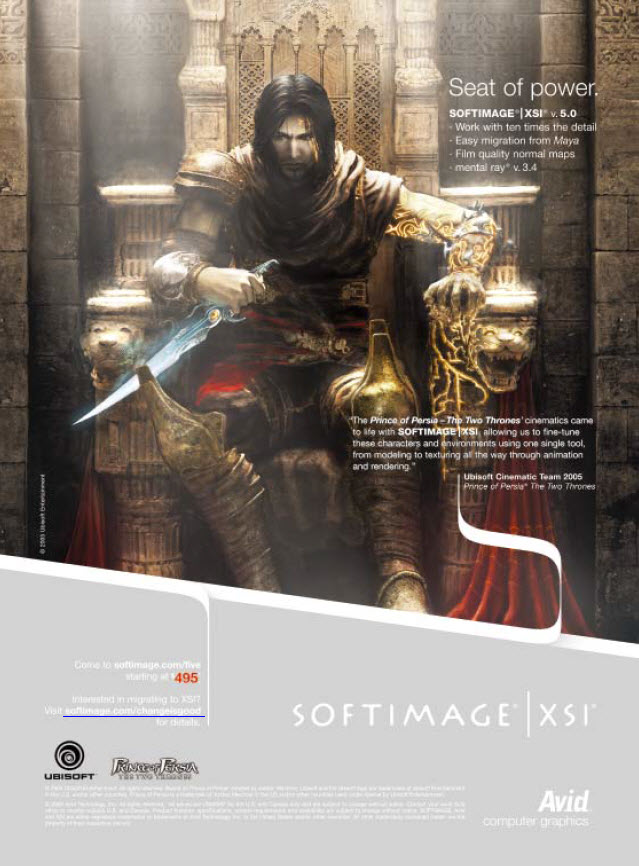
Seat of power.
SOFTIMAGE|XSI 5.0

  • Work with ten times the details
  • Easy migration from Maya
  • File quality normal maps
  • mental ray v.3.4

gdm_nov_2005_XSI_seat_of_power_advert

gdm_nov_2005_XSI_seat_of_power_advertgdm_nov_2005_XSI_seat_of_power_advert

gdm_nov_2005_XSI_seat_of_power_advert2

“The Prince of Persia–The Two Thrones’ cinematics came
to life with SOFTIMAGE|XSI allowing us to fine-tune
these characters and environments using one single tool,
from modeling to texturing all the way through animation
and rendering”

–Ubisoft Cinematic Team 2005

An advert from the November 2005 issue of Game Developer Magazine. I didn’t find it last week because I just did a text search for “Softimage”.

Friday Flashback #245


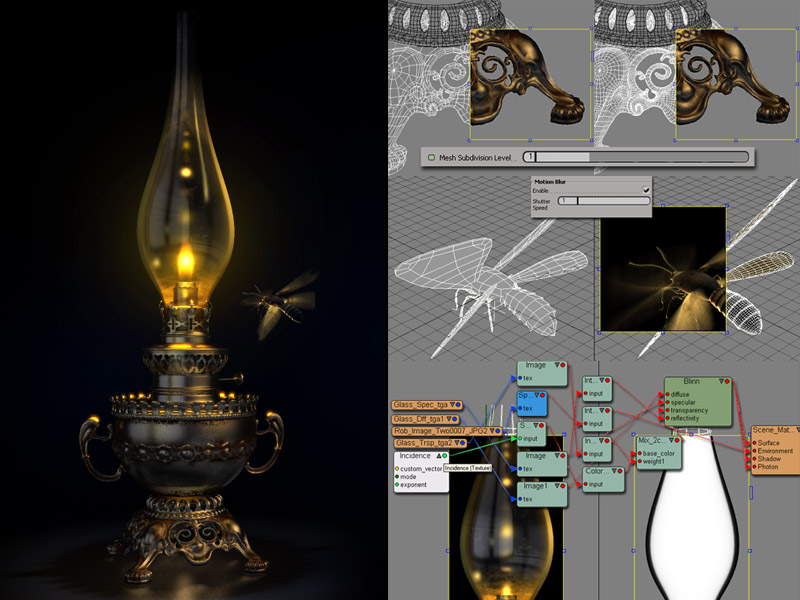
A Sumatra screenshot, source unknown (looks like something from the web site or from a magazine article).
Sumatra0010lg

Update: Top commenter Hirazi found that this screenshot was the “Pick of the Month” from June 2001. Titled “Last Check Point”, it’s the work of Max Evgrafov. Via the wayback machine, we get this description:

The great Italian writer Primo Levi once wrote:

“Loving your work (unfortunately the privilege of a few) represents
the best, most concrete approximation of happiness on earth.”

Like Levi, who worked as a chemist by day and a writer the rest
of the time, XSI guru and June Gallery winner Max Evgrafov
loves his work, even when he’s not on the job.

Currently a hard-working animator in the game development
department of the large Russian company 1c, Evgrafov has
spent the last eight or so months developing levels, animating
CG soldiers and paratroopers, and modeling and texturing
low-res polygonal objects for IL-2 Shturmovik, a high-level
flight simulator that has been in the works for over three years.

It’s pretty nice work if you can get it, but it’s after work that
some of Evgrafov’s best ideas get a chance to shine. His winning
entry, entitled “Last Check Point” and featuring a startling realistic
3D oil lamp and hovering moth, shows just how brightly Max’s
light can shine. “I was introduced to the magical world of 3D
through my architectural studies at university,” says Evgrafov
thoughtfully.

“When I graduated, I found work on a television
channel, before moving on to some advertising
agencies. Eventually, I got to know SOFTIMAGE|3D
and became interested in character animation,
which I worked on for a year and a half.”

He recently picked up SOFTIMAGE|XSI, and has spent a lot of
time exploring its possibilities. Indeed, his enthusiasm and expertise
for XSI seem to extend to nearly every part of the software:
“Firstly, SOFTIMAGE|XSI offers excellent polygonal modeling
capabilities,” says Evgrafov with enthusiastically. “The system
enables me to do some great work with materials and, of course,
render passes. I was frankly amazed by the easy to use XSI
interface. I really like working with it. Also, the Render Tree
offers a vivid and easy instrument for creating materials. It
allows me to create and edit complicated materials with
complicated textures without fear of getting lost. ”

That’s all well and good, but it is the SOFTIMAGE|XSI
animation toolset for which Evgrafov reserves special praise.
“I really like the animation toolset,” he says. “XSI lets me
create layered animations, put them together in the Animation
Mixer, estimate the animation of a single character, and so on.
Put simply, XSI provides convenient features non–stop while
I’m working.”

Put simply, Evgrafov is doing pretty well for somebody claiming
to have a lot to learn. In addition to winning the Softimage.com
XSI Gallery competition for “Last Check Point”, the image
also won an all-Russia computer graphics competition
held by web site http://www.render.ru/.

One thing is certain: this Max Evgrafov’s time to
shine…and he has the 3D light to prove it.

Congratulations, Max!

Friday Flashback #234


Customer story from 2001: Giant Killer Robots and Monkeybone

PAGING DR. FREUD: Giant Killer Robots Give You Nightmares with Monkeybone
by Michael Abraham

CS_GKR_1lg

First off: get your mind out of the gutter. Director Henry Selick’s Monkeybone is not the latest offering from the purveyors of porno out there. Sure, Dr. Freud would have a field day with the title alone, but Monkeybone is actually a light-hearted – if occasionally puerile – love story with a particularly imaginative look at the mysteries of the unconscious. The performances are solid, the story is wonderfully twisted, and the visual effects, created by San Francisco’s Giant Killer Robots with more than a little help from SOFTIMAGE®|XSI™, are nothing short of mind-blowing.

All of this does not detract from the fact that the good doctor, were he still breathing, would probably write yet another book solely about this movie. But I digress.

Monkeybone opens into the blissful life of cartoonist Stu Miley (Brendan Fraser), whose wisecracking, decidedly risqué comic strip features a mischievous monkey who is typically doing something disgusting. The strip is a huge hit, of course, and is about to be turned into a national TV show. Stu is finally ready to propose to Julie (the beautiful Bridget Fonda) but is the victim of a freak accident before he can pop the question.

Lying in a coma, Stu’s spirit ends up in purgatorial Downtown, a nightmarish, carnival landscape populated by mythical gods and creatures that revel in the nightmares of the living. As the nefarious Monkeybone prepares to move from Stu’s psyche into reality using the poor guy’s body to make the trip, Stu realizes that he must outwit none other than Death herself (Whoopi Goldberg in some inspired casting).

The team at Giant Killer Robots was initially approached in early 2000 about contributing a short sequence of shots to the picture, but soon found themselves being awarded an increasing numbers of shots as the movie unfolded. Lead by founders Peter Oberdorfer, Michael Schmitt and John Vegher, each of whom assumed the visual effects lead for different parts of Monkeybone, the project was fully up and running by April 2000.

“We essentially spent the summer working on a very elaborate nightmare sequence involving 18 shots,” says Oberdorfer, the Visual Effects Supervisor who was in charge of texture and lighting on the nightmare sequence, and of animation and compositing of some wild rollercoaster shots. “It also involved a speeding rollercoaster, a ‘brain-eye,’ and a very creepy operating room. After that was complete, we had a brief break from Monkeybone, but were soon called back to do more. I guess we must have done something right.”

“We were provided with creative guidelines for the nightmare sequence, but within those guidelines we were allowed huge flexibility,” says Schmitt, who was Technical Director for tracking, modeling, rendering and final compositing of the Bull bartender shots, which we’ll talk about soon. “They basically said, ‘This is the painting – bring it to life.’ And that’s just what we did.”

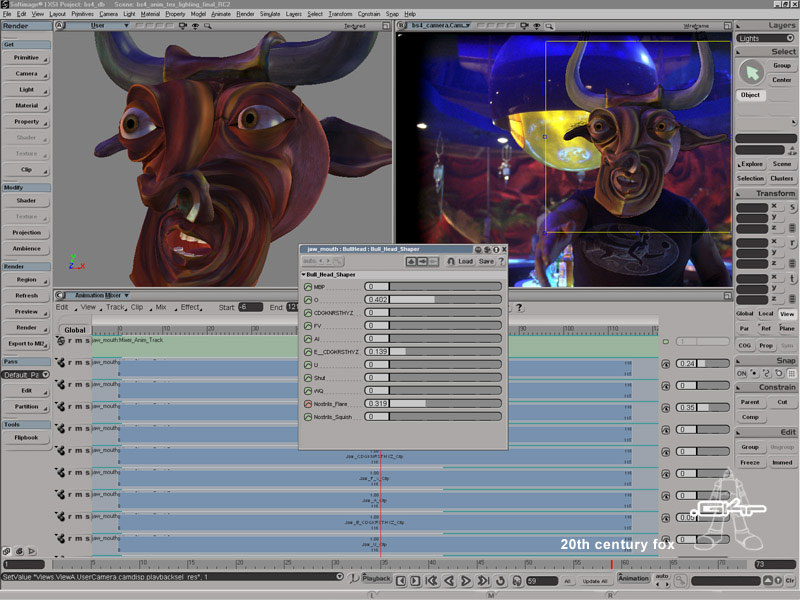
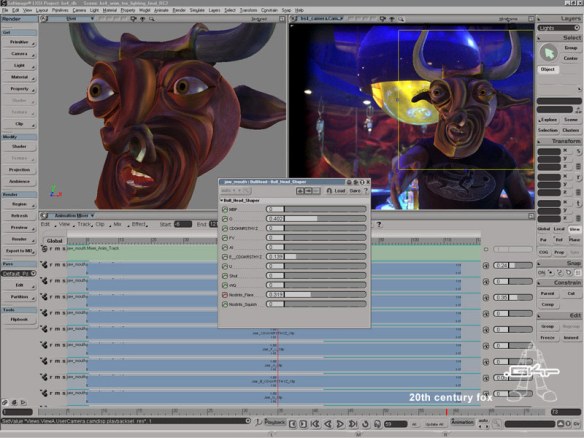
One challenging scene from Downtown involved a curmudgeonly bartender appropriately named Bull. Initially, an actor wore a bull-like animatronic mask in the live-action scene, but Selick didn’t care for the final look. Giant Killer Robots offered a decidedly digital solution.
CS_GKR_2lg

“We erased Bull’s head,” says a casual Vegher, who served as modeling Technical Director and character animator for the shots involving Bull. “We replaced it with a much wilder CG version. There were a great many challenging shots in Monkeybone but, on a per shot basis, this had to have been the toughest one. That was one thing that was really fun about this project. There was a really wide variety of effects being used, so we got to flex our creative muscles. Each shot was a little different from the others, and there were four or five different directions that we had to go in. We used a beta version of SOFTIMAGE|XSI for all the shots we created, then rendered everything in mental ray. By the time we got to modeling, texturing, rendering and animating the Bull mask, we were using SOFTIMAGE|XSI version 1.5.

To simplify the animation and lip synch process, they devised sliders for each phoneme and expression. The sliders worked like the strings of a marionette; each one could be pushed or pulled depending on the desired expression. Of particular help on the Bull mask, according to Oberdorfer, were the new modeling tools in SOFTIMAGE|XSI version 1.5, which allowed them to turn the puppet like mask into a fully expressive CG character.

“SOFTIMAGE|XSI was perfect for what we had to do,” continues Schmitt. “After getting a complete cyber scan of the animatronic mask, we used it as a guideline for creating the new character. We could not have modeled the very intricate mask without XSI’s snap-to-surface tool. The Bull mask took a lot of research and development in all aspects: animation, modeling, rendering, etc. It was a very complex mask and a big challenge. Even with the very high-quality cyber scan, the detail of the mask was pretty rudimentary. We ended up putting the physical mask next to the person doing the modeling that day as a constant reference.”

“We also used the Animation Mixer pretty heavily,” says Vegher. “Being able to create our own custom interface and set up all the phonemes for the mouth and other facial parts was invaluable. Working with animator Jamee Houk, we were able to put together a bunch of shapes developed by Brett Miller and I. Jamee was able to set up a control panel, so that we were working independently, but always referencing the same scene. It made things a lot easier on us.”

Though the Bull mask may have been more complex, the nightmare sequence comprised a full 18 of the eventual 24 shots for which Giant Killer Robots was responsible.

CS_GKR_3lg

CS_GKR_4lg
“The nightmare sequence is really a mini-narrative within the film as a whole,” says Oberdorfer. “It was a shot-by-shot sequence that involved a lot of CG in each shot. That was probably the most difficult task in terms of quantity and in terms of deadline. Even then, we used only SOFTIMAGE|XSI for everything. This was really the perfect project for both using and developing SOFTIMAGE|XSI.”

Friday Flashback #233


Softimage demo reel from 2003

Including Studio 4C, UVPhactory, Liga_01 Computerfilm GmbH, Centre National D’Animation et de Design, Vancouver Film School, Spontaneous Combustion, ILM, Nintendo, Sega, PsyOp, Glassworks, Capcom, Buzz Image Group, Topix, Christophe SCHINCO, la maison, Janimation, Dimension Films, Microsoft Games Studios, Rising Sun Pictures, Konami, Studio AKA, Cinepix, Framestore CFC, So! Animation, wotomoro, and others.

https://vimeo.com/26160509

Friday Flashback #228


ACTOR amazes customers
Softimage introduces the ACTOR module. Setting new standards in character animation.

silicon_graphics_performer_introducing_softimage_actor_module_1992
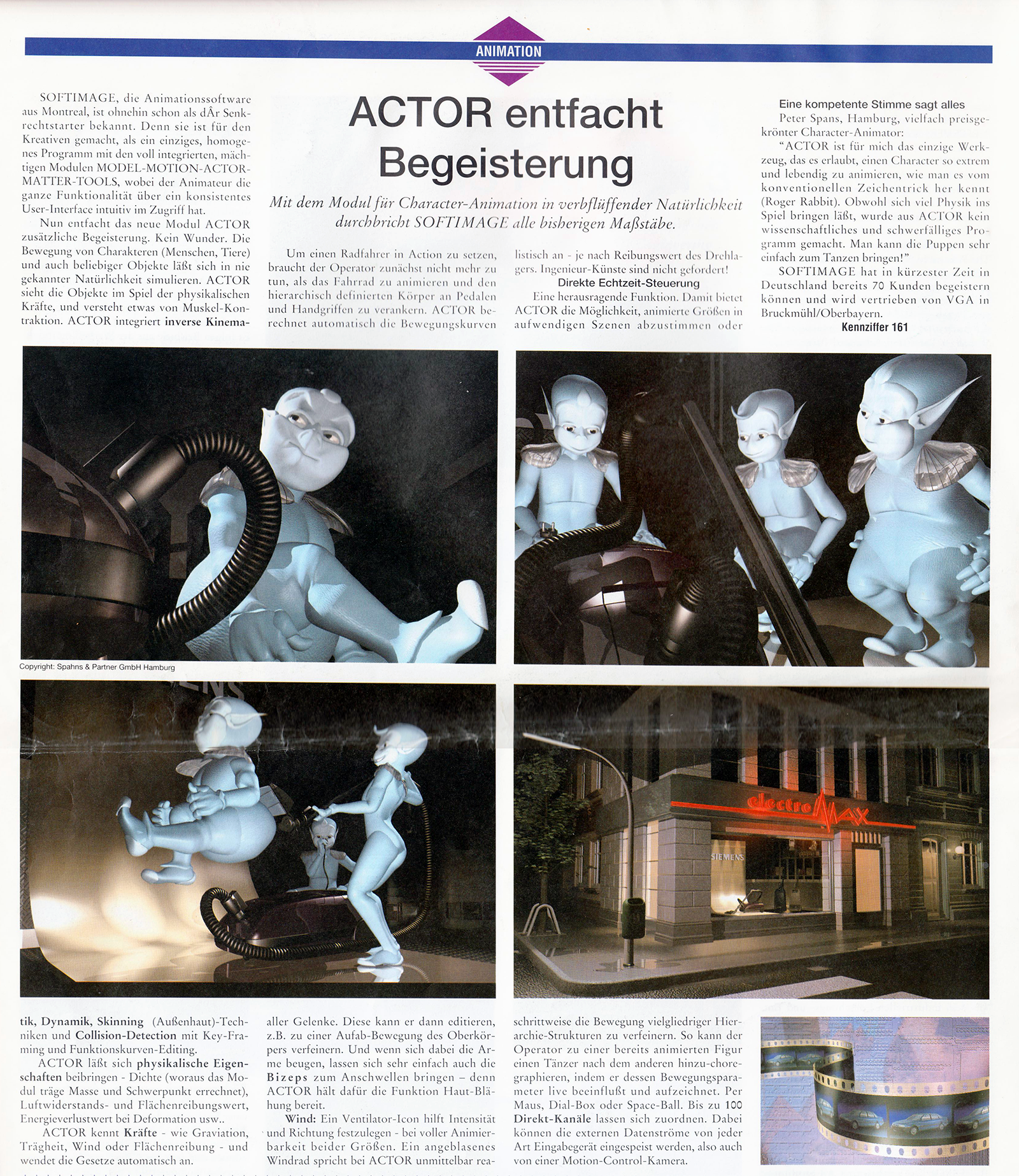
Original article in german from the “Silicon Graphics Performer”magazine for the “CEBIT” Germany. Printed 1992. Translated by S. Constable 2015.

SOFTIMAGE, the animation software from Montreal is already very well known as a kickstarter. The software is targeted to creative artists and comes with fully integrated and powerful modules: MODEL-MOTION-ACTOR-MATTER-TOOLS, that gives the artists full and and consistent control within a single interface.

The new and amazing ACTOR module in Softimage fits perfectly within the other parts of the software.

Animation of characters (humans, animals) as well as any objects is achievable in its natural movement like never seen before. ACTOR lets you play with physical forces and it knows of muscle contraction. ACTOR integrates inverse kinematics, dynamics, skinning (skin-movement) and collision detection. All controllable with keyframing and f-curve editing. ACTOR is aware of physical values like gravity, inertia, wind or friction – and can handle these automatically.

To give life to a bicycler the operator just have to animate the bicycle and constrain the characters hands and feet to the handles and pedals. The ACTOR module computes the movement of the entire body and its joints. It computes f-curves which are editable. To add up or down movement to the body. If the character arms bend, it gives control to muscle deformation as well.

Wind: Intensity and direction is controllable with an icon independantly and it is fully animatable. A wind wheel will react realistically to that forces, dependent on its friction. No need for a physics lesson!

Direct realtime control: An outstanding feature. ACTOR allows to adjust the motion of complex hierarchies easily. The operator can add additional motion to an already animated character with realtime control. It will be automatically saved and also allows fine control after recording. Via mouse, space-ball or dial-box. Up to 100 channels are possible even with additional external devices like a motion control camera.

Customer reaction
Peter Spans, Hamburg, Award winning character animator:

“ACTOR is the only tool that allows to animate characters with so much life, like you could do in traditional cell animation (Roger Rabbit). Even physics can be used, ACTOR isn’t a scientific and clumsy tool. You can make the puppets dance very easily!”

siemans_aliens_spans_and_partner
Siemens: Aliens In a computer-generated world, these aliens are beamed down outside a shop called ‘ElectroMax,’ where they admire the Siemens vacuum cleaner in the window and jump through the glass, onto the window display. Shown at the SIGGRAPH ’92 Chicago Electronic Theater

SOFTIMAGE has 70 customers in germany already and is distributed by VGA in Bruckmühl/Bavaria.