TOTALLY TWISTED: SOFTIMAGE®|3D AND THE MILL HELP TURN THINGS AROUND FOR LEVI’S By Michael Abraham
Ever get the feeling that you and your significant other just aren’t seeing eye-to-eye? Wouldn’t life be great if she (or he) would come around to your way of thinking, instead of persisting with her (or his) totally twisted take on the world? Wouldn’t the sun shine brighter, the wine seem drier, and the food taste spicier if those we love would just learn to think as we do? Wouldn’t it?
Happily, the answer – as implied by an innovative new spot for Levi’s – is a big “No!” Indeed, the 60-second “Twist”– the collaborative artistry of ad agency Bartle Bogle Hegarty(BBH), director Frank Budgen of Gorgeous Productions (London, UK) and the tremendous effects work of The Mill (also of London) – embraces diversity and spontaneity just as lovingly as a brand new pair of Levi’s Engineered Jeans. According to the spot, the new cut of denim is quite literally “Twisted to Fit,” as the tagline goes, combining traditional Levi’s detail with higher-performance fabric and a twisted side-seam that will apparently hug your booty like an intimate friend while allowing you to twist and shout with a bunch of strangers.
Shot in the outskirts of Cape Town, South Africa, “Twist” brings a car full of remarkably limber young people to a roadside restaurant. A comely young woman rebels against the crowded confines of the backseat by stretching her long legs well beyond the natural limitations of bone and muscle. As miraculous as her contortion appears, it proves to be only the beginning.
Encountering a locked rest room door, one of the male passengers takes advantage of a supple young woman emerging from the ladies’ room. With a little creative twisting, the young man trades the young woman’s head for his own and promptly takes advantage of the available facilities. Featuring music by famed dance trio Pepe Deluxe, “Twisted” makes ample use of passionate imagination and some of the best effects the commercial world is likely to see.
“Ultimately, ‘Twisted’ was making unnaturally stretching and morphing limbs appear natural,” says Russell Tickner, Senior Animator at The Mill. “Although mainly a compositing job, there were a couple of pretty complicated 3D shots in ‘Twisted’ with which SOFTIMAGE|3Dv.3.9 really helped us out.”
A 3D designer and animator for over thirteen years and a six-year veteran user of SOFTIMAGE|3D, Tickner’s background includes architecture, graphics and multimedia work for projects such as Lost In Space and the always-interesting Bjork’s album “Homogenic.” Since joining The Mill as a freelancer, he has worked on a plethora of 3D intensive commercials, including Lincoln, New York Life, Daewoo, and Evian, and is creating effects shots with sister-company Mill Film for Simon West’s upcoming feature Tomb Raider. “Twisted” provided Tickner with some significant 3D challenges.
“I had to make various kinds of limbs and heads that were very closely modeled on the live action,” says Tickner. “We have an in-house texturing tool that allows us to take a 3D model and rotoscope it from the camera’s point-of-view. Once the live action material is added, you have a certain degree of extra movement that lets us move things around 15 degrees in each direction without seeing any distortion in the texture map. That way, we are able to make our 2D characters sort of appear to be 3D.”
For the scene in which the bathroom-bound man twists and then removes his own head, Tickner was provided with a live action scene in which an actor holding his head and moves his head as far as it would go to either side. The rest was up to the 3D artist.
“The scene required that this guy lift his head approximately four inches off his shoulders,” say Tickner with a smile. “Obviously, you can’t do that naturally. It involved some interesting rotoscoping, texturing and lighting to ensure that things matched the live action. They shot the entire spot in an extremely soft grade which is probably the most difficult type of lighting to match with 3D elements. Invariably, 3D has a vaguely plastic look, with high contrasts between darks and lights. When we held the 3D up against this very well-exposed live action footage, the look just wasn’t right.”
To solve the problem, Tickner went straight to the fully-integrated rendering wonder that is mental ray ®. “The latest version of mental ray has a great feature called Final Gathering,” explains Tickner. “It basically helps to light a scene based on information from texture maps. What I did was create a mock-up of the scene using the live action footage and texture maps, and then used that as my Final Gathering light source. So, all the lighting that landed on my various limb and head models was based on the actual, physical set. Rather than using point light sources and area lights to try and simulate the proper light, we were able to very quickly replicate the light in the scene. That really made such a huge difference to the spot’s natural look.”
Referring to the use of the newest version of mental ray as “vital” to the spot’s success, Tickner was also able to cut down on much of the color grading performed by the compositing artists.
“They did a little bit of color grading, just to polish things,” says Tickner. “The whole commercial was then played back out to film, then brought back into the Telecine where it was given its final, more polished grade. The fact that we used the very soft technical grade to match the 3D elements was very different from our normal procedure.”
In the end, Tickner can’t say enough about The Mill’s commitment to mental ray and SOFTIMAGE|3D. “Using mental ray in SOFTIMAGE|3D was one of the nicest parts of this job,” he says emphatically. “The reason we’re so committed to mental ray at The Mill is that we have the best directors in the world bringing in some of their best live action footage shot by the best DPs and graded by the best Telecine artists. With this top quality footage, we really need to provide the very best CG and 3D stuff possible. mental ray gives us that extra level of rendered image that we need to do the best quality work.”
Macross Frontier The Movie is a completely new work based on the TV series but with a new composition. Following the first part ~ Ituwari no Utahime ~ released in November 2009, the second part of the two-part work “Macross Frontier The Movie ~ Goodbye No Tsubasa ~ “was finally released in February 2011. In the final edition, Goodbye No Tsubasa, the fierce battle between the variable fighter Valkyrie and the space creature Vajra will also enter the final battle. And finally, the conclusion is reached on the whereabouts of the love triangle between the main character Alto, the two diva Cheryl, and Ranka.
This article contains making information about the specific cuts contained in the work. Please be careful if you are going to see the work from now on.
Pursuit of quality unique to the movie version
The movie Macross F CG production uses all Autodesk 3D animation products, Softimage, Maya, 3ds Max, and MotionBuilder. Therefore, we asked Mr. Yagishita of Satellite Co., Ltd., who was in charge of video production, about the 3DCG expression in Macross Frontier The Movie. Mr. Yagishita is involved in the production of the series from the TV version Macross F as a senior director of CGI. In the latest work, “Macross Frontier The Movie -Goodbye Tsubasa-“, he was in charge The CG production unit consisting of three teams.
The CG production of Goodbye Tsubasa is carried out by the following three teams.
Opening Church Live: Color Co., Ltd./GEMBA Co., Ltd. is in charge First
half Combat: Graphinica Co., Ltd. is in charge
Lanka Live and Final Battle: Satellite Unit of Satellite Co., Ltd. is in charge
UnknownCASE Co., Ltd. who participated in the production as a satellite unit in this interview Mr. Kashima and Mr. Sakiyama also attended. Mr. Kashima is In producing the movie version of CG, it was a proposition to pursue quality that could not be achieved . And Mr. Sakiyama is in charge of animation and layout direction as a CG animation director.
With the TV version. For this reason, high-quality CG production is being carried out in total for the work, from the creation of battle scenes to the production of live scenes.It can be said that the movie version is also characterized by incorporating rich expressions such as destructive expressions, fluids, and crowd simulations.
Destructive representation using Momentum, Softimage’s Bullet Physics plugin.
Pre-production
Goodbye Tsubasa pre-production work began in early summer 2010. Before starting this production, technical verification is being conducted on how to improve the texture of the sea of clouds and smoke. Also, as of July, satellites are producing music clips that incorporate crowd simulation. It is said that technical research on crowd expression was also conducted based on the points of reflection here.
During the preparation period, efforts are being made to improve work efficiency and unify quality. For example, notes to make Valkyrie’s pose look beautiful have been prepared as instructions for 3D data. In addition, Mr. Sakiyama has prepared various work guidelines such as camera angle of view, lens aperture presets, and camera angles that make the model look good. These data were distributed to each company newly participating in the project. In this way, after effectively unifying the consciousness in advance, the transition to this production was carried out with a perfect system. This production of CGI cuts lasts about four months from October 2010 to January 2011, and the total number of CGI cuts is over 500. About 80 CG artists were involved in the production of the entire project.
Fusion of drawing and CG
At the start of video production, when the storyboard materials are ready, director Kawamori will take the lead in directing meetings with the director, drawing staff, and CG staff. Here, we will discuss whether to make the cut by drawing or by CG. Then, after considering the merits and demerits of both drawing and CG, the work separation and work order will be decided.
For cuts that require 3D camera work, the CG team first creates the layout and then draws. On the contrary, in the cut where 2D expression is the main, the CG is matched with the layout of the drawing team. At satellites, we have been involved in many fusions of drawing and CG. For this reason, it is said that there is a soil in which each person in charge can smoothly proceed with the work while taking the lead from each other. Since there is know-how to prevent the difference between the expressions of the CG part and the drawing part, it is said that the satellite’s strength is that it can respond flexibly even to cuts that are difficult to express.
As explained in the making of the live scene described later, there are cuts that express characters such as Cheryl and Ranka in 3D. When using 3D expressions for characters, it is basically not done to mix drawing characters and 3D characters in the same cut. This is to avoid losing the balance between quality and cost by mixing them. Exceptionally, it is said that there are scenes where the body of the mecha is 3D and the arm to the tip is a hybrid expression such as drawing.
In one scene of the movie, a cut appears in which the camera slowly wraps around the crouched Lanka. Camera work that wraps around slowly is considered taboo in animation because the video is distorted and the picture tends to collapse. In that case, you might think that it is better to create characters entirely in 3DCG. However, modeling costumes for limited shots and reproducing natural fabrics in 3D can be very costly. Therefore, in this scene, rendering with a simple 3D model is performed once. Then, the drawing work is done while using the CG image as a guide. By doing this, it is said that even slow camera work expresses natural movement without failure. The production is proceeding while carefully considering the merits and costs of 3D and drawing.
Trajectory of artistic missiles released from Valkyrie
Valkyrie’s 3D data is gradually approaching completion by making many changes by catching the design after making Kawamori’s sketch in 3D. This work is done by a dedicated person from modeling to UV setting using 3ds Max.
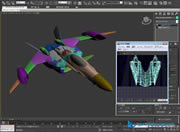
Vajra also modeled by 3ds Max
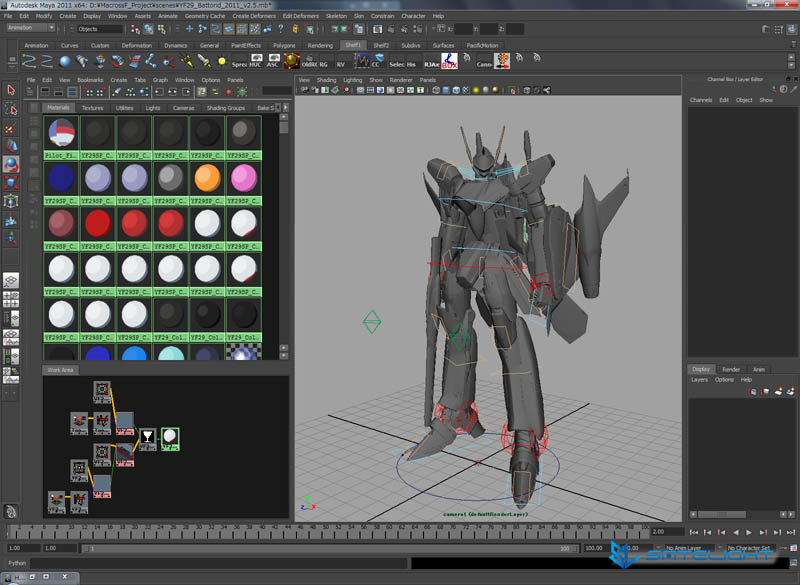
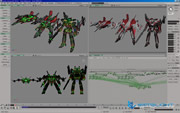
The completed model data will be exported to Softimage and Maya and used in the shots in charge of each team. Valkyrie appearing in the work has data for Softimage, Maya, 3ds Max even if it is the same aircraft. Video production is carried out using Autodesk products that each person in charge is good at. Depending on the cut, camera work created in Softimage was imported into Maya in FBX format for work, and layouts and animations created in Maya were imported into 3ds Max.
YF-29 loaded into Softimage and Maya.
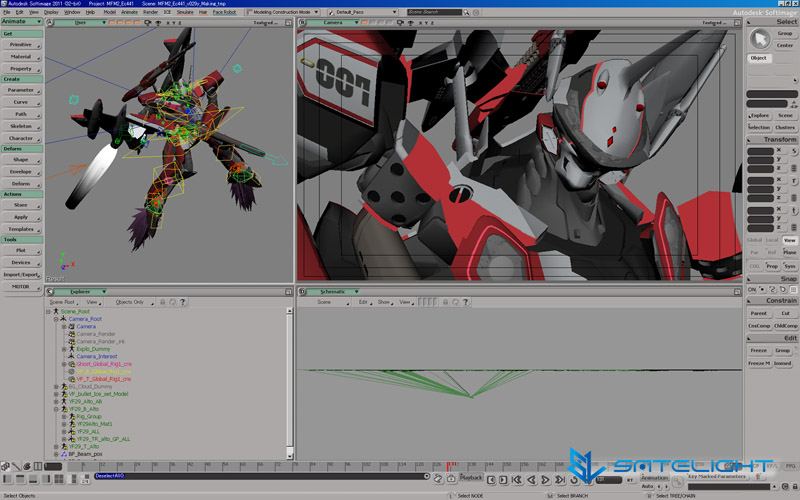
Softimage rig setup screen. Fighter, gawalk, and batroid rigs were prepared for each software
So how was the subtle difference in rendering texture between different software unified?
First, the base color, highlight, outline, shadow, and ambient occlusion material were output from each software. The solution was achieved by sharing the basic composite network that Mr. Kashima built for these materials. In other words, even if the software used in the same cut is different, the subtle differences in rendering texture are automatically absorbed by the composite process.
Valkyrie with a new 2.5D texture, which is different from toon and photoreal, is expressed in this way. The project was able to proceed smoothly by establishing an environment where multiple Autodesk products can be used together.
In the battle scene, the 3DCG team takes the lead in deciding the action composition and layout. In the battle scene, he seems to be pursuing images that take advantage of the dynamics unique to 3D, which specializes in expressions such as depth, wraparound, and atmosphere.
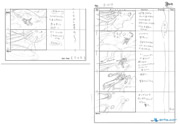
In the production of battle scenes, first, animatics images are created based on storyboards. For cuts with complex actions, draw on paper, put together ideas, and then start animatic work. This is because the analog method of drawing on paper is superior in the initial action when comparing cuts and considering replacement. Then, the action composition is solidified while checking the completed test video with the deputy director and the director. The final check by Director Kawamori is performed as a series of sequences that combine the rendered video and the song.
Based on Kawamori’s storyboard, Mr. Sakiyama reworked the 9-second action composition.
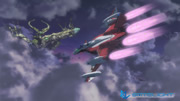
Many people think of the Macross series as a beautiful missile trajectory. Three methods are used for each scene in the trajectory of smoke-generating missiles.
A type that uses the missile itself as an emitter to generate particles
A type that allows vertically generated particles to follow the path
Completely hand-painted type
A missile that emits light from the trajectory of the beam, not smoke, is represented by a tube along the path of the curve. It is said that the 3DCG team is also digitally drawing the completely hand-painted smoke and beams.
Animation expression peculiar to Japan
Macross F’s CG animation inherits Japanese-specific animation expressions such as tame and claw. For example, it is an exaggerated expression that when an object crosses in front of the camera, it moves the object a little slowly, when it moves to the back, it rapidly increases its speed, and when it moves far away, it moves slowly.
The paintings are made with attention not only to the movement but also to the angle of view of the camera. On the same screen, the object in the foreground is drawn with a wide-angle lens, and the object in the back is drawn with a telephoto lens. This expresses a perspective that emphasizes the depth peculiar to Macross.
In outer space, in order to create a feeling of weightlessness, it seems that they are consciously adding camera rolls, daringly arranging layouts and enemies upside down and lighting from below.
Mr. Sakiyama is said to have been interviewing at an air show in advance with the staff in order to give reality to the flight scene of the fighter. It is important to feel the power of the real thing and the atmosphere of the site and to output the experience to the work through your own filter in order to create a better work. In order to give a sense of urgency to the camera animation of the battle scene, the movement of the camera is kept in mind as if the cameraman actually shoots while flying in the battle space. Inexperienced CG animators tend to add schedule-harmonious animations that fit too much on the screen. It is said that a good animation will be created only when the actual experience, the feelings of the shooting cameraman, the feelings of the character himself, and the aspect as a director who calmly judges the situation are all balanced.
In the battle depiction in the atmosphere, the symbolic expression by the concentrated line is not used, but the airflow material is used to express the sense of speed.
According to Mr. Yagishita, it is the unique sensibilities of Japanese people that robots have the sensation of finding personality and character. Even a robot like a Battroid with no facial expressions expresses emotions in terms of how to put in the power of the hands, the direction of the face, and the standing figure, expressing Valkyrie’s character.
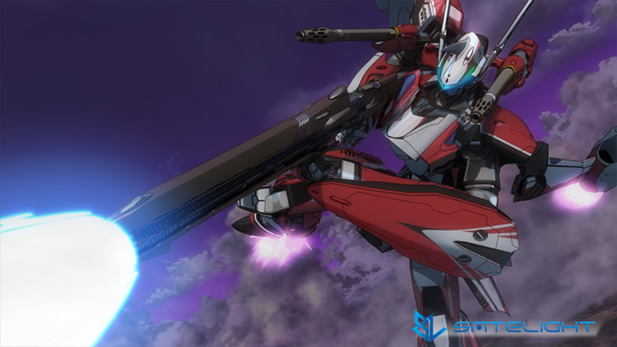
Japanese limited animation has advanced layout and cutting technology in order to maximize the expression within the constraints of the number of cells. However, if the number of 3DCG is limited in order to bring it closer to the limited animation, the sense of speed unique to Valkyrie will be lost. Therefore, Valkyrie’s animation is visualized in full frame in cuts where action and camera work are intense.
While inheriting the animation peculiar to Japan by exaggerated expression, the goodness of CG is utilized in the part that could not be expressed due to restrictions so far. Mr. Yagishita, Mr. Kashima, and Mr. Sakiyama all said that it is their important task to pass on the know-how of animation unique to Japan, which is not cartoon, to young staff.
3D representation in live scenes and backgrounds
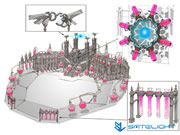
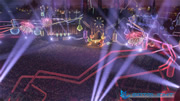
At the opening of the work, Cheryl’s church live will be unfolded with a masterpiece of video expression. The dance of multiple characters and the expression of the crowd were taboo productions in traditional cel animation. However, in this work, 3DCG is used in such situations to achieve a new visual expression.
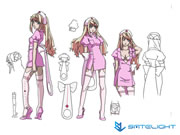
Motion capture technology is used in the dance scene. In shooting, a live-action reference video is also shot at the same time as the capture data is recorded. First, the dance cut split editing was performed using this live-action material. Once the cut split was decided, the capture data was retargeted and the animation was processed using MotionBuilder. In this way, a powerful dance scene in which multiple characters appeared was created. In addition, it is said that the shaking of Cheryl’s hair was also calculated automatically by the simulation function of MotionBuilder.
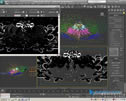
MotionBuilder data loaded into Maya
Background material and Cheryl setting material
The excitement of the audience is not a traditional still picture, but a crowd simulation by Massive.
Even on the live stage of Fairy Lanka, some cuts are animated by 3D characters. Initially, this cut was planned to be done by drawing, but due to the good quality of the animatics produced in 3D, it was decided to compose it with a full 3D character. 3D is also used for effects on live stages.
Moreover, when the camera work changes drastically, it is difficult to create a background with a huge amount of information in art. Therefore, it is said that most of the background in the work was produced in 3D.
From the left, 3D background, background effect, and background setting material.
From the left, 3D background, background effect, and background setting material.
He also used Google Earth to perform virtual location scouting in order to give reality to the process of approaching the mountain ranges on the surface of the earth from outer space. The production is done after careful research on the distance between the ground and clouds, the altitude of the horizon, and the size of the 15km space fleet.
Maya renders the background material in the cut where Valkyrie penetrates the sea of clouds.
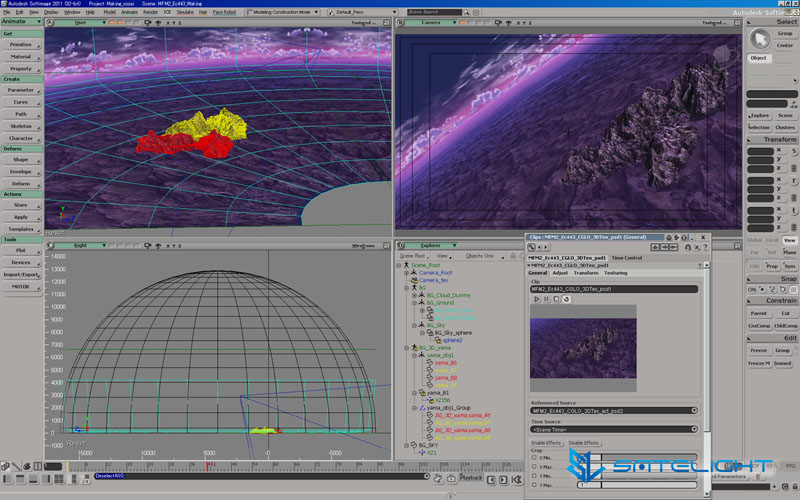
Background production with Softimage that is conscious of altitude and scale.
The rendered Valkyrie, character, and background materials will be temporarily composited by the CG team. The composite data is submitted to the shooting team after the CG team sets the atmosphere, familiarization processing, and motion blur effect to some extent. Finally, the shooting team makes composite adjustments for all materials, including drawing. In this way, the video in which the timing synchronization with the inserted song is precisely calculated is completed.
The movie version of Macross F is a dense work that is not an exaggeration to say that it is a single work with only each part such as battle scenes and live scenes. Even if you shift your eyes to a part different from the main production, it can be said that the fun like a circus with play studded in the small parts is a big attraction. Every time I review it, I’m sure there will be new discoveries.
Finally
In this project, using all Autodesk 3DCG products had the advantage of being able to take advantage of their respective areas of expertise. Multiple choices such as Softimage’s ICE and non-destructive, Maya’s fluid representation, 3ds Max’s rich plug-ins, and MotionBuilder’s real-time nature have made it possible to solve problems flexibly even on tight schedules.
Satellite will continue to actively consider workflows to maximize the advantages of each software. Mr. Yagishita strongly talked about future satellite efforts to accept the goodness of Japanese animation and to present new expressions centered on 3D that are not bound by that frame.
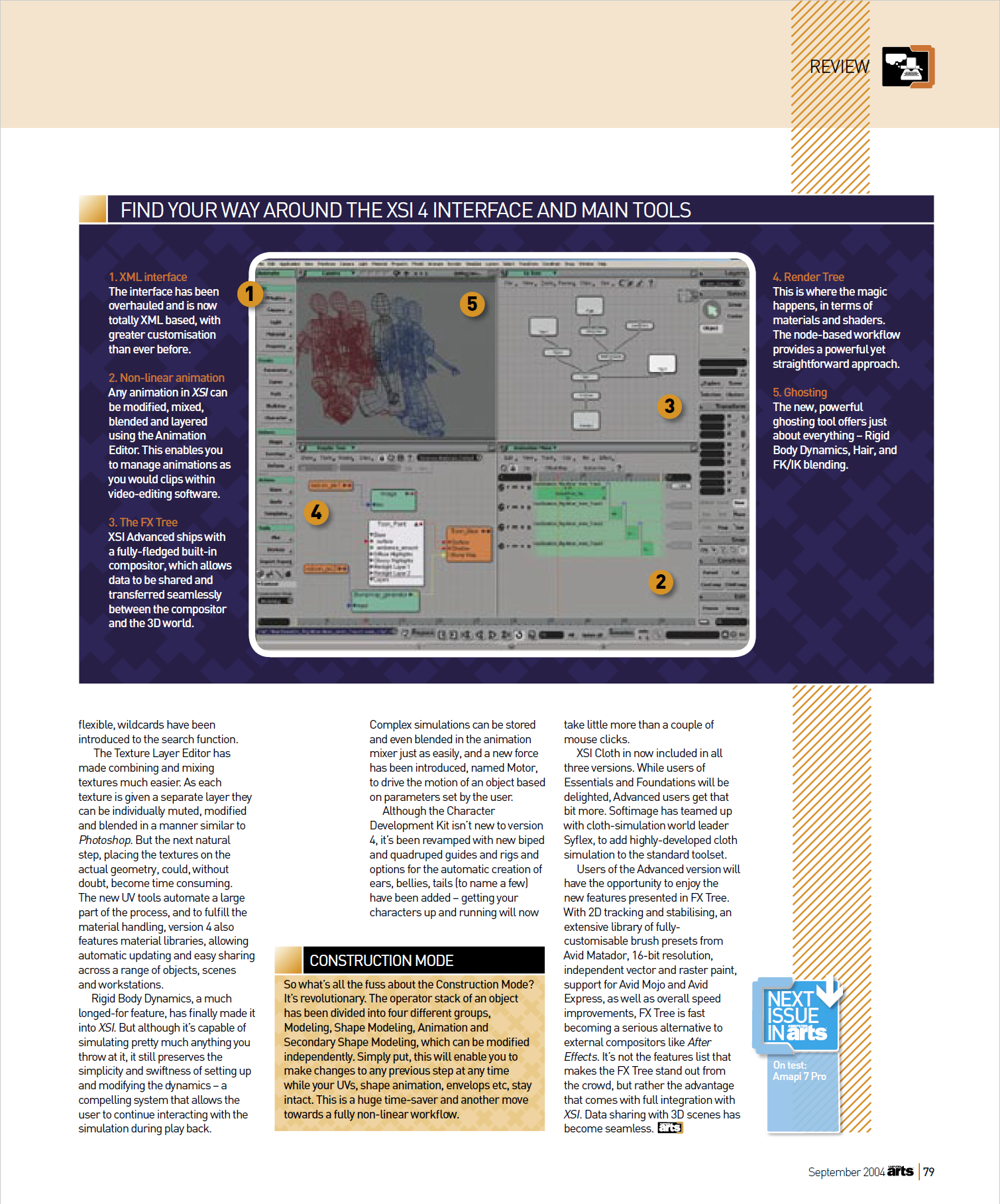
Softimage XSI 4 — with a prominent price cut, Rigid Body Dynamics, Syflex cloth, Construction Modes, and a 400-page New Features manual, it looks like Santa’s come early




















 eX-SI
eX-SI 