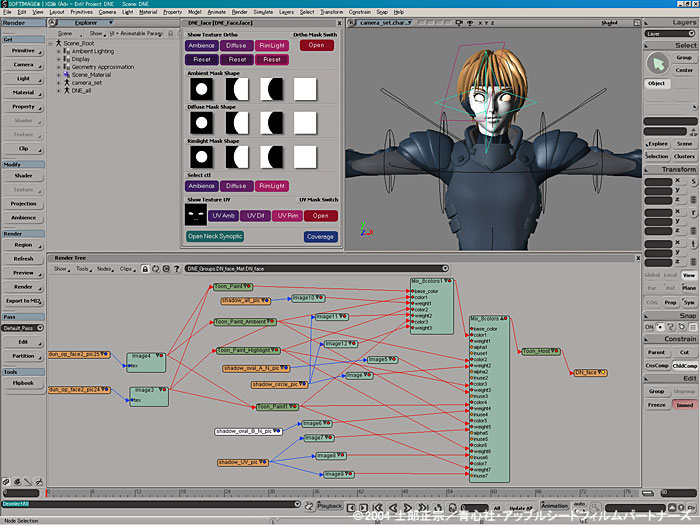
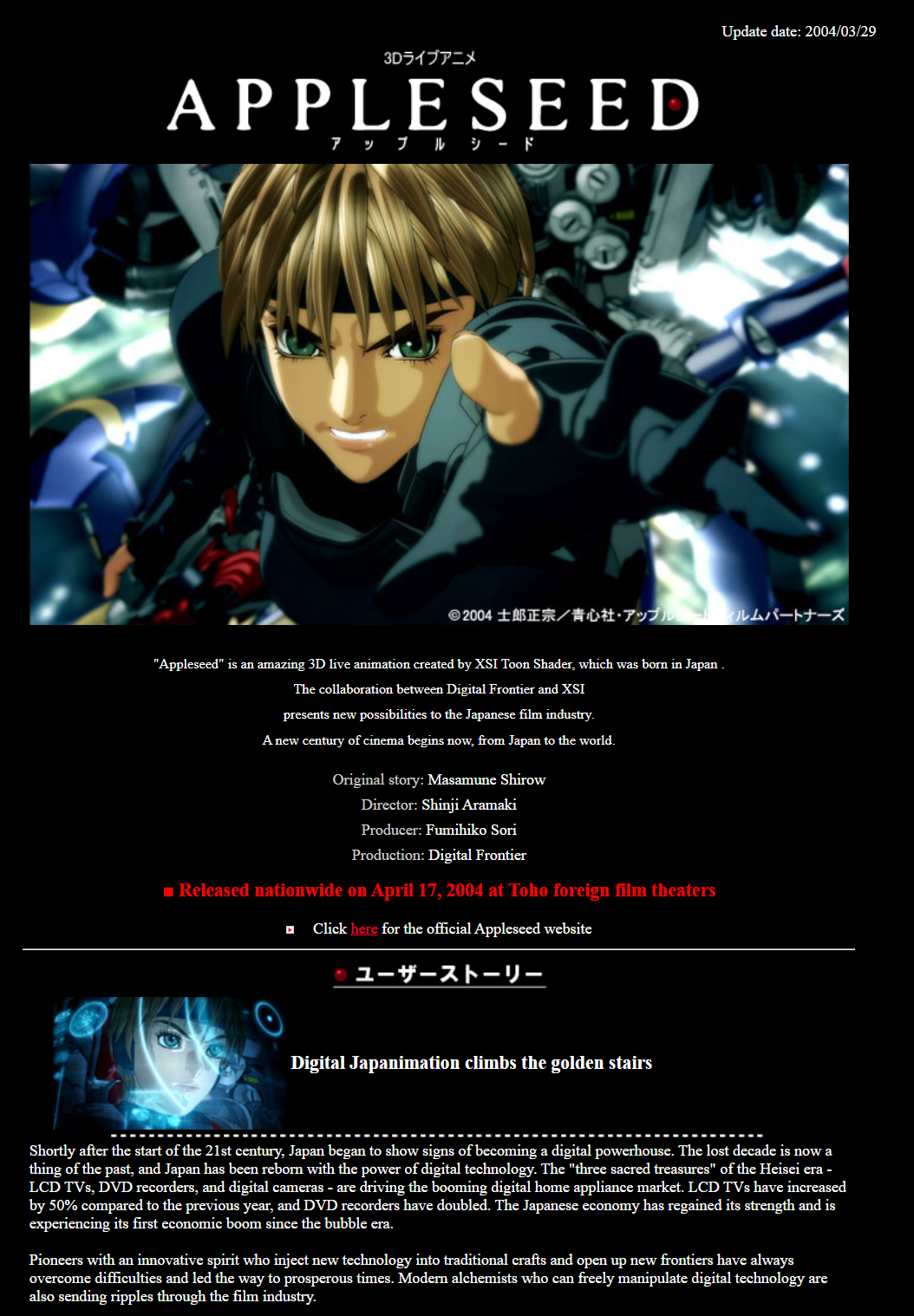
“Appleseed” is an amazing 3D live animation created by XSI Toon Shader, which was born in Japan . The collaboration between Digital Frontier and XSI presents new possibilities to the Japanese film industry. A new century of cinema begins now, from Japan to the world. Original story: Masamune Shirow Director: Shinji Aramaki Producer: Fumihiko Sori Production: Digital Frontier ■ Released nationwide on April 17, 2004 at Toho foreign film theaters
Here’s the user story from softimage.jp (retrieved from the waybackmachine, and google translated to English):
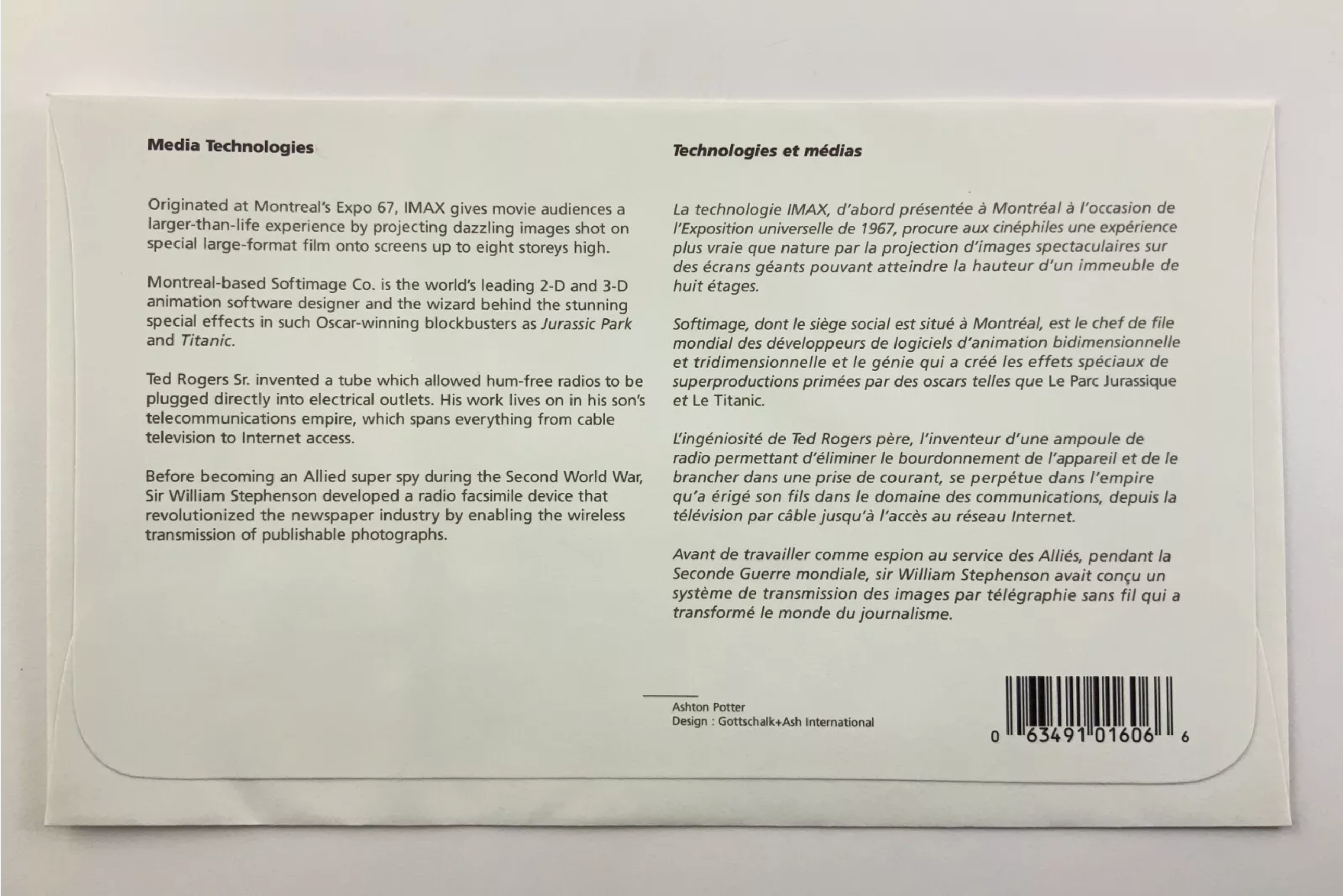
Due to popular demand, Canada Post released the 68 specially designed stamps as a series of 17 Millennium souvenir sheets from December 17, 1999 to March 17, 2000 each depicting four different stamps.
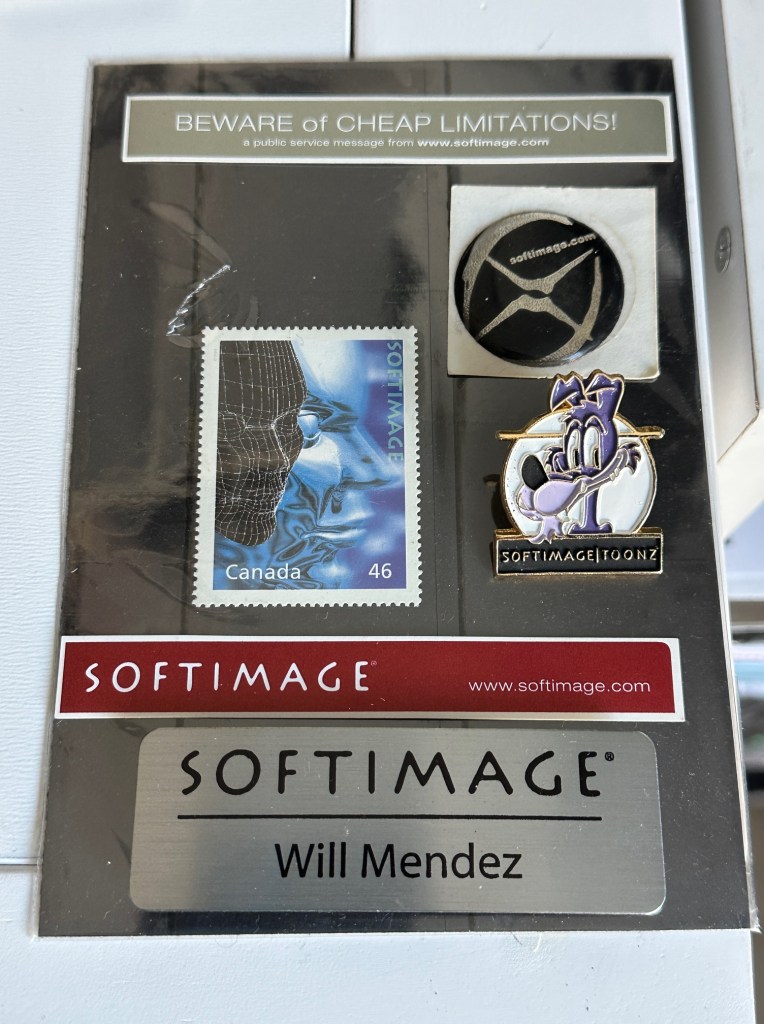
The Media Technologies series included Softimage: From the Computer Age to the Dinosaur Age
Andrew, could you please introduce yourself to our readers and tell us about your background, where you work and what your daily tasks are?I graduated from Nottingham in Fine Art in 2001, were I began my course as a painter. During my second year I went to see the multimedia show onedotzero at the ICA and was amazed at the possibilities and diversites in computer animation and digital effects, to me it offers the same freedoms as painting, in that you start form blank canvas and create a world within the frame of the image. I currently work at The Mill doing 3d animation for commercials and music promos. As for daily tasks I don’t really have any. Every job throws up different challenges.
Please tell us what lead you to CGI animation? Why do you find it more interesting over other CGI fields? My role at in Mill3D is a bit of an all rounder, in fact we all are. Because we work in small, close teams and not on massive feature length projects you have to be able to deal with anything that’s thrown your way, it really keeps you on your toes.
Which is your favorite animation software and which one did you find the easiest to learn? I use SOFTIMAGE|XSI now, I think it’s got some great tools, but it’s the speed of the Softimage workflow that makes it as usable as an artist, and it’s very intuitive. I don’t really use much other software other than Photoshop and AfterEffects, which are both essentials.
Tell us how it is to work with Mill in general and how important the animator’s role is in the production process at Mill.The Mill is a fantastic company. There’s a great sense of team effort on all the jobs we do. As the 3d team we have a very important role, we are supplying elements to a job that we have to make from scratch and is as important as the film neg that comes in from the shoots. This means that we get involved in jobs right from the start, often attending the shoot and being involved in pre-production and the creative process.
How difficult was it to go from being a runner at Mill to becoming a full-blown animator?
For me it wasn’t too much of a struggle moving on from being a runner. The Mill is very keen for new people to come through and everyone in Mill3D was really helpful with giving me time to train and setting me projects of my own to do. Nobody expects you to be a runner for ever, and if you work hard and train and have lots of enthusiasm then there are some great opportunities.
What was your role in the creation of the latest O2 advert (Digital Music Player)?
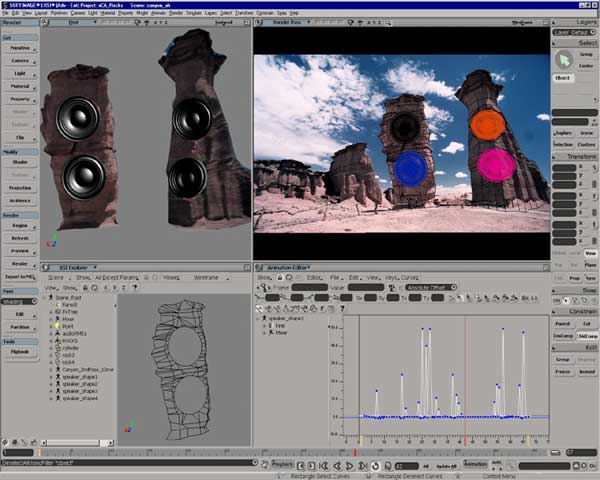
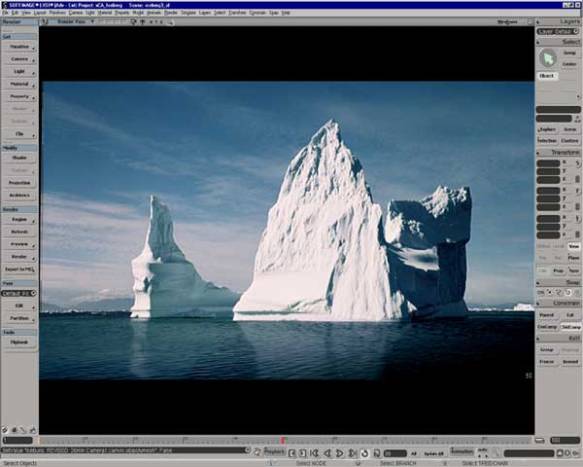
I was involved in most of the shots where speakers were integrated into the environment, such as the iceberg and the roof top. It was our job to design and develop the look of what these things would be, taking them from there pencil drawn storyboard state to the final shot.
And again, what role did you play in the production process of the Mercedes advert, that in the end brought you the “Boards” award?
I worked on all of the car shots, animating motion trails, constructing the environments that the cars were in. I also did the motion trails on the diver and helped with the fencer shots.
The teamwork among animators and the animation supervisor can be tricky and problematic, how does it work in Mill? If you are using different software how do you bring all the work together on the production stage?
There aren’t any problems working with the supervisors, in fact the not even called that, there just members of the team. Russell Tickner was the lead animator and effects supervisor on Mercedes. He’s very open to ideas and letting animators take control of there shots and making them there own. As for software, we have a really good setup and renderfarm that renders everything through Mental Ray. That is our most important tool, it doesn’t matter if you’re using XSI or Maya, and it’s the quality of the final image that is paramount. The software you used to get there is not important.How important receiving the ‘Boards’ Award was for you? Could you tell what this award means to an animator producing commercials?
It feels really great to receive the award, it was a huge surprise. Now I’ve got to maintain the same standards and keep making good work.
What do you think about the work of the other two finalists in the ‘Animators’ category – Justin Harder and Michael Overbeck?I’d never seen there work before so it was great to see. I thought that both of them had really cool styles and I think that the variety of the work in this category shows just how diverse and exciting animation is.Tell us about your plans for the future. Are you going to continue with the commercial animation or do you have plans to produce something on your own?I definitely have plans to do my own work, I try to keep little ideas on the go all the time. But I enjoy commercials so much and am constantly being challenged with new and exciting projects. I look forward to every new job. And I know there will be many more great projects to work on in the future.
How do you feel when, while watching TV, you run into one of your own commercials that you’ve been working on for weeks or months?You never get tired of seeing your work on air when it’s something you’re especially proud of. I know I love to watch “mercedes movement”, I always see something new in it. And it’s great to get a reaction from someone who hasn’t work on it and looks at it in a completely different way from you, unaware of where the effects overlap with reality.
What is your source of motivation? Where do you go for inspiration?I get most of my inspiration from films and great directors. People like Chris Cunningham have had a huge influence me. Kubrick, Scorcese, Hitchcock, the list goes on. But generally just from popular culture, TV, books, magazines. You can’t help getting inspiration from the world around you.
If anyone could fix the existing tools (software-wise) or create a new tool especially for you, what would it be? A make this look good button would be especially useful.
Your favourite animation technique? Do you find it the most effective? Don’t have a favourite animation technique. I think it’s silly to categorize animation. Animation can be about problem solving to get ideas across to the viewer in the most exciting and interesting way possible. Often mixing different styles of animation gets the bests results. For me if I know something can be done in 2D better then that’s how I want it to be done and am not precious about being purely 3D.
What would your advice be to all those who want to follow in your footsteps and become animators? Experiment like crazy. Don’t be afraid to try new things, often its accidents that produce the most exciting work. Also don’t worry about the technical aspects of the industry or the specifics of learning one 3D package over another. Also don’t be afraid to do a bit of running. I know loads of people that said they’d never run and were too well qualified but they are still nowhere. It gives you a great incite into the company and the industry in general, and you have a good laugh at the same time. Thank you, Andrew, for your time and patience with answering these questions, we wish you all the best with your work and good luck. Also, all of us at Render Node would like to congratulate you on the ‘Boards’ award, well done!.
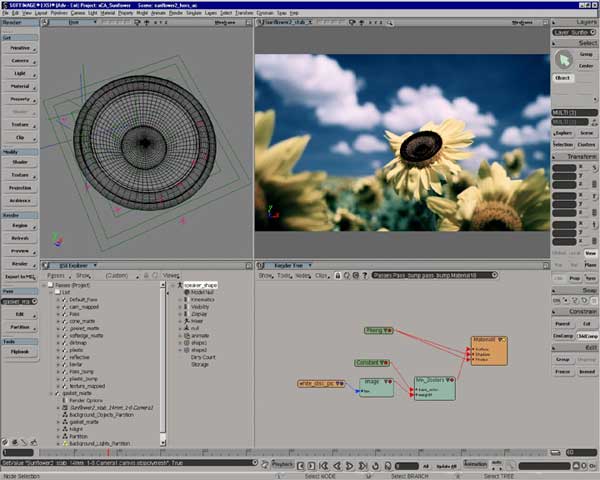
Superior engineering. Visionary architecture. Never before has a software solution been so open and so flexible. SOFTIMAGE|XSI version 4.0 is completely customizable, offering unmatched access to the core of the software and giving unparalleled control over a dramatically accelerated creative process.
THERE’S NO PLACE LIKE HOME: Nintendo Find What They Need at France’s la maison
Michael Abraham Softimage Customer Stories, 2002 Volume 2 Issue 3
It’s true what they say: There really is no place like home. It’s where the heart is; it’s where you hang your hat; it’s where, no matter what you may have done, they have to take you in. Okay, okay, let’s not get crazy, but that is the essential concept behind la maison, a quite startling digital visual effects company located just outside of Paris, in Saint Cloud, France. One thing is certain: the creators of “Symphony”, a striking new commercial for Nintendo directed by Bruno Aveillan, definitely made themselves at home at la maison.
It’s little wonder. Founded in February 2001 by the team of Annie Dautane (formerly Director of VFX at Medialab, now CEO of la maison), Eve Ramboz (Digital Visual Effects Supervisor) and Luc Froehlicher (Head of CG), with help from a friendly partnership with French animation production company Millimages SA and its president, Roch Lener, la maison (literally, “the house”) is actually housed in a 4000 square meter former printing plant. After architect Olivier Rouvillois got his hands on the place, however, little of the old printing plant remained. Each of the company’s different suites has a distinctive atmosphere, with decorative touches influenced as much by the 1950’s as our current era. The overall effect is one of elegant comfort and relaxed creativity, a mix that la maison has conclusively proven to be a very strong one indeed.
“Our real goal at la maison is to provide an environment where directors and producers can develop their projects knowing they are fully supported by exceptional artistic talent and technical expertise,” says Dautane matter-of-factly. “It may sound a little corny to some, but we literally do want to make directors and producers feel entirely at home. That is when the truly great ideas come to the surface.”
In just over a year of operation, there have been a great many great ideas at la maison. Now boasting a staff of 35 strong as well as a stable of established freelancers, la maison has completed no less than 30 projects for commercials, feature films, television and music videos. Their commercial work alone has been for such noted companies as Nestlé, L’Oréal, Citroën, Peugeot, Ford, Thermasilk, Saturn Vue, Victoria’s Secret and, of course, Nintendo.
OF GORGONS AND GAME BOY
What begins as a normal night at the symphony quickly changes into a battle between good and evil in “Symphony,” Nintendo’s latest commercial for GameBoy Advance, which achieved finalist status at the AEAF (Australian Effects and Animation Festival) in February. As a beautiful female conductress begins the music, an elderly patron with the face of a skull, looks up to the elaborately decorative cornices of the concert hall. As he does so, what looks like an angel in the architecture suddenly comes to life as a hideous gorgon, descending on decrepit wings to attack the conductress. Fortunately for her, the musicians are the protective sort: violin bows sprout flames and shoot from their hands like arrows, pinning the gorgon to the wall as one of the tympani players throws a cymbal like a discus, decapitating the dreaded beast.
But this battle is far from over. No sooner has the gorgon’s head taken leave of her shoulders, than the elaborate overhead chandelier transforms into a dragon. Narrowly dodging a blast of electric flame, the conductress uses her baton to reduce the second beast to shards of glass. As the spot closes, the concert hall is returned to its original state, and we see a GameBoy Advance gripped between two hands. The effect is at once elegant and epic, refined and revolutionary.
“For the Gorgon, we had to create a perfect 3D version of the sculpture decorating the theater,” says Froehlicher, head of CG at la maison. “We knew that some of the shots would incorporate both the real caryatids and the one we created, so we wanted to get it exactly right. That was a very big challenge, especially when you consider the realistic, yet phantasmagoric nature of the character. To that end, we took a lot of photographs of the real sculptures from different angles. Using SOFTIMAGE®|XSI™, we were able to recover a lot of geometry from the photographs and extract appropriate textures from them. The wings themselves were created out of assorted dust and (wood) debris.”
As challenging as the Gorgon was, however, she was easy fare when compared with the glass dragon that poses the ultimate threat. Froehlicher continues.
“Creating an immense glass dragon was one thing, but having him explode at the end was quite another,” says Froehlicher. “It required all manner of large, medium and very close shots to accomplish successfully. After a few mapping tests, we knew that the only way we could do it was to create our own geometry. Since the dragon’s look depended on light refracting through the many crystals of glass, we knew we would have to ray trace the whole thing. We also knew that we would have to use SOFTIMAGE|XSI from beginning to end.”
That prospect was somewhat daunting in and of itself, since the la maison team had only used SOFTIMAGE|XSI sparingly, their busy schedule making them think that learning a new software would ultimately be prohibitive. Moreover, some of the freelancers on the Nintendo project had never touched SOFTIMAGE|XSI before. Would SOFTIMAGE|XSI be able to handle such an immense job in just two months?
“It did,” says la maison CG animation supervisor Mathieu Royer, with great satisfaction. “We used scripting to generate some 45000 crystal pearls on NURBS surfaces. The surfaces were then deformed and animated around the main dragon skeleton. We worked on low-resolution models and transferred the final animations onto the complete model. We rendered several layers and mattes for the graphic artists and compositors would be able to integrate the dragon into the real pictures.”
In the end, the entire elaborate production was completed in just three months, with no more than a dozen people handling modeling, tracking, animation and lighting. The results literally speak for themselves.
When asked about his favorite features in SOFTIMAGE|XSI, Froehlicher and Royer don’t hesitate.
“mental ray®, the NLA and Subdivision Surfaces are definitely the top three,” he says with a smile. “Especially mental ray. To render 3D for integration into real pictures, you’ve got to have mental ray, and it is seamlessly integrated into SOFTIMAGE|XSI. That was really the main reason we decided to jump into SOFTIMAGE|XSI from version 1.5. Since then, we haven’t looked back. Different software packages have different advantages, but the ergonomics, the precision and the constructive way of working that we have found with the SOFTIMAGE|XSI animation toolset really makes it an inevitability in the world of 3D animation.”
Royer also reserves special praise for the Animation Mixer: “The Mixer allows us to do infinite variations of one animation, use the same source several times without being repetitive all while keeping different levels of modification. We also do about 99% of our modeling in SOFTIMAGE|XSI now, so those tools are also very strong.”
With the Nintendo spot at the forefront of their impressive reel, la maison is certain to prove Thomas Wolfe – author of You Can’t Go Home Again – dead wrong. On the contrary, when it comes to visual effects and animation, clients are going to be “going home” again and again in the years to come.
Click here to see the Nintendo “Symphony” commercial.

























 eX-SI
eX-SI 