As I wrote yesterday, there surely was a better way to get the neighbors of a specific point than messing around with a bunch of arrays. Here it is.
Hat tip to Eric Thivierge


As I wrote yesterday, there surely was a better way to get the neighbors of a specific point than messing around with a bunch of arrays. Here it is.
Hat tip to Eric Thivierge
There’s surely a better way, but this was a good little exercise in using ICE array nodes.

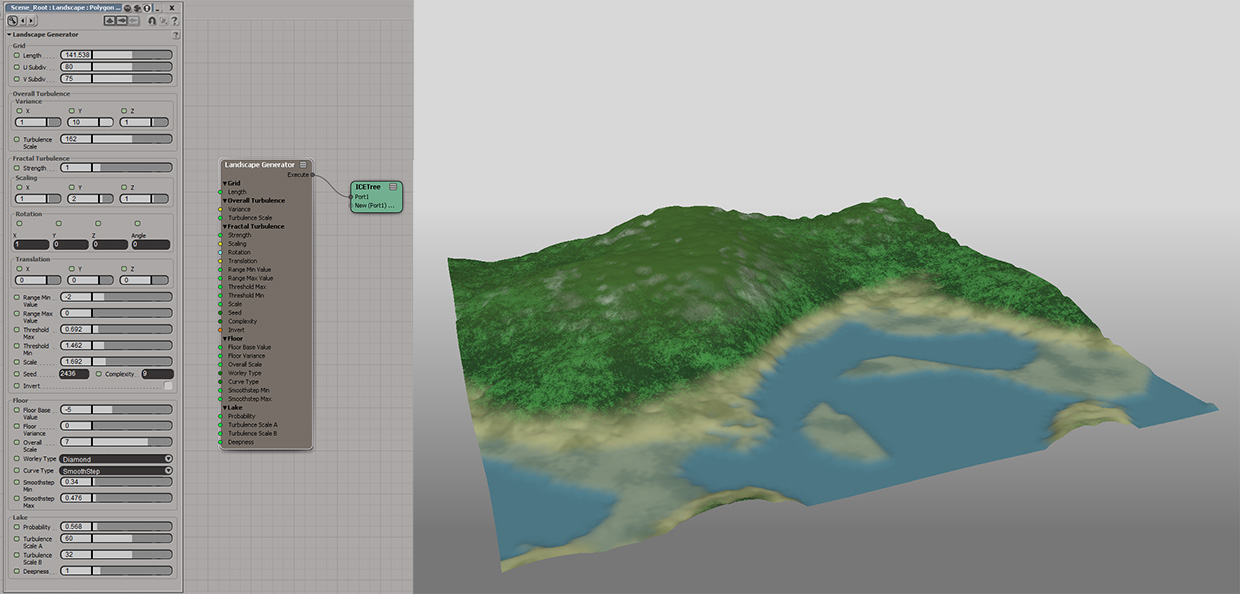
Landscape
by caledonian_tartan
Delete particles near boundary edge
UeberTage 2013 – Fabric Engine presentation (focus on Softimage)
https://vimeo.com/74638146
SOFTIMAGE|ÜberTage2013: Eric Mootz: “Current Developments”
Digital Duckroom by Luca Prasso from 1991
From a thread on renderglobal.org (excuse the Google translation from Italian):
Duckroom Digital and ‘had an idea in aerero to Montrealprima Siggraph 1990, then made in the offices of Softimage in Montreal in 9 days with the ‘equally legendary Olivier Ozoux. served to show the new features of Inverse Kinematics and Dynamics freshly baked from the R & D for the Soft version 1.63 or 1.65
Luca Prasso worked for Softimage Italy as a demo artist from 1990 to 1994, and then went on to work for PDI/Dreamworks for 17 years as a Character TD.
Bio from 2006:
I discovered that I was able to merge drawing and computer skills back in 1982, when the first personal computers appeared in Italy.
At the end of 1986 I joined Compgraf, a small studio in Verona, when I learned the fundamentals of Computer Graphics.
In 1989 I moved to Milan, working for Techex, as a demo artist of CG hardware and software solution. In 1990 I joined Softimage Italy as demo artist for their 3D software package.
With them I travelled the world demonstrating the products and helping to create animations. In 1994 I realized that the Italian CG market was not moving at the same pace of the rest of the world and I decided to seek a job in the US.
In January 1995 I joined PDI as Character Technical Supervisor. I worked on commercials, special effects, feature films and TV series (The Simpsons, Marvin the Martian). I was a Technical Director in charge of Crowd scenes for Antz.
I worked as Character Technical Director Supervisor for Shrek, that won in 2001 the Oscar™ as Best Animated Feature Film.
I then worked on Shrek 2 (released in 2004), Madagascar and Shrek 3 currently in production at PDI/DreamWorks. I’m currently part of a group in charge of designing and developing the next generation of proprietary software dedicated to character setup.
Here’s a handy way to navigate through a scene and show the selected object and its connections in the Schematic: use the XSI Explorer with Viewer set to Schematic.
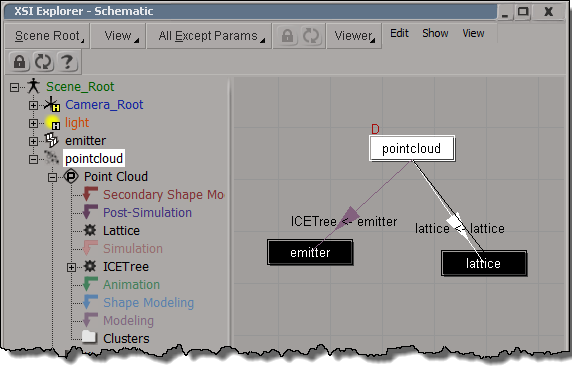
hat tip: David Barosin
Port 2080 is the default port used by the Autodesk licensing service daemon (adskflex).
In most cases, you don’t have to specify the port number when you set ADSKFLEX_LICENSE_FILE:
set ADSKFLEX_LICENSE_FILE=LICSERVER-PC
Sometimes, depending on how the server is set up, you may need to add the port number:
set ADSKFLEX_LICENSE_FILE=2080@LICSERVER-PC
Port 2080 is registered with the Internet Assigned Numbers Authority (IANA), and it’s unlikely you’ll ever have to use a different port.
But if you do, there’s two things you have to do. First, you need to change the port number on the VENDOR line of your license file:
SERVER LICSERVER-PC 0000deadbeef
USE_SERVER
VENDOR adskflex port=2081
Then, on all workstations and render nodes, you’ll have to include the port number in ADSKFLEX_LICENSE_FILE:
set ADSKFLEX_LICENSE_FILE=2081@LICSERVER-PC
PointNeighbors is a set of per-point arrays, so when you feed that into Get Array Size, you get a set of per-point integers (the number of neighbors for each point). Get Set Size, in contrast, will give you a per-object integer (the number of per-point arrays in the set).

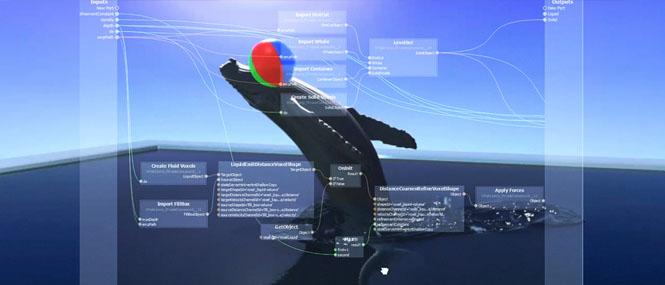
Bifröst: the return of the Naiad team with a bridge to ICE
By Mike Seymour
NOW YOU SEE ME : CROWD DUPLICATION
See also this ICE Crowds in “Now You See Me” (making-of/breakdown video) post on the Softimage mailing list.
https://vimeo.com/rodeofx/nysmcrowdduplication
flow particles around moving surface
by olivier jeannel

Biped Generator (2013)
Softimage ICE wing flapping mechanism
The Mr Hoodie XSI stand-up banner from 2006

The Fibonacci series is a sequence of numbers starting with 0, 1 and where each subsequent number is the sum of the previous two:
0, 1, 1, 2, 3, 5, 8, 13, 21, 34, 55, 89, 144, ...
Thanks to Binet’s Fibonacci number formula, I didn’t have to use a Repeat node 😉

 eX-SI
eX-SI 