
Rediscover creative spirit – New products, new paradigm

Rediscover creative spirit – New products, new paradigm
Reboot on the SOFIMAGE|3D box set:

hat tip: SiliconClassics
From Softimage 3D 3.8 Extreme boxed set – eBay thread on Nekochan Net board.
Ten years ago: 64-bit SOFTIMAGE|XSI previewed

[This screenshot is] actually one we showed at GDC and IDF a few weeks ago. Its the USS Ronald Reagan provided to us by Digimation. The model is 1.5 million polys and there are 36 of them on screen so there are plenty of polys in that scene too. I think that scene is taking up about 3.7 gigs RAM.
The workstations we are using are Dell 670, 380’s and also Intel provided boxes, both dual Xeon and dual-core Pentium 4EE’s with 8 gigs in the dual core boxes and 16 in the Xeon boxes. I was hoping for some SLI goodness but the boxes are single PCIE machines at the moment so we’re running single Quadro 3400’s.
— marksch on cgtalk
Avid to Preview 64-bit SOFTIMAGE|XSI Software at Microsoft Conference
WinHEC 2005 – Seattle , WA – April 25, 2005
Avid Technology, Inc. (NASDAQ: AVID) today announced that it will be demonstrating a technology preview of a native 64-bit version of SOFTIMAGE®|XSI® 3-D animation software during WinHEC – Microsoft’s annual Windows Hardware Engineering Conference – from April 25-27. The technology preview will provide attendees with a first-hand look at a prototype of SOFTIMAGE|XSI software that is designed to take advantage of 64-bit computing architectures in order to streamline time-consuming 3D animation tasks such as modeling, texturing, and rendering. The 64-bit architecture of SOFTIMAGE|XSI software will leverage the increased performance capabilities found in a range of technologies, including Microsoft Windows XP Professional x64 Edition, Dell Precision™ Workstations with 64-bit Intel ® Xeon ™ processors supporting up to 16GB of memory, and the new Dell Precision 380 with the Intel ® Pentium ® Processor Extreme Edition – Intel’s first dual-core processor-based platform which also features Intel ® EM64T, supporting up to 8GB of high speed memory.
“At Softimage, our customers create incredible CG visuals for feature films, commercials, and video games – and they are consistently delivering greater realism and more sophisticated 3D content,” said Marc Stevens , director of product marketing and research & development for Softimage. “Advancements in 64-bit hardware, like dual core processors, enable artists to work at greater speeds and to produce incredible results in less time. We’re pleased to be a part of WinHEC this year in collaboration with Dell and Intel, and for the opportunity to show how 64-bit applications are poised to dramatically change the creative process for CG artists who create some of the most complex and compelling visual imagery in today’s media.”
André Bustanoby, visual effects supervisor at Stan Winston Digital, a LA-based visual effects shop, said, “At Stan Winston Digital, we are dedicated to delivering the highest level of character animation and visual effects for our projects, often with huge 3-D scenes that can slow software applications as we push system memory to its maximum capacity. With 64-bit technology, we expect that our team of artists will be able to increase the complexity of their 3-D work – without sacrificing time – to deliver greater visual experiences to viewers than ever before.” Artists at Stan Winston Digital have used SOFTIMAGE|XSI to create CG imagery for films including Sky Captain and the World of Tomorrow, Garfield and Cat in the Hat.
The technology preview of the 64-bit version of SOFTIMAGE|XSI will demonstrate increases in performance over 32-bit memory systems. Some of these benefits include greater interactivity and faster rendering of massively complex 3-D scenes, and less rendering required for creating special effects with longer sequences that require layering of 3-D, film, and video content.
Club bot doing its thing in XSI 2.0.2 demo version (an example of the EXP watermark)

Limited Edition Games Tee: GDC 2003
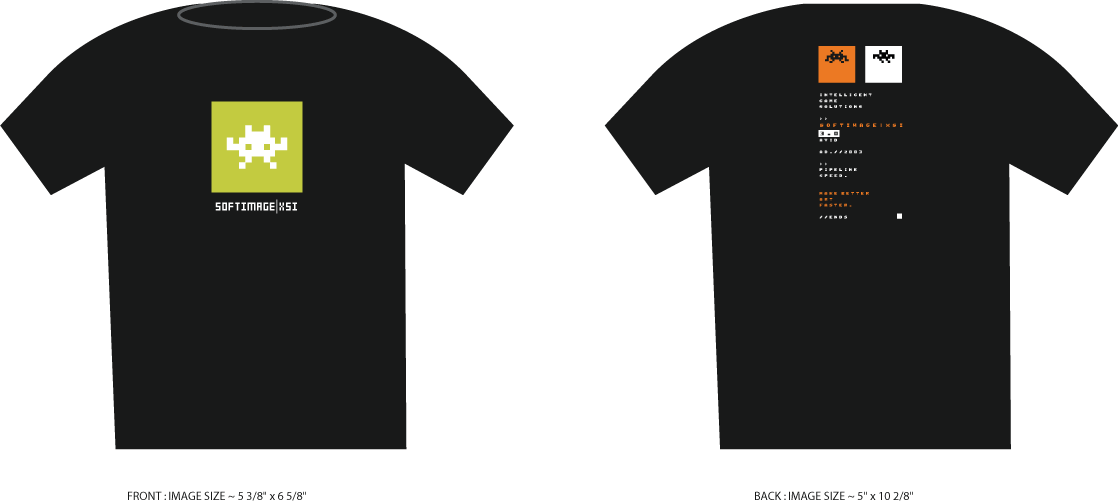
SOFTIMAGE|XSI
Intelligent Game Solutions
Las Vegas, Nevada, April 7th 2003
SOFTIMAGE ANNOUNCES SOFTIMAGE|XSI V.3.5 FEATURING SPEED, INTEROPERABILITY AND WORKFLOW ADVANCES
— Continued Fast Pace of Customer-Driven New Versions Underscores Company’s Unmatched Commitment to Innovation and the Professional 3-D Market —
At NAB 2003, Softimage Co., a subsidiary of Avid Technology, Inc., today announced version 3.5 of its SOFTIMAGE®|XSI® software, the industry’s leading nonlinear 3-D production environment.
In addition to including hundreds of new tools and refinements to increase creativity, productivity and reliability in any production, the SOFTIMAGE|XSI v.3.5 environment also seamlessly and completely integrates mental ray v3.2, the new version of the award-winning rendering technology from mental images GmbH & Co. KG.
The latest version of the XSI environment, which follows less than six months after the release of version 3.0, is driven by the production requirements of industry leading customers, including Capcom, Electronic Arts, Industrial Light & Magic (ILM), Konami, Mainframe, Pixel Liberation Front (PLF), Sega, The Mill and Valve, and continues the company’s unmatched pace of development. The SOFTIMAGE|XSI v.3.5 environment further extends Softimage’s position as the professional 3-D market leader in innovation, customer responsiveness and return on investment.
SOFTIMAGE|DS and SOFTIMAGE|3D (The State of the Art!) brochures from the early Avid days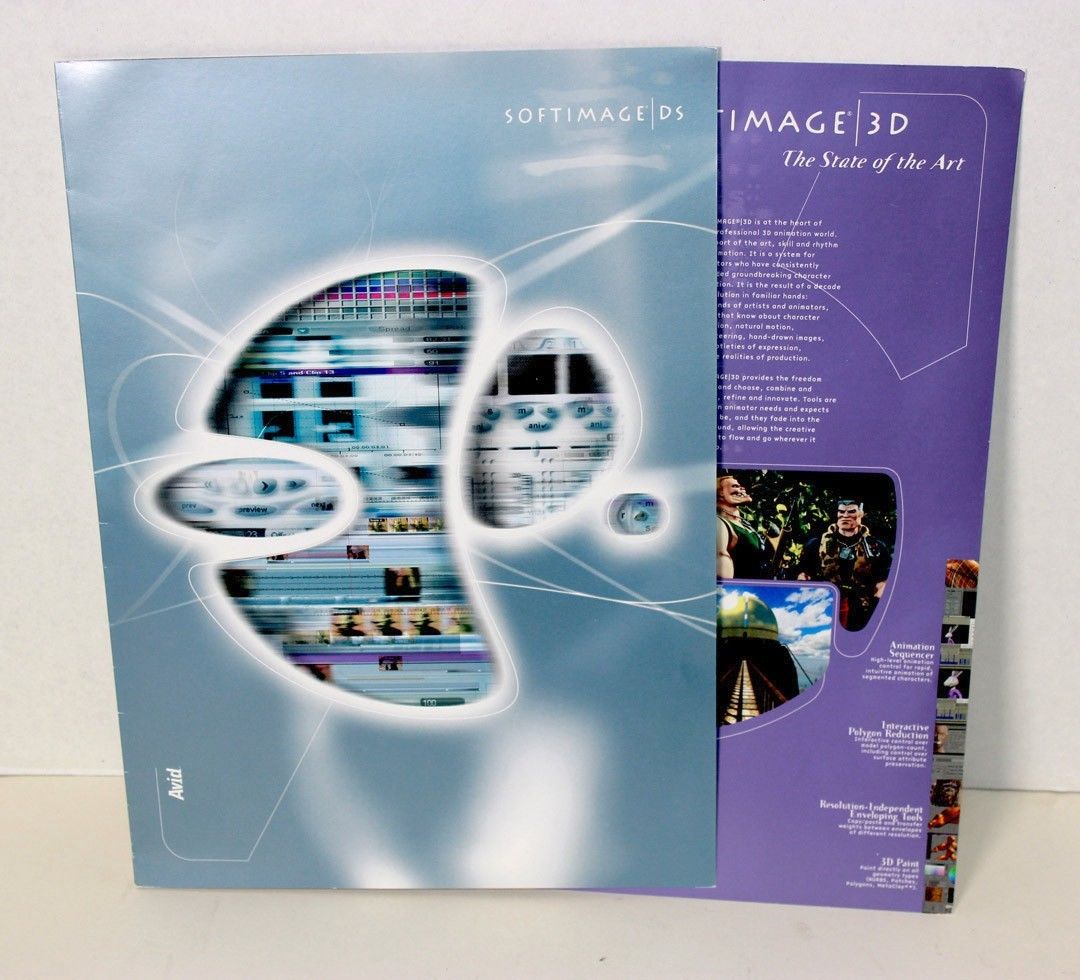
Jumanji’s Amazing Animals (Computer Graphics World, 1 Jan 1996)
ILM used SOFTIMAGE|3D to animate a CG elephant walking step by step over a crushed car.

In one memorable shot in the stampede sequence, a CG elephant walks up and over a car, crunching the car underfoot. For this sequence, the ‘run cycles were abandoned in favor of hand animation.

Here’s the complete article (PDF, 7.4MB). The quality of photocopies back in 1996 was pretty bad.
Produced by Softimage in Montréal, 1994-1995, Osmose was an immersive, virtual environment utilizing 3D computer graphics and interactive 3D sound, a head-mounted display and real-time motion tracking based on breathing and balance.

John Harrison, “immersed” in Osmose development
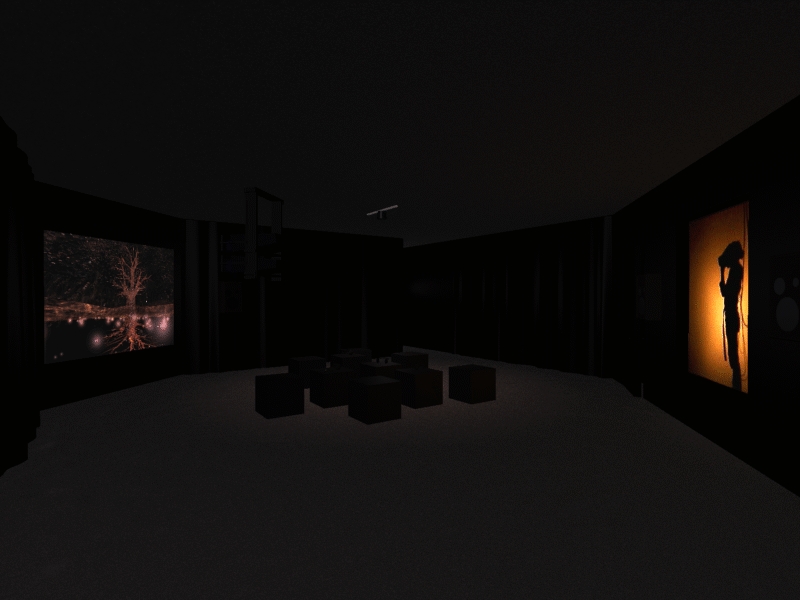
Installation at Musée d’art contemporain de Montréal

Georges Mauro,immersed in Osmose*

Shadow of immersant as seen by audience
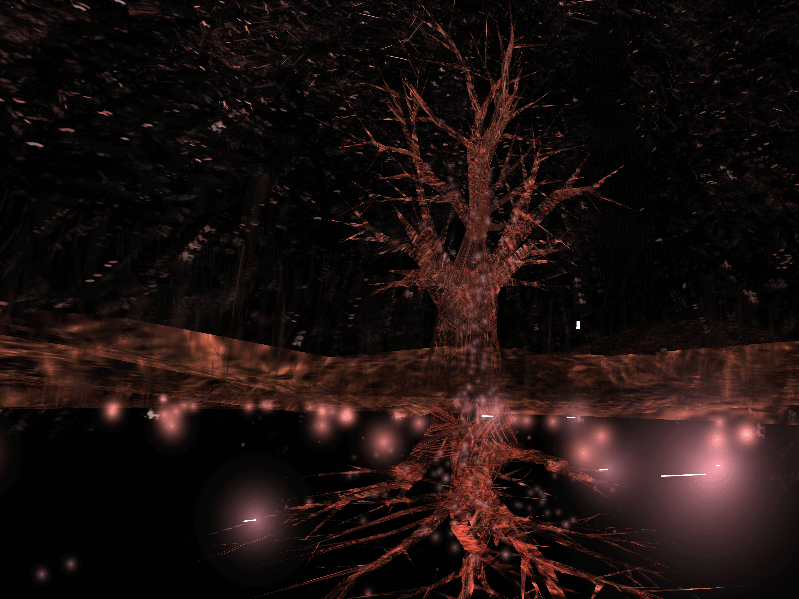
Scene from Osmose
” …By changing space, by leaving the space of one’s usual sensibilities, one enters into communication with a space that is psychically innovating. For we do not change place, we change our nature.”
–Gaston Bachelard, The Poetics of Space, 1964 Clearing with Tree
Osmose is an immersive, virtual environment utilizing 3D computer graphics and interactive 3D sound, a head-mounted display and real-time motion tracking based on breathing and balance.

Tree
Created by a team led by artist Char Davies, Director of Visual Research at Softimage (Montréal), Osmose is a space for exploring the perceptual interplay between self and world, i.e. a place for facilitating awareness of one’s own self as embodied consciousness in enveloping space. This work challenges conventional approaches to virtual reality and explores what Davies believes to be the most intriguing aspect of the medium, namely its capacity to allow us to explore what it means, essentially, to “be-in-the-world”.
Immersion in Osmose begins with the donning of the head-mounted display and motion-tracking vest. The first virtual space encountered is a three-dimensional Cartesian Grid which functions as an orientation space. With the immersant’s first breaths, the grid gives way to a clearing in a forest. There are a dozen world-spaces in Osmose, most based on metaphorical aspects of nature. These include Clearing, Forest, Tree, Leaf, Cloud, Pond, Subterranean Earth, and Abyss. There is also a substratum, Code, which contains much of the actual software used to create the work, and a superstratum, Text, a space consisting of quotes from the artist and excerpts of relevant texts on technology, the body and nature. Code and Text function as conceptual parentheses around the worlds within. Through use of their own breath and balance, immersants are able to journey anywhere within these worlds as well as hover in the ambiguous transition areas in between. After fifteen minutes of immersion, the LifeWorld appears and slowly but irretrievably recedes, bringing the session to an end.
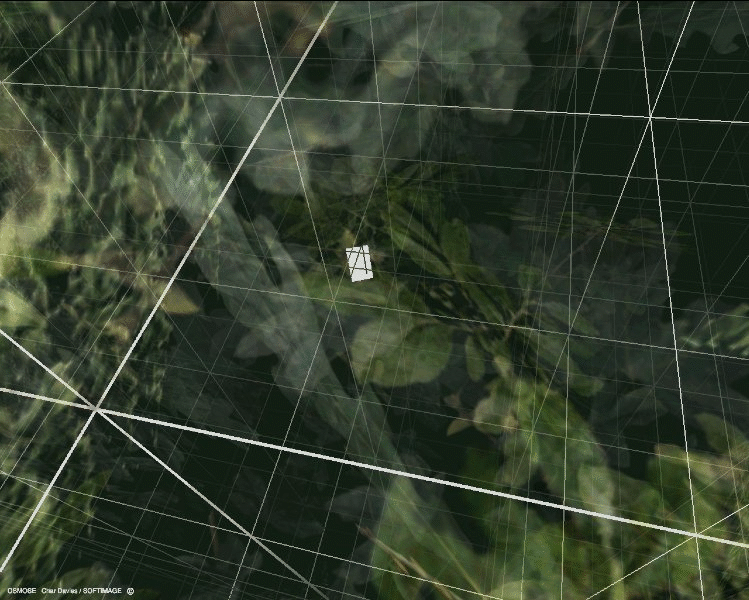
The Forest
In contrast to the hard-edged realism of conventional 3D computer graphics, the visual aesthetic of Osmose is soft, luminous and transparent, consisting of translucent textures and flowing particles. Figure/ground relationships are spatially ambiguous, and transitions between worlds are subtle and slow. This mode of representation serves to ‘evoke’ rather than illustrate and is derived from Davies’ previous work as a painter. The sounds (447K WAV) (1.8M AIFF) within Osmose are spatially multi-dimensional and have been designed to respond to changes in the immersant’s location, direction and speed: the source of their complexity is a sampling of a male and female voice.

Tree in transition
The user-interface of Osmose is based on full-body immersion in 360 degree spherical, enveloping space, through use of a head mounted display. Solitude is a key aspect of the experience, as the artist’s goal is to connect the immersant not to others but to the depths of his or her own self. In contrast to interface techniques such as joysticks, Osmose incorporates the intuitive processes of breathing and balance as the primary means of navigating within the virtual world. By breathing in, the immersant is able to float upward, by breathing out, to fall, and by subtlely altering the body’s centre of balance, to change direction, a method inspired by the scuba diving practice of buoyancy control. The experience of being spatially-enveloped, of floating rather than flying or driving is key. Whereas in conventional VR, the body is often reduced to little more than a probing hand and roving eye, immersion in Osmose depends on the body’s most essential living act, that of breath — not only to navigate, but more importantly — to attain a particular state-of-being within the virtual world. In this state, usually achieved within ten minutes of immersion, most immersants experience a shift of awareness in which the urge for action is replaced by contemplative free-fall. Being supercedes doing.
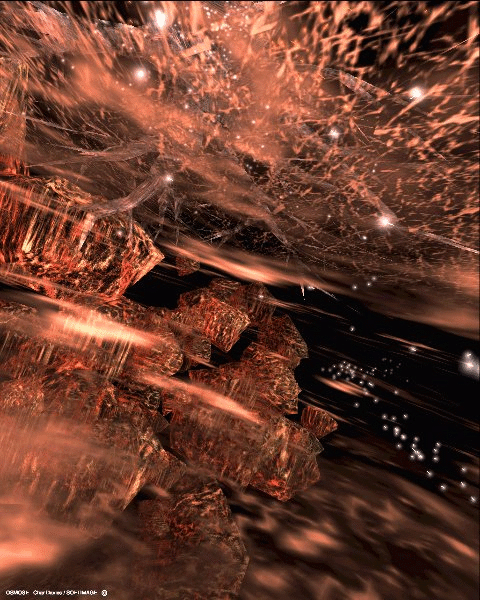
The Subterrainean
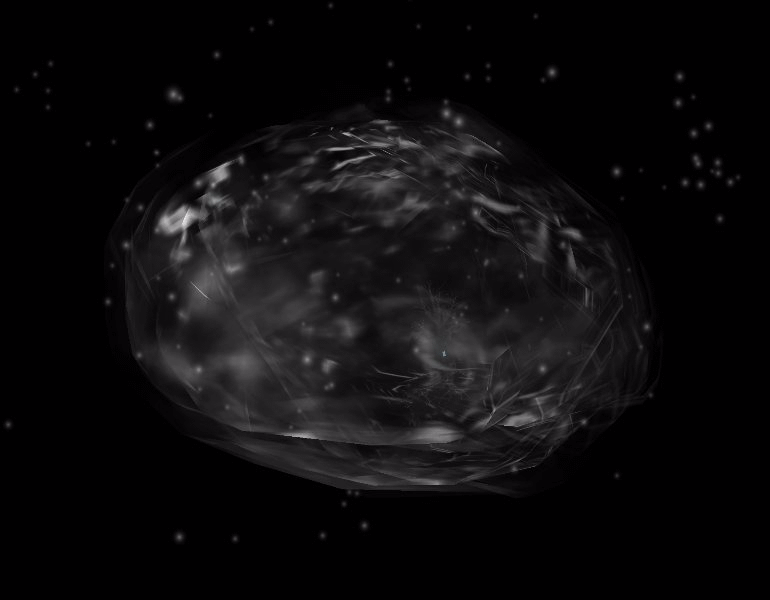
The Lifeworld
Based on the responses of several thousand individuals who have been immersed in Osmose since the summer of 1995, the after-effect of immersion in Osmose can be quite profound. Many individuals feel as if they have rediscovered an aspect of themselves, of being alive in the world, which they had forgotten, the experiencing of which they find to be very emotional, leading some to even weep after immersion. Such response has confirmed the artist’s belief that traditional interface boundaries between machine and human can be transcended even while re-affirming our corporeality, and that Cartesian notions of space as well as illustrative realism can effectively be replaced by more evocative alternatives. Immersive virtual space, when stripped of its conventions, can provide an intriguing spatio-temporal context in which to explore the self’s subjective experience of “being-in-the-world” — as embodied consciousness in an enveloping space where boundaries between inner/outer, and mind/body dissolve.
The public installation of Osmose includes large-scale stereoscopic video and audio projection of imagery and sound transmitted in real-time from the point-of-view of the individual in immersion (the “immersant”): this projection enables an audience, wearing polarizing glasses, to witness each immersive journey as it unfolds. Although immersion takes place in a private area, a translucent screen equal in size to the video screen enables the audience to observe the body gestures of the immersant as a poetic shadow-silhouette.
Credits
Charlotte.Davies: Concept and direction
Georges.Mauro: Creation of graphics
John.Harrison: Virtual Reality software programming
D.Blaszczak: Sound design and programming
rb@accessone.com: Music composition and programming
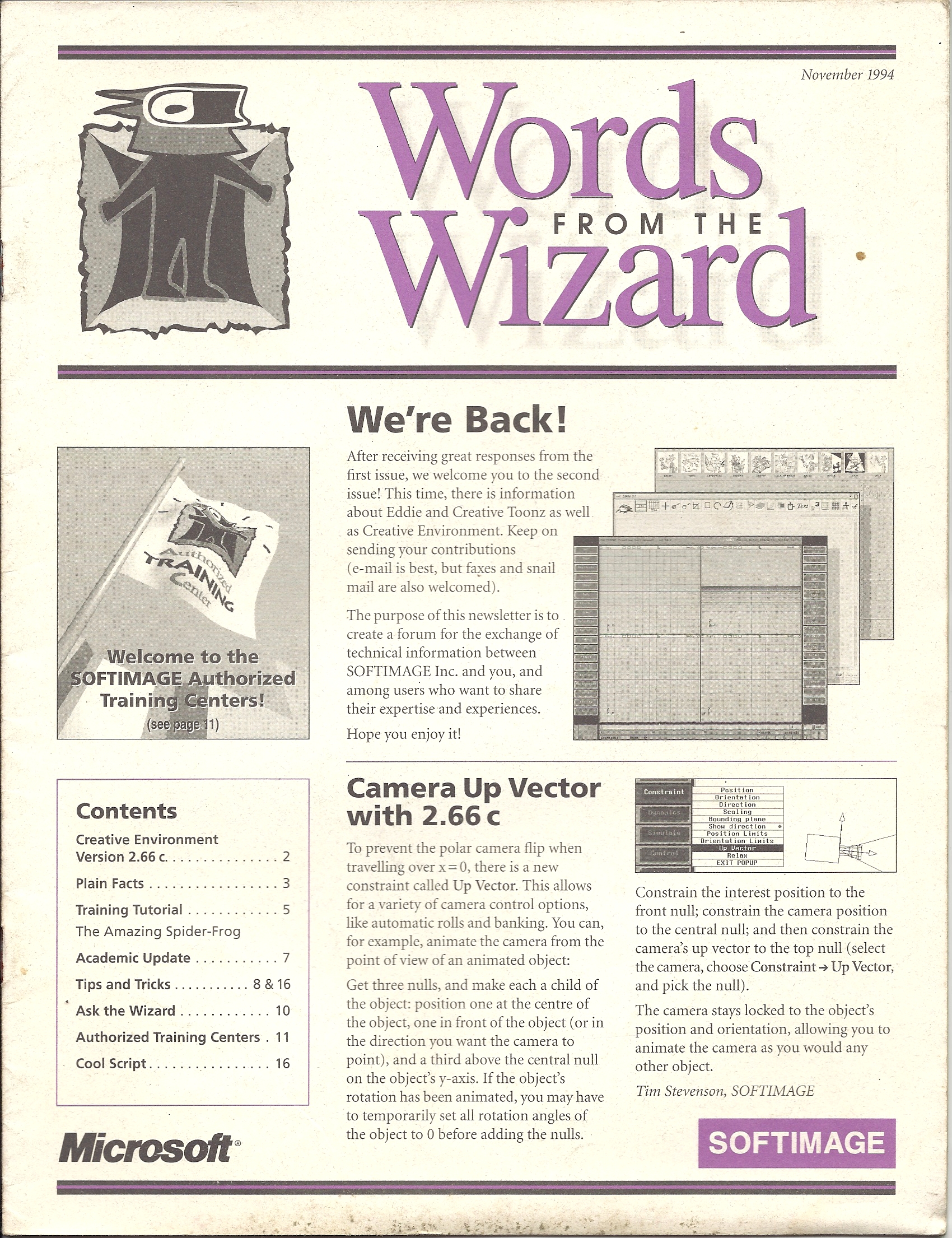
Words from the Wizard – Nov 1994, second issue
16 pages
Contents: Creative Environment 2.66 c, Plain Facts, Training Tutorial: The Amazing Spider-Frog, Academic Update, Tips and Tricks, Ask the Wizard, Authorized Training Centers, Cool Script
 eX-SI
eX-SI 