Paint dialog box and palette from SOFTIMAGE|3D v3.8


Paint dialog box and palette from SOFTIMAGE|3D v3.8
SOFTIMAGE|3D screenshot from 1997. Shows the ToonAssistant. Note the logged-in user (micharia).

I find it interesting that the User name is shown on the status line. I suppose that is part of Softimage’s Linux Unix heritage?
From the 1999 SOFTIMAGE|3D demo CD:

For Boxing Day, the SOFTIMAGE|3D box set:

hat tip: unfortunately I don’t remember exactly where I got this
SOFIMAGE|3D screenshots for Motherdroid, from CG WORLD December 2000
Screenshots originally posted on softimage.jp:
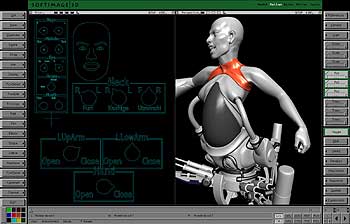
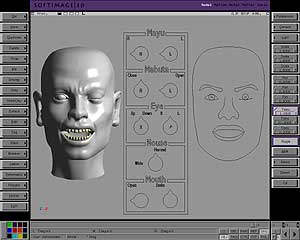

Other screenshots I found on a blog:


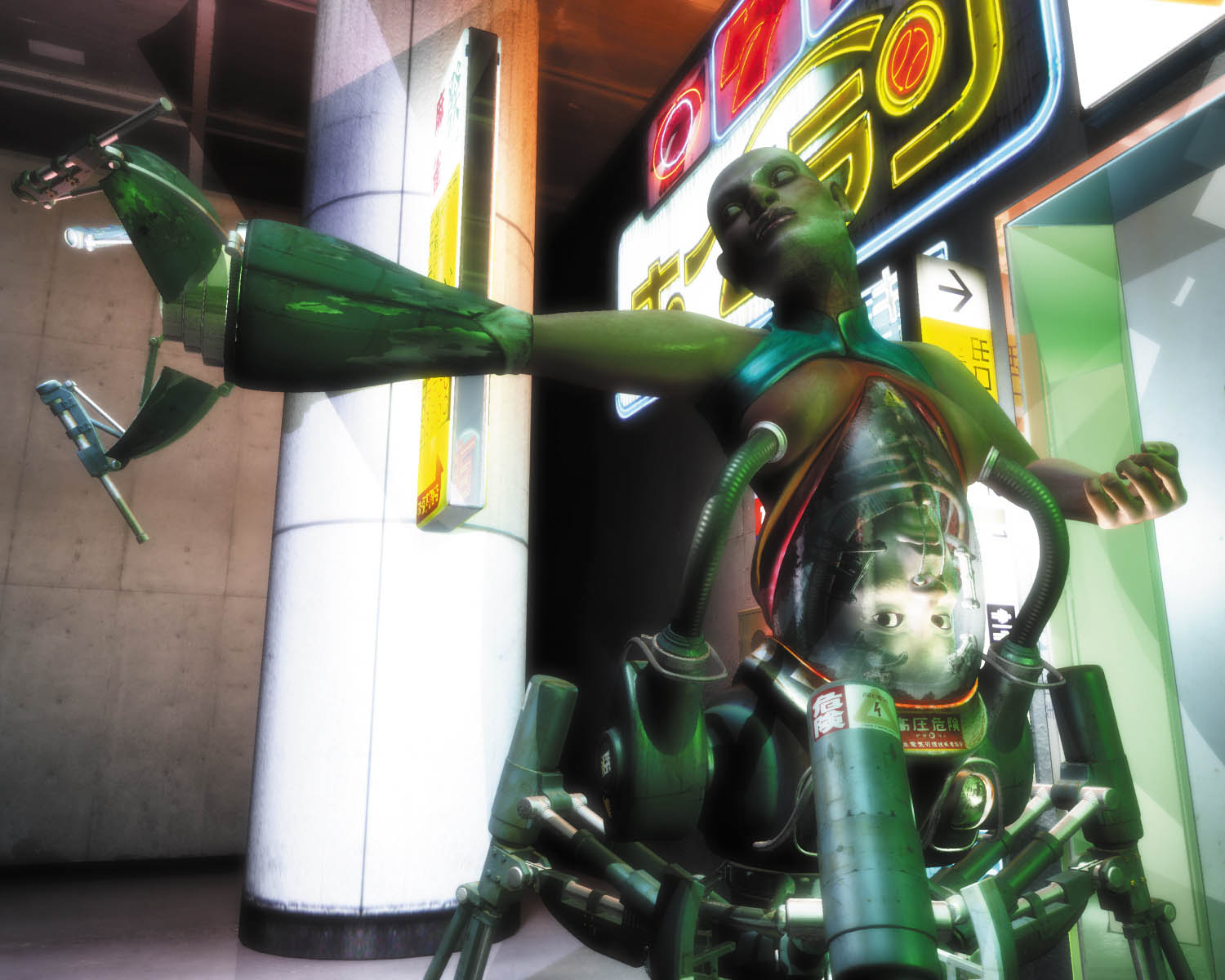
And finally, the MEKARATE video that includes the MotherDroid.
Mekarate, directed and produced by Hiroyasu Shimo, was part of the SIGGRAPH 2003 Computer Animation Festival. It focuses on an inept office worker who is haunted by a self-destructive wish and plagued with anti-social behavior.
The late Emru Townsend wrote this about MEKARATE:
On the other hand, Hiroyasu Shimo’s Mekarate eschews nature entirely; an office worker nods off at his computer late at night, and has disquieting dreams—only to awaken to find that there are worse things happening in the waking world, with much more in store for him. Contemporary Japanese anime and cinema directors have a singular talent for depicting alienation, and this film practically reeks of it, amid all the horrific biomechanical creatures that torment the lead character. Distressing audio and a visual aesthetic that faithfully mimics a handheld video recording contribute to make Mekarate so disturbing you can’t look away.
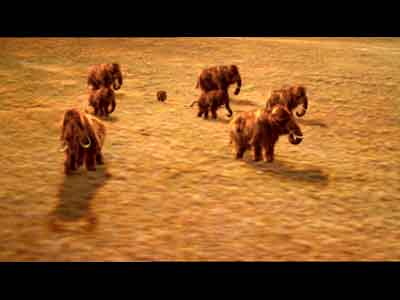
From March 2001: Skaramoosh used SOFTIMAGE|3D v3.9 and SOFTIMAGE|XSI v1 and v1.5 to create over 23 minutes of computer animation for Discovery’s flagship documentary ‘Land of the Mammoth’, a two-hour programme.
The project, involving in excess of 100 computer generated (CG) shots, took a core team of eight people four months to complete and includes the animation of not only mammoths but also a woolly rhino and a giant deer. The mammals were modelled in Softimage 3D v3.9 and animated using SOFTIMAGE|XSI.
Some screenshots of Softimage software from the video:


hat tip: Dan Yargici
I recently found a Quicktime of the behind-the-scenes film for a project we did at Skaramoosh for The Discovery Channel back in 2001.
We did all the animation in XSI v1 and transferred actions back to Soft 3D (can’t remember the exact version, the last before v4 iirc) for rendering due to the fact that we created the fur using Nordisk Film Fur Designer (my responsibility on the project).
The fur renders were OpenGL in Fur Designer so there was LOTS of post fudgery, but damn it was fast! Despite the speed, we still had to rent in a ton of Octanes to push it through. It was summer and everyone had to work with an rendering Octane between their legs so the office was toasty to say the least!
I don’t know if Stefano will remember, but we looked into PhoenixTools fur for Mental Ray (which he wrote iirc) at the time and I had some direct conversations with him while I tried to get to grips with it.
It was featured in the first edition of the XSI magazine (I say first edition, I think it was the only edition!) which I still have kicking about somewhere.
I’m the guy in the grey shirt, studiously taking notes at 2:13. Other people from the list past and present who make an appearance are Sebastian Read, Olly Nash, Maarten Heinstra and Keith Fallon.
And from a news release, here’s some more background on the project:
SKARAMOOSH COMPLETE MAMMOTH CG PROJECT
DIGITAL effects company Skaramoosh have created over 23 minutes of computer animation for Discovery’s flagship documentary ‘Land of the Mammoth’, a two-hour programme.The project, involving in excess of 100 computer generated (CG) shots, took a core team of eight people four months to complete and includes the animation of not only mammoths but also a woolly rhino and a giant deer. A large amount of the project was completed in SOFTIMAGE|XSI version 1.0 and final stages in version 1.5.
Andrew Hunter, Digital Effects Director, Skaramoosh, said: “What excited us about this project was that we were involved in the entire production process for all the special effects shots, right from the storyboarding stage. This included the commissioning of a life size mammoth model for blue screen shoots, travelling to places as far apart as Siberia and America to film realistic backplates through to actually creating and animating all required 3D mammals and finally compositing all the shots. The backplates themselves could be made up from anything up to six different layers.”
The sequences were created to illustrate the life pattern of mammoths, where and how they lived and survived. Specifically created sequences include birth, mating, fighting and, finally, dying. There is also a sequence to illustrate what the mammoth evolutionary process was thought to have been.The mammals were modelled in Softimage v3.9, animated using SOFTIMAGE|XSI and then brought back into Softimage v3.9 to render the fur. Once rendered the animation was taken into one of two compositing systems, Avid Illusion or Avid DS, to be composited with the backplates. Careful scheduling was required to avoid any compositing bottleneck.
‘Land of the Mammoth’ airs on the Discovery Channel on March 11.
SOFTIMAGE|3D system requirements circa 1999: 96MB RAM, 2GB free hard disk space


These days, you need about 1.4GB to extract the Softimage installer.
SOFTIMAGE|3D screenshot from September 2004, showing the Major Motoko Kusanagi character from the Ghost in the Shell game developed by Cavia

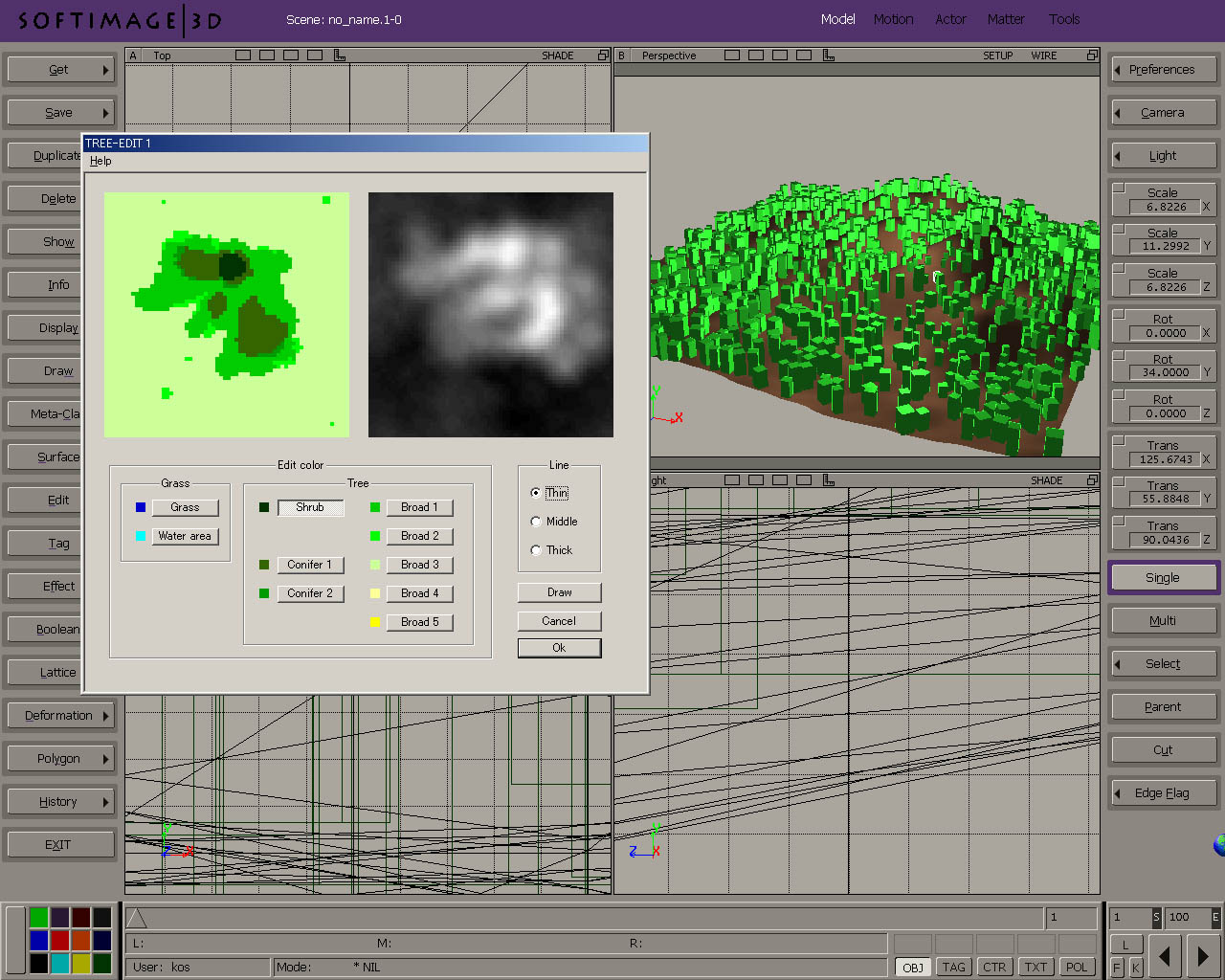
A SI3D forest.
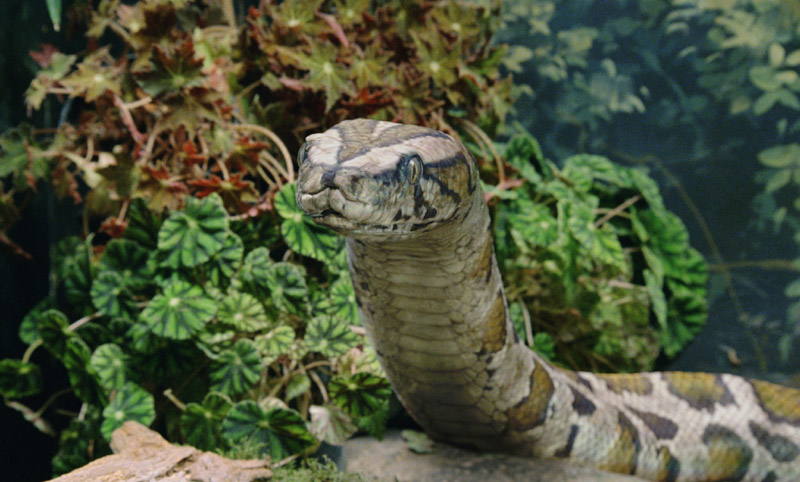
Feb 2002 Customer story on how ILM used SOFTIMAGE|3D on Harry Potter and the Philosopher’s Stone, in particular the CG python seen at the beginning of the movie.

SOFTIMAGE|3D close up
Sonia Osorio
Glasses, bowl-cut hair, a British prep-school look – not exactly qualities of a hero with mass appeal, but Harry Potter has become just that: a literary and marketing phenomenon with children and adults alike. Harry Potter and the Sorcerer’s Stone is the film adaptation of J. K. Rowling’s first novel in her series of best-selling adventures about a young wizard coming into his own. Directed by Chris Columbus, the film has steadily attracted fans since its opening. With a dominant theme like magic, visual effects experts from various facilities had to create some magic of their own to deliver the 600 CG-intensive shots required. Film production designer, Stuart Craig’s designs became the guidelines for all character creation. This included the skills of makeup artists, Jim Henson’s Creature Shop and the animators at five London effects houses and three facilities in California, one of which was Industrial Light & Magic (ILM).
While animatronic creatures were used in shots requiring limited movement, more complex character motion and close-up performances required intensive CG work. Columbus was insistent that the creatures be subtly convincing, regardless of the potential for some outlandish characters to pop into Harry Potter’s magical world. Case in point: the CG snake created for the scene at London’s Regent’s Park Zoo, where Harry visits the reptile house with his foster parents and obnoxious cousin Dursley. As Harry “bonds” with a python, the glass barrier separating the snake from visitors magically disappears and the python slithers out to interact directly with Harry.
For camera line-up and sleeping scenes, an animatronic snake was used, but creating a truly convincing performance required a fairly complex CG actor. “We do a lot of creature work at ILM based on a biped model,” states technical animator Paul Kavanagh. “But a snake is essentially a tube of vertebrae and muscle moving in all sorts of ways, and I had to animate that believably.”
ANIMATING A TUBE OF VERTEBRAE & MUSCLE
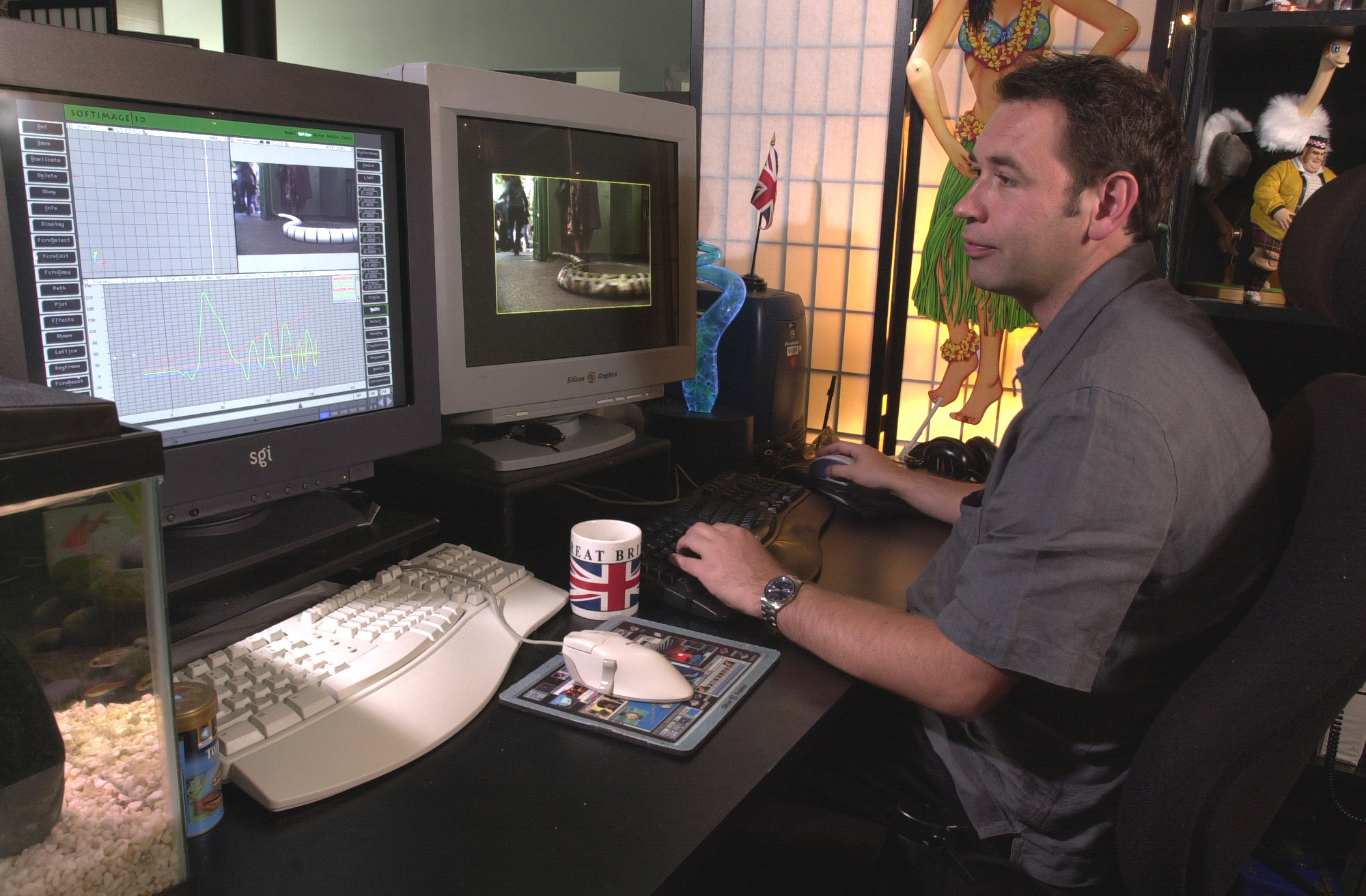
The initial SOFTIMAGE®|3D model of the snake was composed of nine controllers down the creature’s length, which could be translated to affect its length and shape. But Kavanagh found the model slow to animate and it was difficult to obtain the full range of motion required. He therefore doubled the controllers to 18, but this turned out to be “twice the effort and twice the complexity – and I still wasn’t getting the full motion I wanted,” says Kavanagh. “The snake needed to be animated over objects and I couldn’t get that by moving boxes [controllers] around.”
It was decided to build an intermediate model in SOFTIMAGE|3D to drive the original controller-model, but the question of how a snake actually moves still lingered. Kavanagh explains: “One of our animators brought in her pet python for me to observe slithering around the hallways. So I took some video footage of that, got reference material from National Geographic, and determined that as a snake moves, its muscles and coils contract to push it along a path. To replicate that, I built a path in SOFTIMAGE|3D of where the snake needed to travel, then I could take the intermediate model and slide it along the path drawn in 3D space.”
MAKING IT BELIEVABLE

Good idea, one problem: it looked just like a snake sliding along a pre-determined path. The path itself needed to be animated so that, as the snake moved, some coils would contract, others would expand and the path itself would follow this motion via controllers along the route, complete with a tail-whipping motion, to create a real-life slithering feeling.
ILM’s in-house Anim-Rep software enabled Kavanagh to take SOFTIMAGE|3D files with controllers in-place and apply them to completely different scenes in SOFTIMAGE|3D. The intermediate model of the snake slithering along the path could thus be “anim-repped” into the initial 18-controller model, enabling it to follow the path-animated model’s motion.
ILM’s deformation tools were then used to create highly realistic flesh movement. This method, first used to advantage on Jurassic Park III, distributes textures over musculature and bones for a more organic look instead of having CG textures stretching in localized areas. “Our rendering and compositing departments also did a wonderful job making it all work in the scene,” adds Kavanagh. “Chris Columbus couldn’t stop talking about the work; he really loved it.”
It’s always gratifying to satisfy the director, but what really keeps Kavanagh motivated? “Well, I was going to say the money, but that’s not the real reason. I went to see the movie with my wife and it was great watching the crowd’s reaction to the snake scene – they didn’t even notice it was an effect, which is what you want at the end of the day. That’s the true value of the job: to create something that works that well.”
 eX-SI
eX-SI 