SOFTIMAGE|3D system requirements circa 1999: 96MB RAM, 2GB free hard disk space
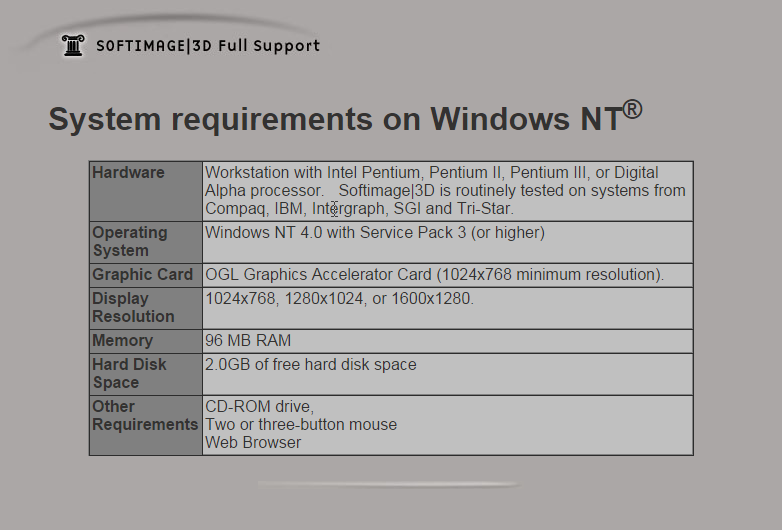
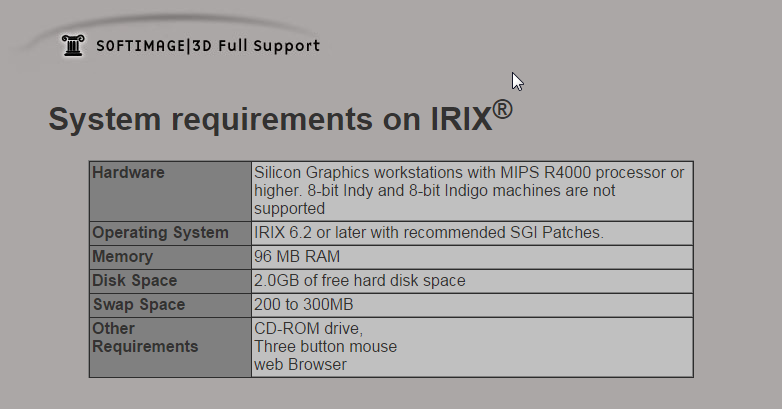
These days, you need about 1.4GB to extract the Softimage installer.

SOFTIMAGE|3D system requirements circa 1999: 96MB RAM, 2GB free hard disk space
These days, you need about 1.4GB to extract the Softimage installer.
SOFTIMAGE|3D screenshot from September 2004, showing the Major Motoko Kusanagi character from the Ghost in the Shell game developed by Cavia

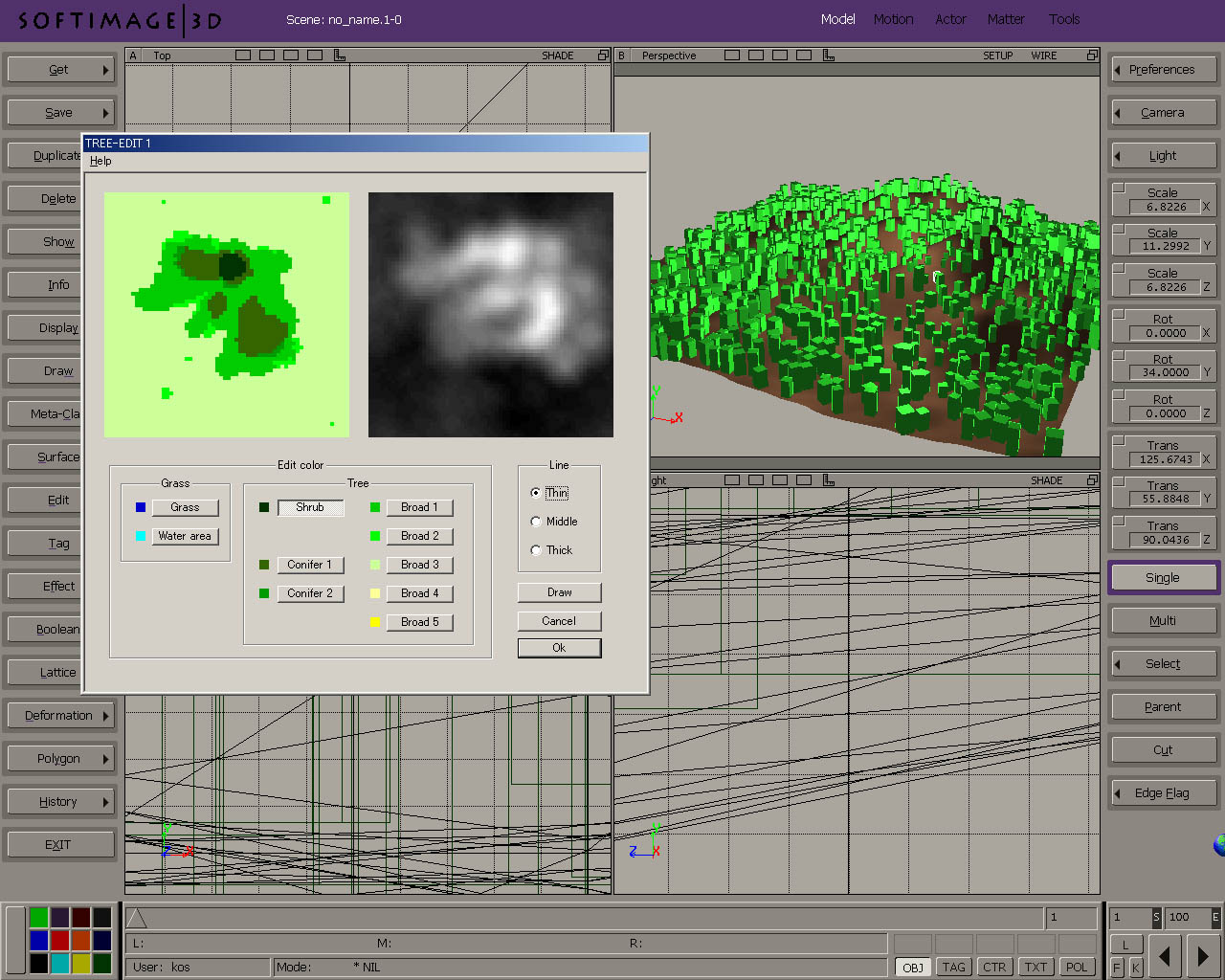
A SI3D forest.
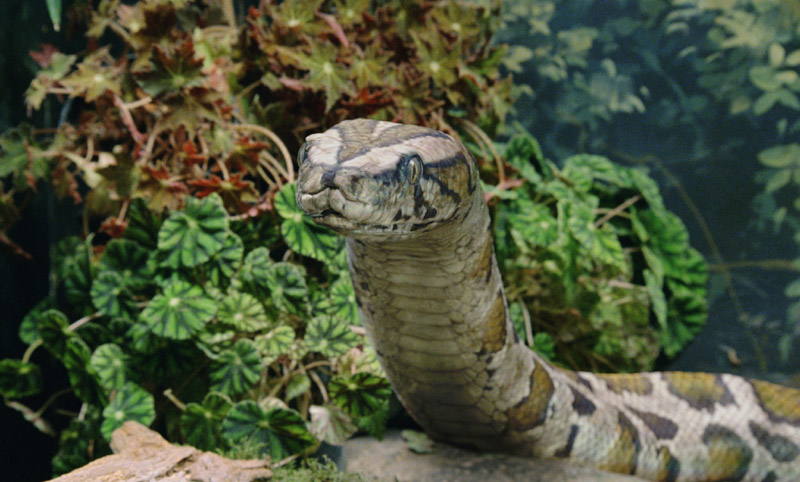
Feb 2002 Customer story on how ILM used SOFTIMAGE|3D on Harry Potter and the Philosopher’s Stone, in particular the CG python seen at the beginning of the movie.

SOFTIMAGE|3D close up
Sonia Osorio
Glasses, bowl-cut hair, a British prep-school look – not exactly qualities of a hero with mass appeal, but Harry Potter has become just that: a literary and marketing phenomenon with children and adults alike. Harry Potter and the Sorcerer’s Stone is the film adaptation of J. K. Rowling’s first novel in her series of best-selling adventures about a young wizard coming into his own. Directed by Chris Columbus, the film has steadily attracted fans since its opening. With a dominant theme like magic, visual effects experts from various facilities had to create some magic of their own to deliver the 600 CG-intensive shots required. Film production designer, Stuart Craig’s designs became the guidelines for all character creation. This included the skills of makeup artists, Jim Henson’s Creature Shop and the animators at five London effects houses and three facilities in California, one of which was Industrial Light & Magic (ILM).
While animatronic creatures were used in shots requiring limited movement, more complex character motion and close-up performances required intensive CG work. Columbus was insistent that the creatures be subtly convincing, regardless of the potential for some outlandish characters to pop into Harry Potter’s magical world. Case in point: the CG snake created for the scene at London’s Regent’s Park Zoo, where Harry visits the reptile house with his foster parents and obnoxious cousin Dursley. As Harry “bonds” with a python, the glass barrier separating the snake from visitors magically disappears and the python slithers out to interact directly with Harry.
For camera line-up and sleeping scenes, an animatronic snake was used, but creating a truly convincing performance required a fairly complex CG actor. “We do a lot of creature work at ILM based on a biped model,” states technical animator Paul Kavanagh. “But a snake is essentially a tube of vertebrae and muscle moving in all sorts of ways, and I had to animate that believably.”
ANIMATING A TUBE OF VERTEBRAE & MUSCLE
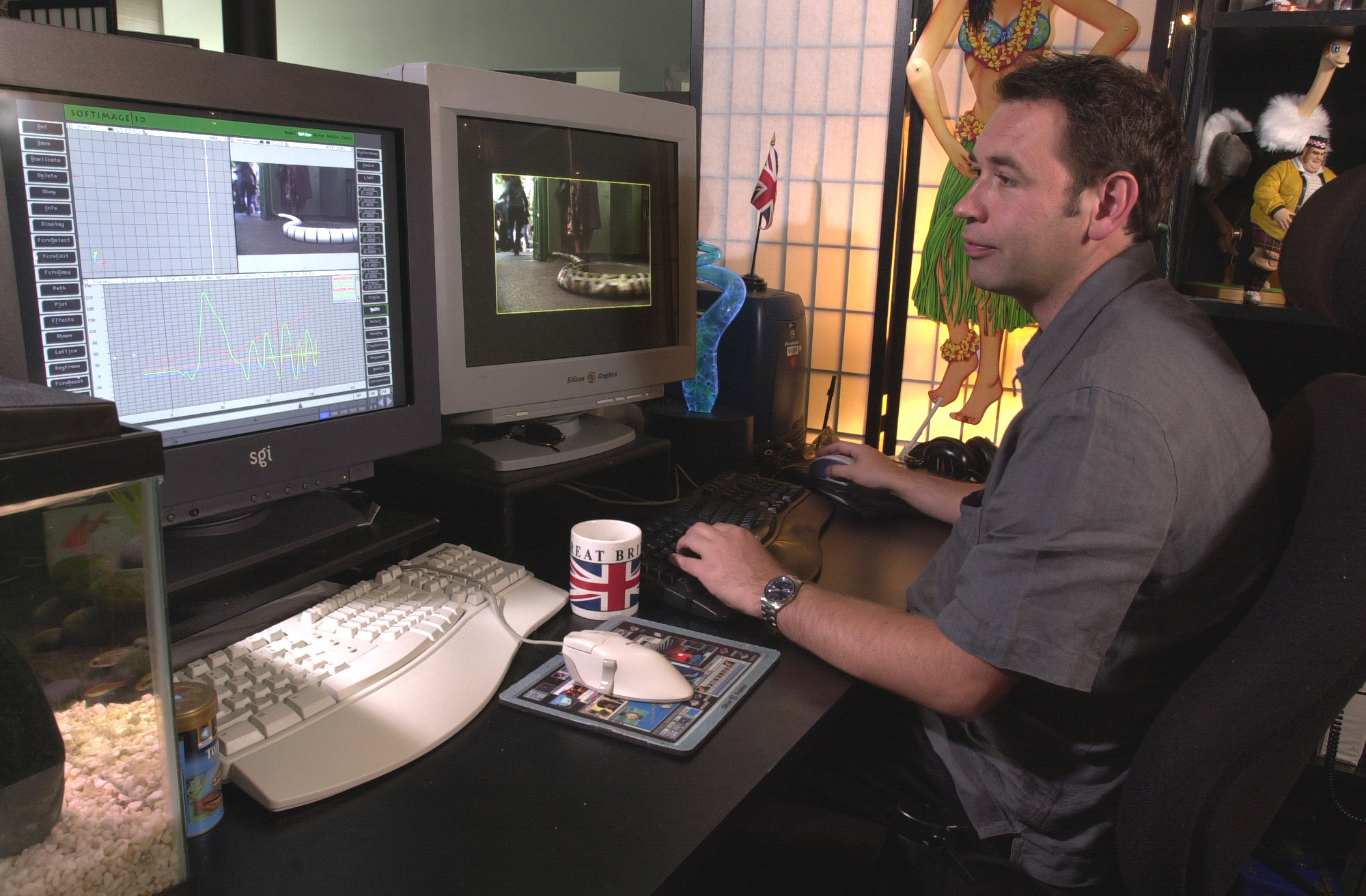
The initial SOFTIMAGE®|3D model of the snake was composed of nine controllers down the creature’s length, which could be translated to affect its length and shape. But Kavanagh found the model slow to animate and it was difficult to obtain the full range of motion required. He therefore doubled the controllers to 18, but this turned out to be “twice the effort and twice the complexity – and I still wasn’t getting the full motion I wanted,” says Kavanagh. “The snake needed to be animated over objects and I couldn’t get that by moving boxes [controllers] around.”
It was decided to build an intermediate model in SOFTIMAGE|3D to drive the original controller-model, but the question of how a snake actually moves still lingered. Kavanagh explains: “One of our animators brought in her pet python for me to observe slithering around the hallways. So I took some video footage of that, got reference material from National Geographic, and determined that as a snake moves, its muscles and coils contract to push it along a path. To replicate that, I built a path in SOFTIMAGE|3D of where the snake needed to travel, then I could take the intermediate model and slide it along the path drawn in 3D space.”
MAKING IT BELIEVABLE

Good idea, one problem: it looked just like a snake sliding along a pre-determined path. The path itself needed to be animated so that, as the snake moved, some coils would contract, others would expand and the path itself would follow this motion via controllers along the route, complete with a tail-whipping motion, to create a real-life slithering feeling.
ILM’s in-house Anim-Rep software enabled Kavanagh to take SOFTIMAGE|3D files with controllers in-place and apply them to completely different scenes in SOFTIMAGE|3D. The intermediate model of the snake slithering along the path could thus be “anim-repped” into the initial 18-controller model, enabling it to follow the path-animated model’s motion.
ILM’s deformation tools were then used to create highly realistic flesh movement. This method, first used to advantage on Jurassic Park III, distributes textures over musculature and bones for a more organic look instead of having CG textures stretching in localized areas. “Our rendering and compositing departments also did a wonderful job making it all work in the scene,” adds Kavanagh. “Chris Columbus couldn’t stop talking about the work; he really loved it.”
It’s always gratifying to satisfy the director, but what really keeps Kavanagh motivated? “Well, I was going to say the money, but that’s not the real reason. I went to see the movie with my wife and it was great watching the crowd’s reaction to the snake scene – they didn’t even notice it was an effect, which is what you want at the end of the day. That’s the true value of the job: to create something that works that well.”
Old SOFTIMAGE|3D screenshot from 1998.

The State of the Art
SOFTIMAGE|3D is the art, skill and rhythm of 3d animation –
system for animators who have consistently produced ground
breaking animation, signature effects and photo-realistic
imagery. It is the result of a decade of evolution – from
interface design that put control back into the hands of
artists, to the breakthrough character animation of
Godzilla. SOFTIMAGE|3D The State of the Art, Defined.

From a picture dated 12 May 2004, a variety of memorabilia, including:

Hardware for a Soft world

Inset from the March 1997 issue of Game Developer Magazine. Oooh, 2GB hard disk; ahhh, 128MB RAM 😉
The personal workstation…a thoroughbred system indeed…with dual 200MHz P-Pro processors, 128MB ECC memory, 2GB Ultra-SCSI disk…list price with a 21″ monitor was $18,690
Brad Hiebert demos Softimage for Bill Gates, back in 1995
Screenshot of Wam!Net ROD Render in SOFTIMAGE|3D. From the Softimage web site back in 2000/2001.

Press release from April 2000:
Softimage Works With WAM!NET to Offer High-Speed Rendering to the Animation and 3-D Special Effects Industries
NAB2000
LAS VEGAS–(BUSINESS WIRE)–April 9, 2000
Softimage Co., a subsidiary of Avid Technology, Inc. (NASDAQ: AVID), and WAM!NET Inc. today announced that WAM!NET has joined the Softimage Developer program as a Gold Level Partner to provide its ROD!(TM)service (Render On Demand). ROD! is designed to give SOFTIMAGE(R)|3D and SOFTIMAGE(R)|XSI(TM) artists and animators a strong alternative to traditional rendering and asset management.
This relationship will give digital content creators an option to farm out the rendering process using the WAM!NET(R) ROD! service. Studios and small production facilities alike can reduce production costs and accurately estimate projects with the ROD! service, which provides the much-needed computing power for larger projects. This additional “as-needed” computing power allows animation and special effects studios to reduce overhead costs and accurately estimate project requirements, enabling them to remain competitive in the growing animation and special effects industry.
“Softimage is one of the top innovators in three-dimensional and two-dimensional graphics technology,” said Keith Elzia, vice president of strategic development at WAM!NET. “WAM!NET is an e-services company that believes in providing best-of-breed technology to its subscribers. Softimage is a technology leader in the animation and special effects industry. As a Gold Level Partner, our joint marketing and sales effort with Softimage will help build a stronger ROD! service for the animation industry with the two popular Softimage software applications available on ROD!.”
“WAM!NET has provided a powerful and cost-effective rendering service that is an excellent alternative for all of our customers regardless of size,” said David Miller, director of business development at Softimage. “The benefit of the WAM!NET ROD! service is that it is available on an ‘as-needed’ basis to provide added coverage and economic flexibility for the ebbs and flows of animation and special effects projects.”
WAM!NET’s ROD! service provides high-speed, wide-area rendering services and offers an effective way for all studios to do high-speed rendering and bid with confidence on large projects that require tremendous rendering power and asset management capabilities. WAM!NET’s services eliminate the need to upgrade or add to existing hardware and software to access high-speed, on-demand rendering.
The Benefits of WAM!NET
WAM!NET provides many benefits to SOFTIMAGE|3D, SOFTIMAGE|XSI and mental ray(R) customers, including:
–The ability to offload computer-intensive, time consuming rendering functions to WAM!NET’s high-speed, wide-area media network to save both money and time on projects;
–Asset management features and offsite archives provide an efficient method of storing and managing their rendering workflow;
–Access to WAM!NET’s distributed rendering on a high-speed, privately managed and secure network;
–The ability to utilize the WAM!NET ROD! service to outsource their computer-intensive rendering needs and enjoy increased profits and improved productivity as artists free up their workstations for more projects; and
–Most importantly, large or small studios alike will be able to enjoy WAM!NET’s ROD! service and confidently pursue larger projects with the processing power to meet tight deadlines on a pay-as-you-go basis.
About WAM!NET Inc.
WAM!NET Inc., with its digital media management service, sets the industry standard for electronic collaboration in the graphic arts, advertising, marketing and entertainment industries. WAM!NET’s Industry Smart(TM) high-speed transportation network, on-line archiving service and production workflow application software allow subscribers to digitally collaborate with thousands of global trading partners with one simple connection. Since its incorporation in the state of Minnesota in 1994, WAM!NET has attracted more than 1,900 users of direct services and over 6,800 users of its dial-up and Internet Gateway service. WAM!NET services are available throughout America, Europe and Japan.
WAM!NET is headquartered in Eagan, Minnesota, with offices throughout North America, Europe and Japan. The company has benefited from strategic relationships with SGI, MCI WorldCom and Winstar Communications. For more information about WAM!NET, call 800.611.9006, or visit WAM!NET’s Web site at http://www.wamnet.com.
WAM!NET(R) is a registered trademark and Industry Smart(TM) and ROD!(TM) are trademarks of WAM!NET Inc. All other trademarks and registered trademarks are the property of their respective companies.
About Avid Technology, Inc.
Avid Technology, Inc., of which Softimage Co. is a subsidiary, is an international, industry-leading provider of digital audio and video tools for information and entertainment applications. Avid’s products are used by a variety of customers worldwide including film, television and interactive content producers, TV news broadcasters, corporate communicators and consumers. For more information, visit the Softimage site at http://www.softimage.com or Avid’s Web site at http://www.avid.com.
(c)2000 Avid Technology, Inc. All rights reserved. Product specifications are subject to change without notice. Avid and Softimage are registered trademarks and XSI is a trademark of Avid Technology, Inc. WAM!NET is a registered trademark and Industry Smart and ROD! are trademarks of WAM!NET Inc. mental ray and mental images are registered trademarks of mental images GmbH & Co. KG in the USA and/or other countries. All other trademarks contained herein are the property of their respective owners.

