CValue out; CValueArray pick_args(2); pick_args[0] = L"Pick an object"; pick_args[1] = L"Pick an object"; Application().ExecuteCommand( L"PickObject", pick_args, out); CValueArray array = (const CValueArray &)out; LONG button = (LONG)array[0]; X3DObject pickedObject(array[2]); Application().LogMessage( pickedObject.GetFullName() );
The case of the capture viewport that was in the wrong place
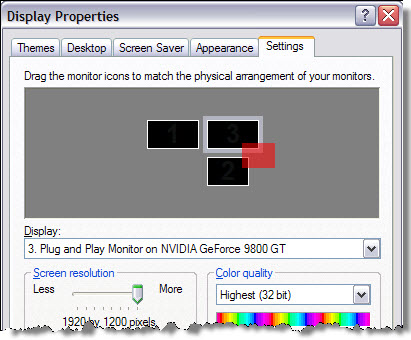
In this case, the customer reported that when he did a viewport capture, the capture area wasn’t in the right place. In this screenshot of his display properties, the red area is where the viewport capture happened:
There’s no way to set the position of the viewport capture window (it is all done automatically), so these kinds of problems are most likely a problem with the monitor setup configuration. The customer disabled his third monitor, and the capture viewport worked. So he then lined up all three monitors in a row, and then the viewport capture worked.
Autodesk Softimage Hardware Certification FAQ
From the Autodesk Softimage Hardware Certification FAQ:
Q: What version of Linux does Autodesk use in the Softimage graphics certification process?
A: Autodesk Softimage 2012 graphics certification testing was performed using Fedora Core 14.
OS: Fedora 14 64bit OS
Kernel Version: 2.6.35.11-83.fc14.x86_64
Xorg Version: 1.9.4-1.fc14.x86_64
Glibc Version: 2.13-1.x86_64
The glibc version is missing from the FAQ page, but it’s a safe bet that it’s the same version used for the Maya certification.
What’s a polynode?
The definition of a polynode is not indexed, but you can find it by searching the Softimage User’s Guide. Here’s what I found in the 2011 User Guide (I still tend to use the CHM for searching 😉
“…polynodes (also known as polygon nodes or texture sample points). There is one polynode for every corner of a polygon. At a vertex, there are as many polynodes as there are adjacent polygons.”
–Softimage User’s Guide, About User Normals
“There is one polynode for each polygon attached to a point.”
–Softimage User’s Guide, Displaying Polynode Bisectors
Every polygon has a polynode for each of its corners, so at a given vertex there are as many polynodes as there are polygons that share that vertex.
–Softimage User’s Guide, About Vertex Colors
“Each UV pair in a set of coordinates associates a location on an object, called a “sample point”, to a location on an image. On a polygon object, the sample points are polygon nodes, or polynodes. There is one polynode for each polygon corner. ”
–Softimage User’s Guide, About Texturing in Softimage
Here’s a default cube with the NbPolygonNodes and NodeNormal attributes displayed. Each of the eight vertices in the cube is shared by three polygons, so there are 8×3=24 polynodes.

ERROR : RCMP 0.4 error: cannot open temporary map file “mrmap0_tmp.a08740” for writing
This is an issue that we recently discovered. When final gathering is enabled, mental ray writes temporary files (such as mrmap0_tmp.a08740) to the Softimage installation folder:
C:\Program Files\Autodesk\Softimage 2012\Application\bin
To workaround this issue, either Run As Administrator (on Vista and Windows 7), or make sure that XSI.exe and xsibatch.exe have write permissions in the Application\bin folder.
In Maya 2012, the file is written in a project folder.
C:\Users\stseve\Documents\maya\projects\default\renderData\mentalray\mrmap1_tmp.a04936
Friday Flashback #17
Thanks to Miquel Campos, who brought me some vintage SOFTIMAGE|3D stuff all the way from Spain ;-), including a SOFTIMAGE|3D demo disk from 1999.
From the demo CD, here’s the advanced character animation demo, given by some guy who looks vaguely familiar.
Momentum 2.0.1 – Instancer Operator
Parent constraint between particles of different point clouds
Based on this xsibase thread, here’s a little video that shows how to make the particles in one cloud act like the children of a particle in another point cloud. Basically, the idea is to have the same behavior as objects in a hierarchy, where the children “inherit” the transformations of the parent.
One thing I forgot to mention in the video is that because both point clouds are at the origin, I don’t have to worry about converting between two different local coordinate systems (aka reference frames).
Example scene here.
Autodesk calls for VFX standard
VFX software firms need to standardise tools and processes if the industry is to continue to create high-quality images, according to Autodesk senior media and entertainment vice-president Marc Petit
Finding image clip connections in render trees
Here’s a little Python snippet that finds out where image clips are plugged in.
mat = Application.Dictionary.GetObject("Sources.Materials.DefaultLib.Scene_Material")
images = mat.Shaders(0).ImageClips
for img in images:
for p in img.GetShaderParameterTargets():
print img.Name + " : " + p.fullname
This script will print out this:
# noIcon_pic : Sources.Materials.DefaultLib.Scene_Material.Image.tex # sss_lightmap_clip : Sources.Materials.DefaultLib.Scene_Material.SkinSSS.light
for this render tree: