CrowdFX
by Mark Schoennagal
UI display problems that can be fixed by updating graphic driver
by Maximus

Quick Muscle
by Paul Smith
Bend Paper
by Ендукъ

Making rotational shapes
by Paul Smith

CrowdFX
by Mark Schoennagal
UI display problems that can be fixed by updating graphic driver
by Maximus
Quick Muscle
by Paul Smith
Bend Paper
by Ендукъ
Making rotational shapes
by Paul Smith
Troubleshooting licensing problems on a Softimage Linux workstation? Here’s a quick summary of some things to look for on the workstation:
ADSKFLEX_LICENSE_FILE=@example:@mtlicserver
If Softimage can’t check out a license from the server specified in .xsi_2013, then it tries the servers listed in ~/.flexlmrc. The .flexlmrc lists all the license servers from which Softimage has checked out licenses.
18377	2011/06/23	19:18:59	Reason=Fatal error
18377	2011/06/23	19:18:59	ComputerName=localhost.localdomain
18377	2011/06/23	19:18:59	OS=2.6.35.6-45.fc14.x86_64
18377	2011/06/23	19:18:59	File=AdlmIntNWFBLicense.cpp,Line=766
18377	2011/06/23	19:18:59	VendorID=3 [FLEXLM-NW]
18377	2011/06/23	19:18:59	VendorError=-18 [Server does not support this feature]
18377	2011/06/23	19:18:59	FLEXLM-NW=v11.9.0.0 build 87342 x64_lsb
18377	2011/06/23	19:18:59	Reason=Fatal error
18377	2011/06/23	19:18:59	ComputerName=localhost.localdomain
18377	2011/06/23	19:18:59	OS=2.6.35.6-45.fc14.x86_64
18377	2011/06/23	19:18:59	File=AdlmIntNWFBLicense.cpp,Line=749
18377	2011/06/23	19:18:59	AdlmIntError=20 [License check out failed]
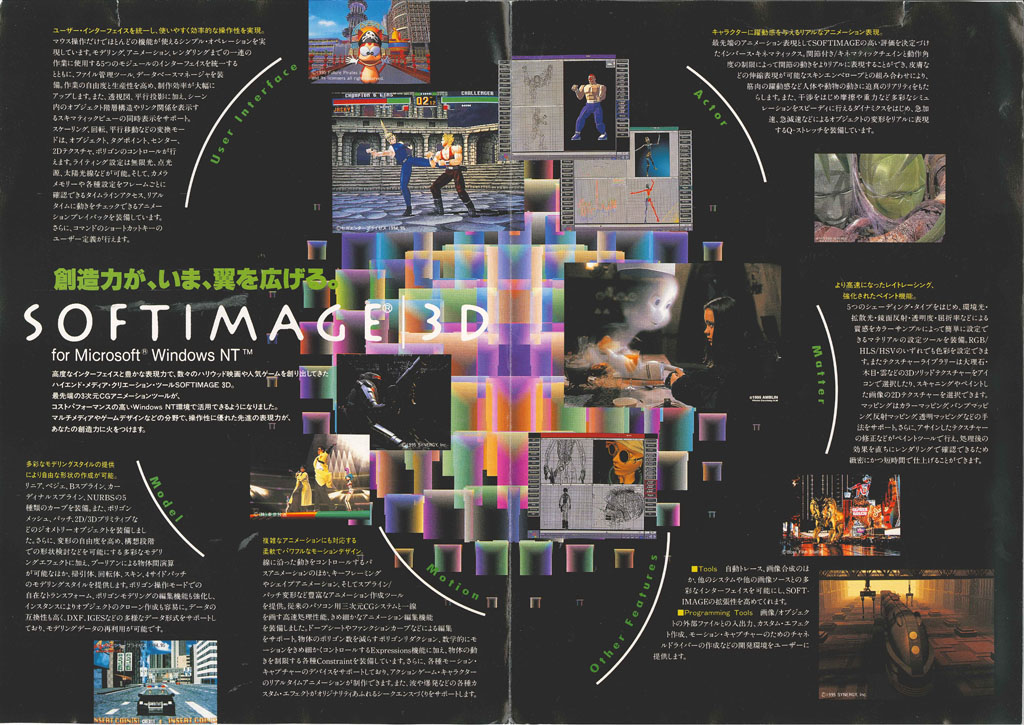
Japanese brochure for Softimage 3D.
I got this off of Twitter a few months ago, but I forgot where so I can’t credit this…
When you’re in a component selection mode (such as Edge, Polygon, or Point), the active objects are highlighted in orange. The “active objects” are the objects that are “active for component selection”.

When Softimage is in a component selection mode, the Selection will either by empty or it will contain CollectionItems (one for each object with selected components).
So, how do you get the active objects? Here’s one way, using the little known, magical “.[obj].”:
# Python
import win32com.client
oActiveObjects = win32com.client.Dispatch( "XSI.Collection" )
oActiveObjects.Items = ".[obj]."
// JScript
var oActiveObjects = new ActiveXObject( "XSI.Collection" );
oActiveObjects.Items = ".[obj].";
From Ciaran on the XSI mailing list, here’s a good example of how to find all light nulls whose names contain “lamp” or “light”:
oLightNulls = oModel.FindChildren2("{*light*,*lamp*}",c.siNullPrimType)
The curly brackets {} are used in a string expression to specify a list of objects.
That String Expressions page still looks pretty much the same as it did back in 1999, when I first wrote it!
In the Selection preferences, there’s a Selection Change Command text box where you can type in a command to run when the selection changes.

Here are two important points about the Selection Change Command:
Awhile back, I wrote a little script that used ElementTree to parse the XML returned by GetConnectionStackInfo. I posted the 2013sp1 version of the script here.
Anyway, I was a little surprised when I couldn’t get the script to run in 2012 SAP. I was sure that it used to work, but now it was giving me this error:
# ERROR : Traceback (most recent call last):
#   File "<Script Block >", line 17, in <module>
#     connections = ET.XML(stackInfo)
#   File "C:\Program Files\Autodesk\Softimage 2012.SAP\Application\python\Lib\xml\etree\ElementTree.py", line 962, in XML
#     parser = XMLTreeBuilder()
#   File "C:\Program Files\Autodesk\Softimage 2012.SAP\Application\python\Lib\xml\etree\ElementTree.py", line 1118, in __init__
#     "No module named expat; use SimpleXMLTreeBuilder instead"
# ImportError: No module named expat; use SimpleXMLTreeBuilder instead
#  - [line 17]
After digging into the problem a bit, I found that the Softimage install did indeed include expat, but Softimage wasn’t finding it…because I had deleted the Application\python\Lib\sitecustomize.py file!!! Doh.
I had deleted sitecustomize.py while investigating a problem report from a customer, and then I didn’t bother putting it back, because Python was still working in general.
sitecustomize.py adds paths like %XSI_HOME%\Application\python\DLLs to the sys.path, and pyexpat.pyd is in that DLLs folder.
Bake ICE data
by Oleg

Align center using faces
by Alan Fregtman

ICE: Emulating Maya Bones
by Alan Fregtman

No Rig muscles
by Paul Smith
Here’s a little Python snippet that creates a bunch of text objects, one for each item in a list. Note the handling of multiple lines (elements in triple quotes).
names = ["Test", """Coming
Soon""", "XSI",
"""one
two
THREE""", "SUMATRA"]

for n in names:
                text = Application.CreateMeshText("CurveListToSolidMeshForText", "siPersistentOperation")
                if n.find( "\n" ):
                                n = n.replace( "\n", "\\par\r\n" )
                                Application.SetValue(str(text) + ".crvlist.TextToCurveList.text.singleline", 0, "")

                Application.SetValue(str(text) + ".crvlist.TextToCurveList.text.text", "%s%s%s" % ("_RTF_{\\rtf1\\ansi\\deff0{\\fonttbl{\\f0\\froman\\fcharset0 Arial;}}\r\n\\viewkind4\\uc1\\pard\\lang1033\\f0\\fs20 ", n, "\\par\r\n}\r\n"), "")
                Application.SetValue(str(text) + ".extrudelength", 1, "")
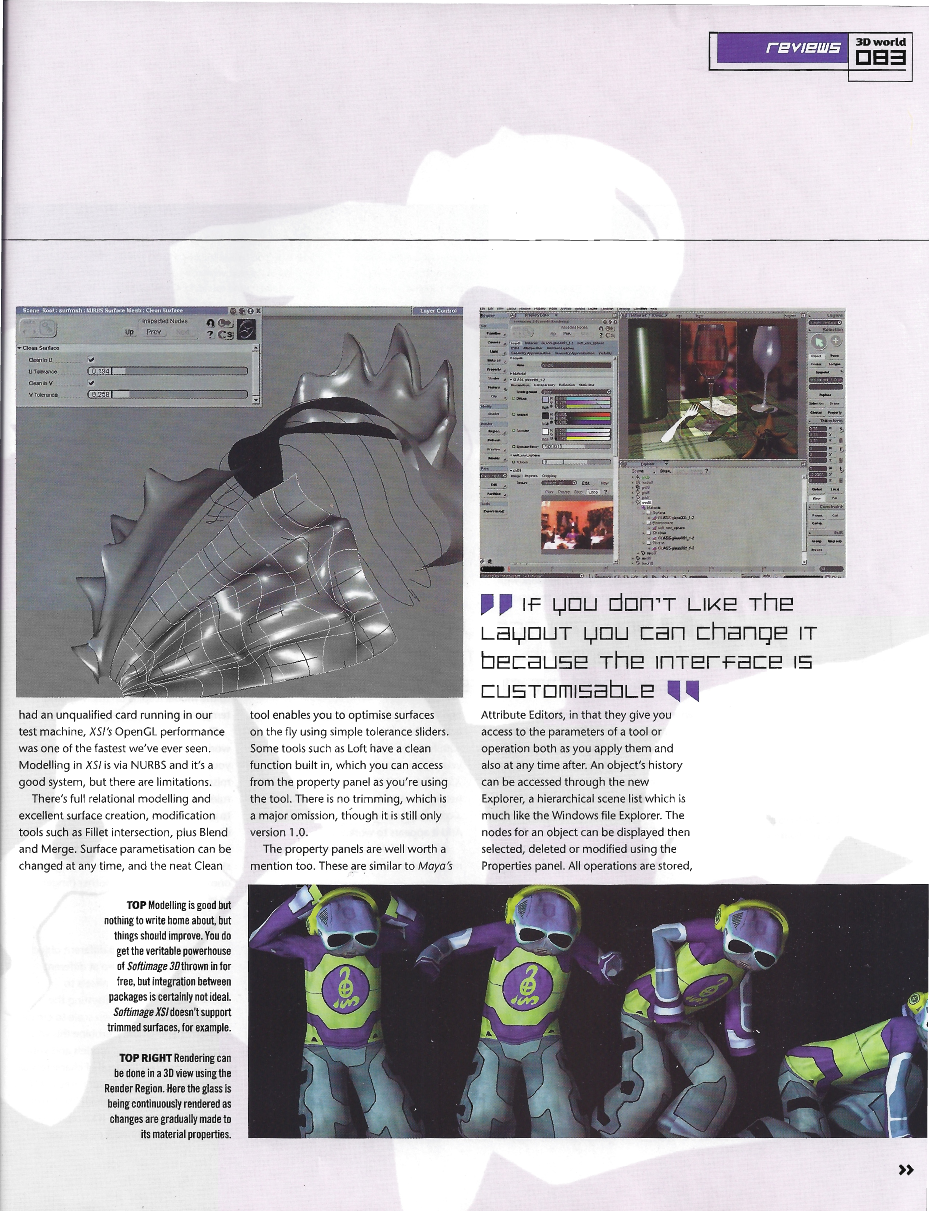
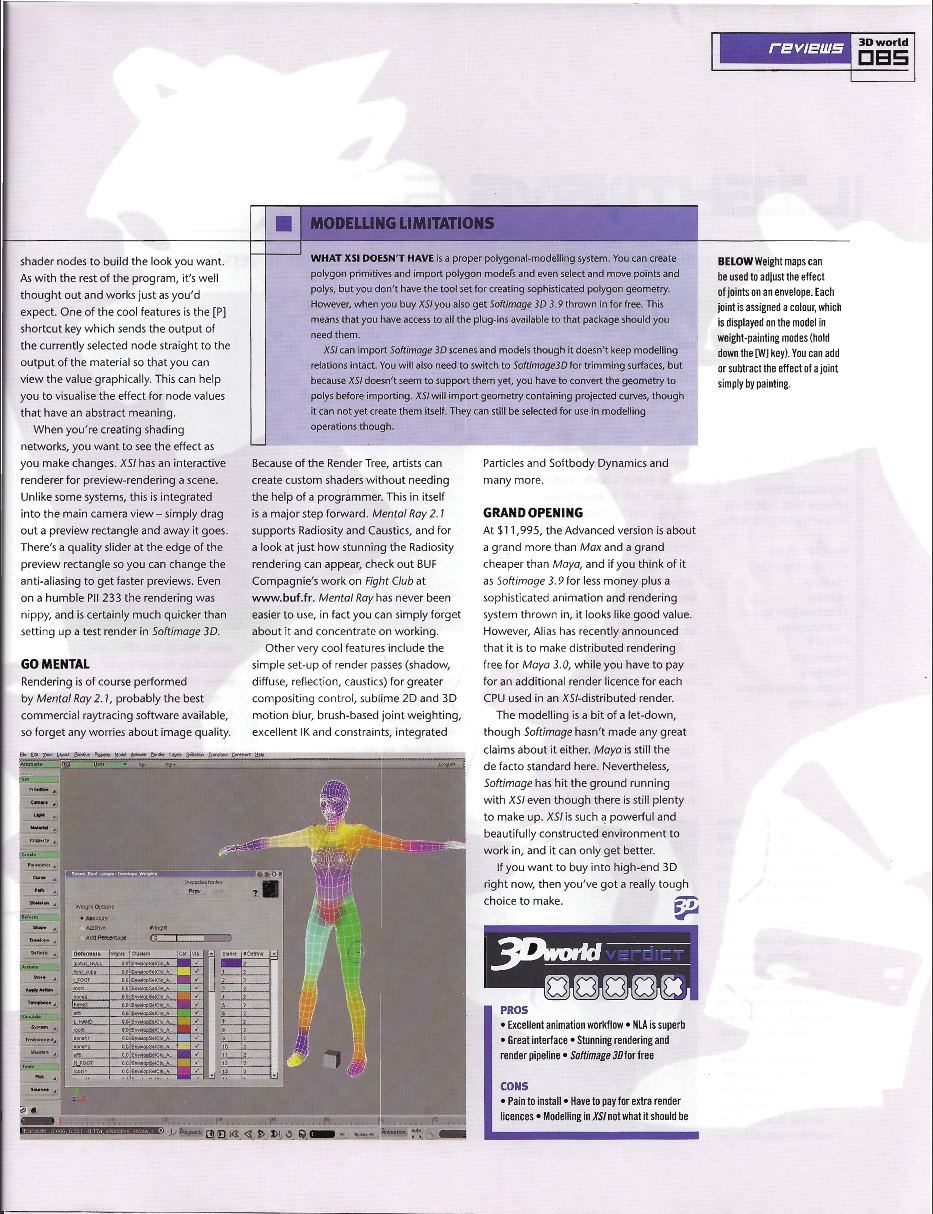
 Review of SOFTIMAGE XSI 1.0 from 3DWorld Magazine issue no 1, 2000.
To be honest, from the outset we were prepared to be underwhelmed by [XSI]…eclipsed as it has been by Maya [but] when you get down to it, XSI is simply a stunning piece of software and we wever very impressed
Hat tip to Daniel Brassard for kindly sending this in.


 eX-SI
eX-SI 