Friday Flashback #581


RENAISSANCE OF THE NERDS 
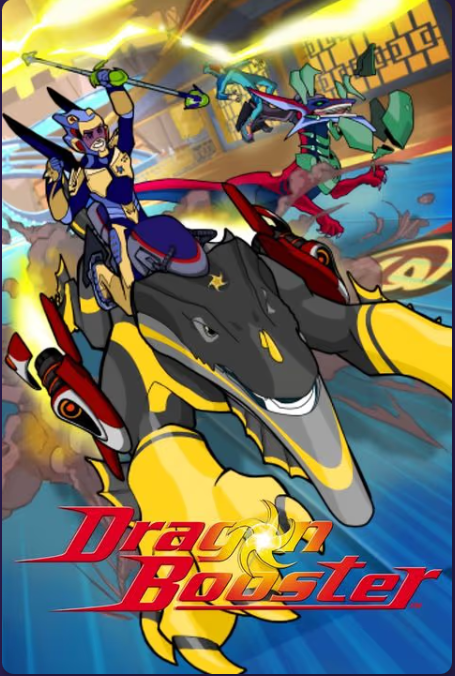
Nerd Corps Gets Busy On Dragon Booster


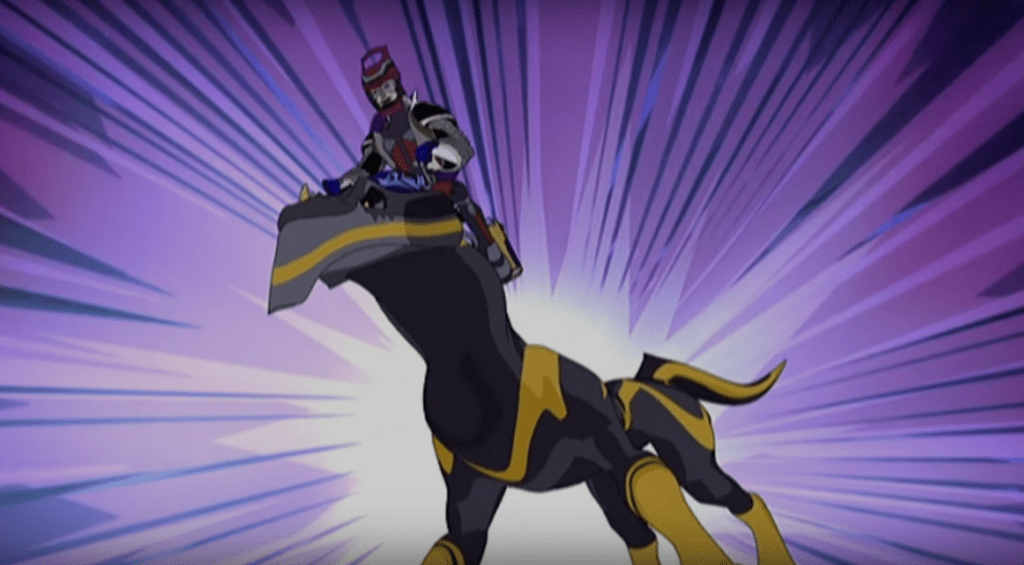
Vancouver’s Nerd Corps uses SOFTIMAGE|XSI’s Compositor, Net View, Synoptic View, Toon Ink lens shader, partitions, passes, overrides, FX Tree and lots more on 39 episodes of Dragon Booster.

By Michael Abraham


Some of you reading this might just be old enough to remember when being a nerd was, at least ostensibly, a bad thing. For the rest of you, just keep playing with your Tonkas and Barbies and let the old folks talk for a minute. If you simply can’t amuse yourselves, just scroll down until you see SOFTIMAGE|XSI

We still know the stereotype: tape on the bridge of the coke-bottle glasses, pocket protector full of pens and the obligatory slide ruler (remember those?), pants hiked to reveal an inch or so of pasty white skin, and an uncomfortably ardent passion for Carrie Fisher. The image may still be there, but the stigma sure ain’t. The last two decades have seen the smart guys getting the fame, the money and the girls. It has been a truly retributive renaissance for those eternally forward-thinking people who endured wedgies and noogies to reach the top of the heap. 

Case in point: Nerd Corps Entertainment in Vancouver, B.C. clearly represent the new nerds: 

“We’re more like neo-nerds,” says Chuck Johnson, Dungeon Master (or Senior Vice President of Production for the hopelessly square readers out there) at Nerd Corps. “We’ve got the same enthusiasm and affinity for technology, but we’re more comfortable and more accepted than our earlier versions. We really represent the evolution of the nerd in a lot of ways.” 

The evolution of Nerd Corps would have made Charles Darwin — himself a nerd by all accounts, and just look what he did! — very proud indeed. Three years ago, Nerd Corps Supreme Commander (a.k.a. President) Asaph “Ace” started up his own development and production shop. Shortly thereafter, Ace was approached by distributor Alliance/Atlantis and creators of The Story Hat to produce a cutting edge television series called Dragon Booster. So enticing was the project that Fipke convinced Johnson to start up CG production at Nerd Corps. 

Two years of natural selection later, Nerd Corps is now 70 nerds strong and well into production on Dragon Booster which is airing weekly on ABC Kids in the US and CBC in Canada. From storyboards straight through to final delivery, Nerd Corps provides all animation production services for the series. For all that activity, however, Johnson insists that the last two years have moved along surprisingly smoothly, thanks in part to SOFTIMAGE|XSI:

“It started with just Ace and I and handful of very talented nerds,” he says nostalgically. “We worked out of a small office for the first eight months or so, during which time our goal was to convince Alliance Atlantis that we could give them the best show for their money. One of our primary objectives was to figure out the most efficient 3D animation pipeline that would still allow the creative process to flow freely. Our initial pipeline test came in January 2003 when we used SOFTIMAGE|XSI to create a two-minute trailer for Dragon Booster. In December 2003, we got the green light for 39 episodes and by March 2004, we had seventy employees. When we were starting out, we had, what many considered to be, a pretty radical pipeline plan, but with the help and expertise of our top notch crew we managed to realize our vision and now we’ve got a highly efficient pipeline, a talented crew and a visually groundbreaking series in production. The Softimage Support gang has really been integral to this whole process. They’ve more than lived up to our expectations of a software partner. They really invested time with us, and it had a significant impact on our success.” 

Johnson also points to SOFTIMAGE|XSI’s fully integrated Compositor as a key benefit to Nerd Corps work on Dragon Booster: 

“Dragon Booster is really graphically styled, and we try to make everything as efficient as possible on a job this big,” Johnson explains. “Traditionally, television animation required so much in-scene 3D work that artists had tons of heavy work and rendering to do. SOFTIMAGE|XSI’s Compositor has enabled our animators to integrate more post-type effects and compositing into their animations. It has also taken things like camera shake and other time-consuming tasks and made them easy and fast. The Compositor saves us all kinds of time while also getting us the spectacular looks we need for this show.” 

Special effects and compositing itself falls into the realm Sandro Di Segni, Nerd Corps’ Lord of Illusions (a.k.a. VFX Supervisor). In addition to heaping more praise on Softimage support, Lord Di Segni singles out the FX Tree, Compositor, Particles and more for special praise on Dragon Booster: 

“The FX Tree was very useful,” says Di Segni. “We have also been working very closely with Softimage to further enhance the Compositor and we believe it’s only going to get stronger. SOFTIMAGE|XSI Particles and ease of modeling broken pieces of geometry and textures has been a great help to us. Partitions, passes and overrides are really strongly built in XSI, and that made all the difference when we were trying to get all these layers rendered for effects. Net View and the Synoptic Views have allowed us to organize our production in a way never before seen. We have also used Net View to organize our rigs and to make extensive documentation about them. Simply put, SOFTIMAGE|XSI provides features that, once you’ve used them, you can no longer live without them.”  

For Michael Monks, Nerd Corps’ Lord of Digital Massing (a.k.a. Modeling Supervisor), SOFTIMAGE|XSI holds still more benefits for Dragon Booster: 

“I considered our biggest challenge on the show would be to achieve a truly unique look,” says Monks thoughtfully. “Getting the look meant producing a huge volume of models in a relatively short amount of time. I found the Toon Ink Lens Shader really powerful, with sufficient control to draw good outlines around and inside the characters that have held up to the scrutiny of all of our episodes to date. One of the most useful aspects of SOFTIMAGE|XSI involved Scripting. With the help of our software team, we’ve been able to create a lot of productivity-based programs through Net View that handle many time-consuming tasks that would have otherwise bogged down production. That gives us more time to focus on the artistic rather than the technical.” 

Supervising Animator Rex Ahn is quick to agree with Monks regarding SOFTIMAGE|XSI Scripting before describing a few favorite features of his own: 

“I believe the flexibility of SOFTIMAGE|XSI has helped us immeasurably,” says Ahn. “Through its scripting capabilities, XSI is so customizable that we can really make the software cater to our needs. Instead of fighting against the software, which I was very accustomed to, the system actually helped us battle our deadlines. It helped all of us to fully realize our unique visions. We know that if we run into a problem, there is always a solution.” 

Ahn pauses for thought before continuing: 

“I really like SOFTIMAGE|XSI’s rendering philosophy with Passes and Partitions,” he says matter-of-factly. “Instead of breaking up layers into separate scene files and spending so much time loading, deleting and saving, layering shots can be done in one single scene.  If there’s an error, it can be repaired and set-up to be fixed on every layer in one pass instead of having to fix multiple scene files. The concept is wonderful and the execution is solid.  Having a built-in compositor that is as powerful as XSI’s FX Tree is a great boon to our production. Instead of having comps that are just ‘overs’, we can spice up shots and make each one look that much nicer. Simple features like Child Comp and Constraint Comp make rigging things very easy and quick.  Pose Constraint is my favorite, actually: I use it all the time.” 

And speaking of time, the Nerd Corps will be spending much of their time on Dragon Booster over the next couple of years. Much, but definitely not all, according to Johnson and Fipke, who have tailored their pipeline and company philosophy to ensure their cadre of nerds live balanced lives. 

“One of the biggest challenges that Ace and I anticipated at the beginning of this project was how to ensure we could keep the work looking great without burning out our crew,” he says philosophically. “Sometimes, episodic television can seem like it never stops and the amount of content that needs to be produced is just astronomical. We knew from the beginning that we were instituting a radically different pipeline and approach to production, so we were a little anxious about it working the way we hoped. Essentially, we’ve spread responsibility for the creation and execution of this project across a wider group of people than usual. We’ve tried to take down the walls between departments and utilize different people throughout the various stages of production. What’s more, we were absolutely adamant about one thing: we wanted our artists to have a good balance in their lives. We did a great deal of planning on the front end to make sure that our employees are able to perform their jobs in a standard workweek. We want our artists to work hard during the day to produce work they’re proud of and then go home and live their lives.” 

Suffice it to say that these nerds made it their way, and now they’ve got it made! 

Friday Flashback #345


Softimage “Twister” Enters Beta at SIGGRAPH

ORLANDO, Fla., July 20, 1998 — Softimage Inc., a wholly owned subsidiary of Microsoft Corp., announced today at SIGGRAPH 98 that its next-generation rendering system, code-named Twister™, is entering the beta test cycle with delivery to customers scheduled for the fourth quarter of 1998.

Twister is the first module of the soon-to-be-released 3-D animation platform, code-named “Sumatra,” which provides a revolutionary new approach to character animation and introduces the concept of nonlinear animation (NLA).

Twister is well-suited for use in combination with SOFTIMAGE® |3D version 3.8, now shipping to customers, which allows users to perform interactive rendering in a next-generation environment. Combining the power of mental ray® version 2.0 with the architecture and interface of the “Sumatra” next-generation 3-D platform, Twister fits neatly into the SOFTIMAGE|3D 3.8 workflow with an interactive tool set that complements and extends the functionality of the current-generation software.

Twister takes advantage of the forthcoming “Sumatra” user interface, which provides much smoother workflow and data access while maintaining the familiar and intuitive Softimage user environment that has become integral to much of the animation industry.

Twister will revolutionize the way people handle production-level rendering,” said Dan Kraus, product manager for Softimage. “Not only does Twister provide the next generation of mental ray, but it also makes tuning and editing scene-rendering parameters a completely interactive process. We fully expect Twister to set a new benchmark in the industry as the first truly interactive renderer.”

“As a beta test site for mental ray 2.0, we’ve been extremely pleased with the truly interactive nature of the tool set and we eagerly await the opportunity to put ‘Twister’ to use in our facility,” said Dave Throssell, head of 3-D animation at London-based The Mill FX.

“Twister seamlessly integrates mental ray 2.0 into the rendering environment, thereby taking full advantage of new functionality for both interactive and batch rendering.”


Interactive Renderer Delivers Improved Creativity and Workflow

Twister allows users to render directly in the 3-D view, with instant feedback that shows how parameter changes affect the final rendering quality. Whereas rendering was once a time-intensive process, it will now become essentially another viewing mode. This interactive view evaluates the entire scene-rendering tree, and it allows users to view and modify all rendering effects, including motion blur and shadow mapping.

Twister also integrates many production conveniences, such as scene-level renderpass definition, allowing users to predetermine all of the computer graphics passes to be used in a production.

Next-Generation Photorealism Sets New Standard for Quality and Workflow

Twister is based on mental ray version 2.0, a next-generation renderer that will set new standards for quality and workflow. In addition to significantly improved performance, mental ray version 2.0 offers a host of new features, such as depth-map shadows, scanline motion blur and polygon displacement, as well as support for caustics, which allows the renderer to accurately calculate and render the light diffusion around a scene.

Twister allows users to distribute jobs quickly and easily across multiple CPUs, both locally and remotely, using new techniques such as distributed tesselation and local texture caching for significantly improved distributed performance.

Pricing and Availability

Twister is scheduled to be available in the fourth quarter of 1998. Licensed users of the extreme version of SOFTIMAGE|3D under a valid maintenance contract will receive
Twister at no charge. Customers with the base version of SOFTIMAGE|3D will receive an approximately 50 percent discount on Twister.

About Softimage

Founded in 1986, Softimage develops software for media-rich applications including video, film, interactive games and CD-ROM applications. Products include SOFTIMAGE|DS (video production), SOFTIMAGE|3D (high-end animation), SOFTIMAGE|EDDIE (compositing) and Toonz (2-D cel animation). The company was acquired in 1994 by Microsoft. Additional information about Softimage and Microsoft can be found via the Internet at http://www.softimage.com/ and http://www.microsoft.com/ , respectively.

Founded in 1975, Microsoft (Nasdaq“MSFT”) is the worldwide leader in software for personal computers. The company offers a wide range of products and services for business and personal use, each designed with the mission of making it easier and more enjoyable for people to take advantage of the full power of personal computing every day.

Softimage is a registered trademark and Twister is a trademark of Softimage Inc., a wholly owned subsidiary of Microsoft Corp.

Microsoft is either a registered trademark or trademark of Microsoft Corp. in the United States and/or other countries.

Mental ray is a registered trademark of mental images Geselleshaft fur Computer Film und Maschinenintelligenz mbH & Co. KG, Berlin, Germany. All rights reserved.

Other product and company names herein may be trademarks of their respective owners.

Softimage general information:

United States and Canada: (800) 576-3846

International: (818) 365-1359

Note to editors: If you are interested in viewing additional information on Microsoft, please visit the Microsoft Web page at http://www.microsoft.com/presspass/  on Microsoft’s corporate information pages.

Friday Flashback #335


Interview with Joseph Kasparian
Textures & Lighting Lead on 300 at Hybride, Joseph Kasparian talks about creating 540 visual effects shots, the production process and how to work with completely green-screen shot movies.
March, 8th, 2007by Raffael Dickreuter 

1173333602_jo1
Joseph Kasparian, Textures &
Lighting Lead at Hybride.

Tell us how and why you got started in the cg industry?
When I was 18, I dreamed of becoming the lead guitarist of a big band that would tour around the world or becoming a professional skateboarder. For some enigmatic reasons, I ended up in Finance at the University of Montreal (HEC). But the day that I saw the T1000 in Terminator 2, I realized what I really wanted to do for a living and that would be Special Effects.

In 1992, a close friend of mine introduced me to the world of computer graphics. I realized that the possibilities were endless. I kept on studying full time in Finance but was spending 6 to 8 hours a day learning 3D at home. It was the biggest hobby I ever had.

When Jurassic Park came out, I heard the professional software used for the dinosaurs was Softimage 3D and that it was made in my hometown Montreal. My dream of working in that field was more than ever possible. As soon as I got my degree in 1996, I took a specialize course in 3D animation at the NAD Centre. Once I finished, I got a job at Hybride in 1997 as a 3D animator. It’s been 10 years now.

What do you like to do in your spare time?
For what I remember, I use to play guitar, mountain bike and snowboard. But now I have a 4 year old son and I’m trying to spend most of my spare time with him and my wife. So the correct answer would be I play with Legos and Transformers and make up my time to not miss the incredible kids channel shows.

Tell us about your responsibilities on 300 as Lighting and Texturing Supervisor
As the Textures and Lighting lead, I have to evaluate the complexity of each sequence with the supervisors. I establish procedures to speed up the artist’s work which includes constant R&D; on new techniques to texture and light scenes. I make sure the outputs of my team suit the compositors needs. I guide my colleagues technically as to follow the art direction and to keep the composition in place. And finally, I take care of delivering some of the more complex shots.

What were the biggest challenges in order to deliver the desired look on this production?
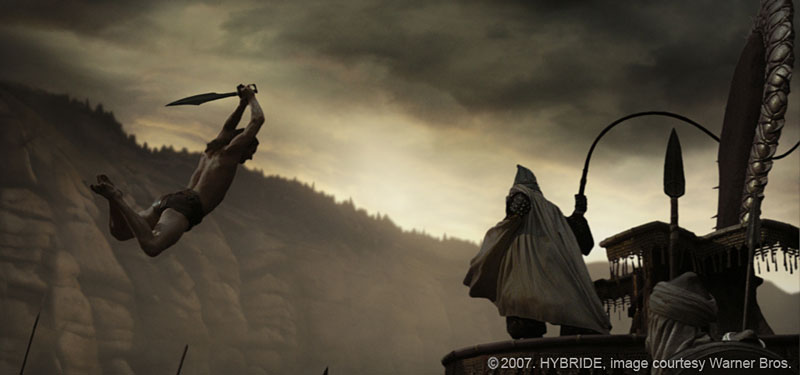
We had to transform the very stylistic look of the renowned American comic book author into film: silhouetted images, painted skies with brush-stroke effects, contrasting colors, charcoal blacks, and so on. For the environments created, each structure had to be an obvious part of Frank Miller surreal world before to be photo reel. The Hot Gates walls and skies were probably the most important aspect to define before to start the production. It was crucial that each vendor respects the exact same look. In order to help that process we received detailed documentation and concept arts about the look we had to achieve.

The wolf is another good example of the style they were looking for: a surreal beast in a photo real environment developed with an artistic touch. In the graphic novel, the wolf appears only as a huge black silhouette with red eyes. We kept those elements and integrated skin, muscles and hair to go a few steps closer to the real world.

jo5

What custom tools or techniques were used especially in the area of lighting?
Many lighting techniques were used depending on the location. At first, we had to rely on precise layouts. Once we had the client approbation and depending on the amount of shots, we chose to move forward with regular Textures and Lighting techniques or Matte paintings.

We created high dynamic range environments for each sets. The effort on textures was critical to accomplish the movie style. In fact, we had to reduce the contrast levels on the 3D side to bring them back with the live footage on the final comp. The combination of flat textures with dynamic lighting helped us deliver images that allowed great flexibility for extensive color correct sessions.

The textures created where either a mixture of procedurals done in Dark Tree called within XSI or a good use of quality pictures taken from the actual set.
The matte paintings were developed over shaded scenes lit using final gathering or light rigs.

For many locations, specific light rigs where built at a very early stage and we used internal scripts to automate the creations of the passes required by the compositing department.

What kind of inspirations were used to inspire the artists for this kind of look besides the comic book?
Sin City and Sky Captain and the World of Tomorrow were without a doubt a major influence because they allowed us to work on very stylized movies that were entirely shot on green screen. We acquired a great confidence and expertise in that kind of movie.

One of the biggest sources of inspiration was the artwork sent by the production. It definitely captured the essence of the comic book and gave us a great head start.
The detailed and very technical documents done from the art department were essential to define properly each location and to develop the appropriate look for the backgrounds and skies. Each section was defined by a specific color palette to the great pleasure of the artists.
jo4

How long was the production schedule for the team at Hybride?
Hybride produced 540 visual effect shots for a total of 45 minutes. A total of 95 Hybride employees worked on the project for 16 months. We were 45 in the 3d department, 35 in the compositing department and 15 in administration and technical support.

We had a wide variety of shots to do:

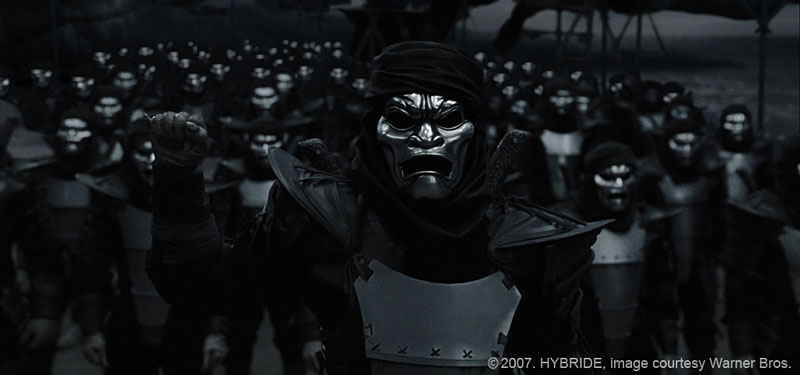
  • Animation: wolf, warriors (Spartans, Persians, Free Greeks, Immortals), troops animation (thousands of warriors), whip, banners, swords, weapons, spears, axes, etc…
  • Virtual Environments: backgrounds for all of our scenes, mountains, cliffs, plains, valleys, winter sceneries, oceans, skies (clouds, lightning, moon), etc.
  • Particles: Snow, embers, fire, rain, blood, smoke, dust, dirt.

Was the film entire shot in blue screen or to what extent is the film life action and to what extent cg?
Having shot the film entirely on a blue-screen background, each step involved in post-production required a considerable amount of work. The live footage included the heros and the ground. Everything else was CG.
jo3
How was the processing of the life action footage to not only blend with the cg elements but at the same time look stylized?
We had to start by matching the 3d environment to the live footage to pretend they were shot simultaneously. Once the integration done, we stylized the whole image with the help of different passes (mats, depth fading, etc…). The extensive use of color correct definitely eased the integration of the live footage with CG elements.

How was XSI used in this production? 
XSI was used to generate almost every 3d elements. The software was very efficient to create complex environments, to do character animation and to manage army scenes with more than a 100 000 soldiers.

jo2
Which features were especially useful?
The ability to built solid output pipelines with the creations of customizable passes was without any question a very important Feature in XSI.

These Features where also very usefull:
1. GATOR to transfers any surface attributes
2. Ultimapper to grab normal maps and occlusion maps.
3. The Render Tree to build complex shaders
4. The Fxtree to do practically everything with image clips.

Which areas of the software should be improved?
The procedurals could be improved in XSI. More than ever, we are asked to generate full cg environments and the usage of procedurals is very efficient for that need. It would also be nice to improve the Texture Editor with some tools such as Uv Layout’s flatten tool and Deep Uv’s Relax tool. And since Pixologic’s Zbrush is now used everywhere, it would be interesting to include a Ztool reader in XSI. That would allow to interactively change the meshes resolution in a different way than with referenced models.

jo6
Do you think we will see more movies in the future like this and what possibilities do you see in this kind of filmmaking?
More movies are shot entirely on green screen. The director can do what he wants with each shot. I think this way of filming will become a standard. The big advantage consists in the infinite freedom of creativity that last long after the shooting is achieved. For 300, the graphic quality quickly takes over the complex and technical aspect to generate the images. This allows the audience to plunge in Frank Miller’s fantasy world. It is obvious that a new trend of film is emerging, a trend that joins more than ever the art of telling a story with the art of drawing that story.

Is there anything you would like to say to the rest of the cg community?
Nothing is more thrilling than working in a field in constant explosion. Not evolution, explosion. Each year, I’m overwhelmed by the images produced by the movie and the game industry. All technical borders are falling apart. The tools are more efficient and the artists more talented. There is no doubt that everything that made this profession exciting ten years ago is true more than ever and I’m delighted to be part of it.


Hybride near Montreal, Canada.