Autodesk® Masters Award Winner – Helge Mathee – Softimage
Masters Award Winner – Helge Mathee – Softimage
1

In a recent case, a customer reported error 1603” during installation. As I’ve mentioned many times in various places, error 1603 is a generic error code that doesn’t tell us much. So, you can either apply some generic troubleshooting (reboot, check download, disable UAC, reinstall VC++ manually, …) or check the detailed installation logs for more specific information.
The problem is this specific case was that the installer wasn’t able to update ProductInformation.pit. Without looking at the logs, I don’t know whether you would ever figure this out.
Just like in programming, Repeat can be considered a generalization of While (K&R: the for loop is a generalization of the while).
The difference between While with Counter and Repeat with Counter is that when you use While with Counter, the counter doesn’t necessarily control the number of loop iterations. Typically you would use some boolean condition (for example, number of polygons reduced by more than 50%) to control the number of loops, rather than an incremented counter. The counter is a convenience, there for you to use inside the while loop.
Here’s a rather artificial example of equivalent While and Repeat loops. The While loop uses a counter inside the loop, and also in the condition. Note that I had to subtract one for the While loop, because inside While with Counter, the counter is incremented after the loop is executed.
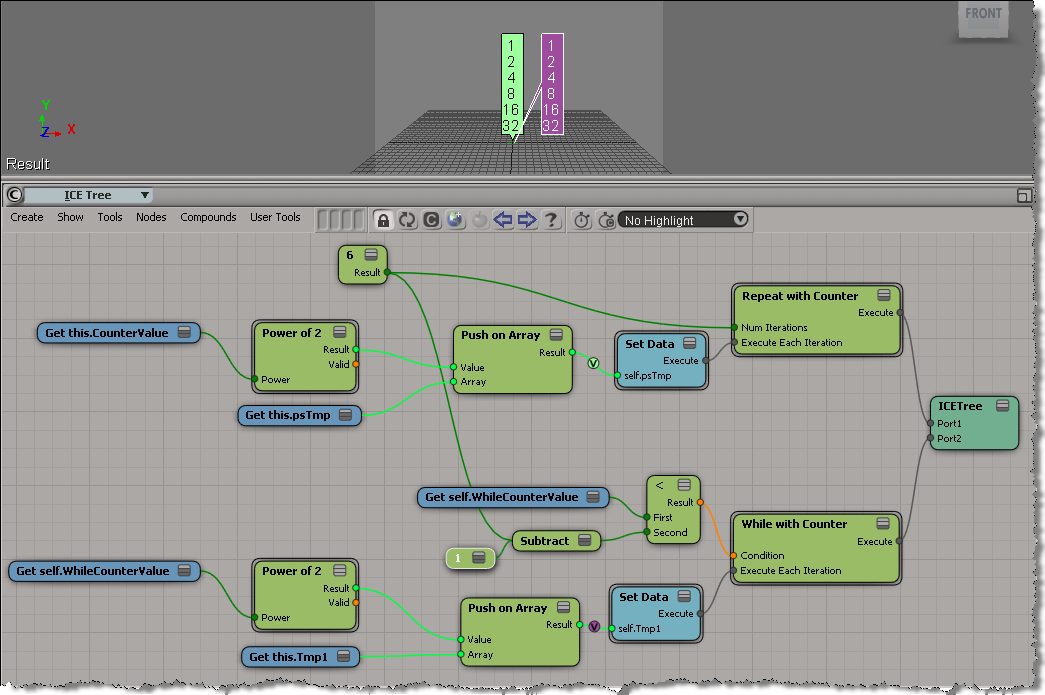
In this example, it would be simpler to just use the Max Repeats:

It seemed like such a nice, simple way to filter polygons:
With ICE, it’s pretty easy to check if the PolygonArea is within a certain range:

But, beware of ICE optimizations!
Because that ICE attribute isn’t used anywhere else in the scene, ICE doesn’t evaluate that tree, so my boolean attribute is never defined, and my custom filter therefore fails. I have to do something like Show Values to force evaluation:

Note: In Show Values, I used Show Values for Tagged Components Only to cut down the visual clutter.
FWIW, here’s a Python example of a custom subcomponent filter:
# psCustomFilter Plug-in
# Initial code generated by Softimage SDK Wizard
# Executed Wed Nov 23 11:31:56 EST 2011 by blairs
#
# Tip: To add a command to this plug-in, right-click in the
# script editor and choose Tools > Add Command.
import win32com.client
from win32com.client import constants

from siutils import si		# Application
from siutils import sidesk	# Desktop
from siutils import sidict	# Dictionary
from siutils import sifact	# XSIFactory
from siutils import simath	# XSIMath
from siutils import siproj	# ActiveProject2
from siutils import sisel	# Selection
from siutils import siuitk	# XSIUIToolkit
from siutils import siut	# XSIUtils
from siutils import log		# LogMessage
from siutils import disp	# win32com.client.Dispatch
from siutils import C		# win32com.client.constants


null = None
false = 0
true = 1

def XSILoadPlugin( in_reg ):
	in_reg.Author = "blairs"
	in_reg.Name = "psCustomFilter Plug-in"
	in_reg.Major = 1
	in_reg.Minor = 0

	in_reg.RegisterFilter("psCustomFilter",constants.siFilterSubComponentPolygon)
	#RegistrationInsertionPoint - do not remove this line

	return true

def XSIUnloadPlugin( in_reg ):
	strPluginName = in_reg.Name
	Application.LogMessage(str(strPluginName) + str(" has been unloaded."),constants.siVerbose)
	return true

# Match callback for the psCustomFilter custom filter.
def psCustomFilter_Match( in_ctxt ):
	Application.LogMessage("psCustomFilter_Match called",constants.siVerbose)

# 	Return value indicates if the input object matches the filter criterias.
	return true

# Subset callback for the psCustomFilter custom filter.
def psCustomFilter_Subset( in_ctxt ):
	log("psCustomFilter_Subset called",constants.siVerbose)

	out_coll = disp( "XSI.Collection" )

	in_coll = in_ctxt.GetAttribute( "Input" )
	for item in in_coll:
		log( item )
		polys = []
		for p in item.SubComponent.ComponentCollection:
			log( p.Index )

			attr = p.Parent.ICEAttributes("psCustomPolyFilter")
			if not attr.IsDefined:
				log( "Cannot apply filter. psCustomPolyFilter attribute is not defined" )
			if attr.IsDefined and attr.DataArray[ p.Index ] == -1:
				#log( "%d : %s" % ( p.Index, attr.DataArray[ p.Index ] ) )
				polys.append( p.Index )

		if len(polys) > 0:
			out_coll.Add( item.SubComponent.Parent3DObject.ActivePrimitive.Geometry.CreateSubComponent(C.siPolygonCluster, polys ) )


	in_ctxt.SetAttribute( "Output", out_coll )

# 	Return value indicates if a subset of the input objects matches the filter criterias.
	return true
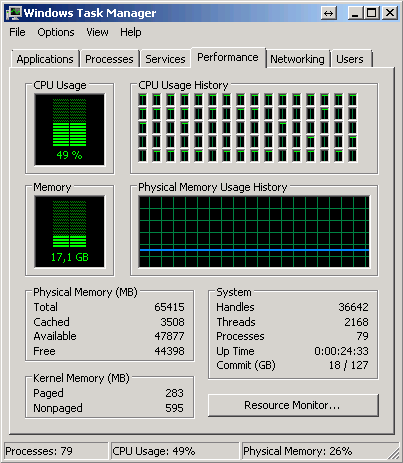
Task Mananger with 80 cores
Using Component Parser to create UV Pass to remap in compositing
by Neochris, February 05, 2010


You can press “.” (period) to repeat the last command (apart from selection, navigation, interactive manipulation, etc.) and “,” (comma) to reactivate the last tool (apart from selection, navigation, SRT).
Here’s a few shots of the old SOFTIMAGE|3D UI:
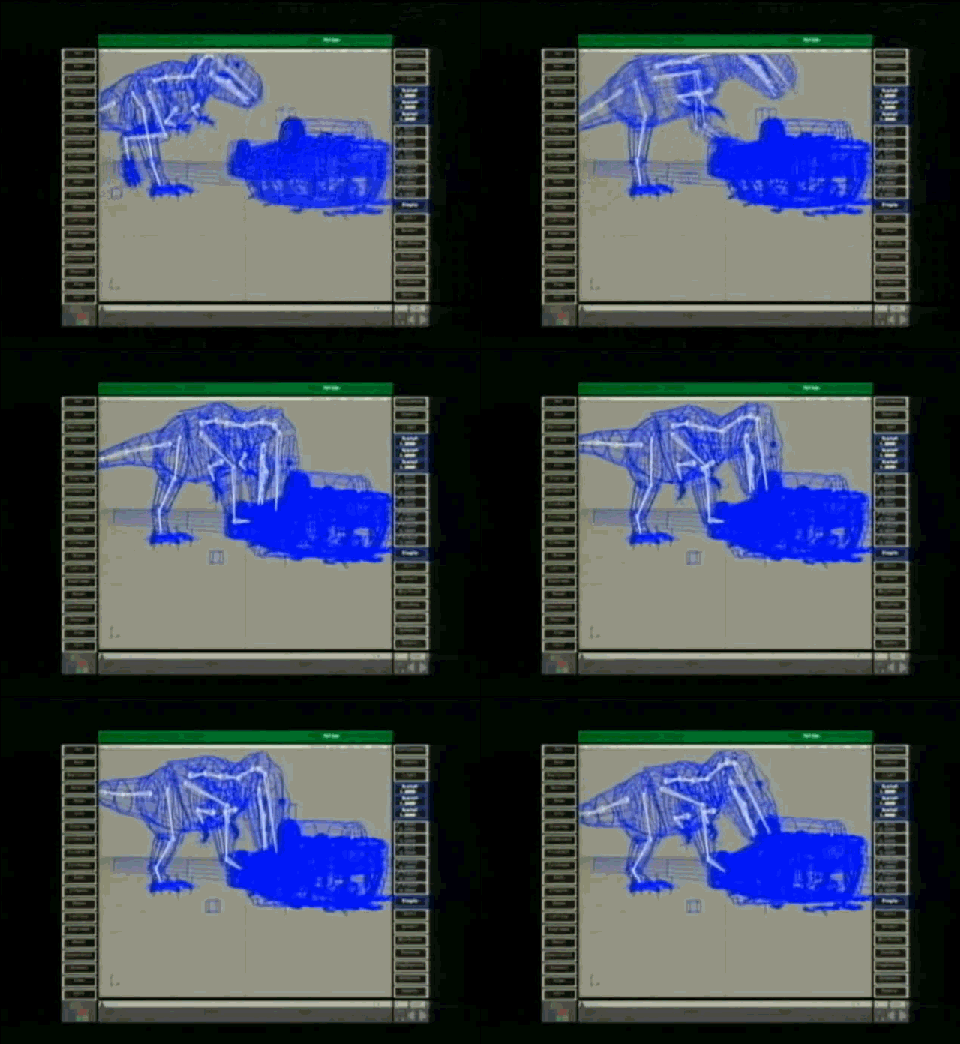
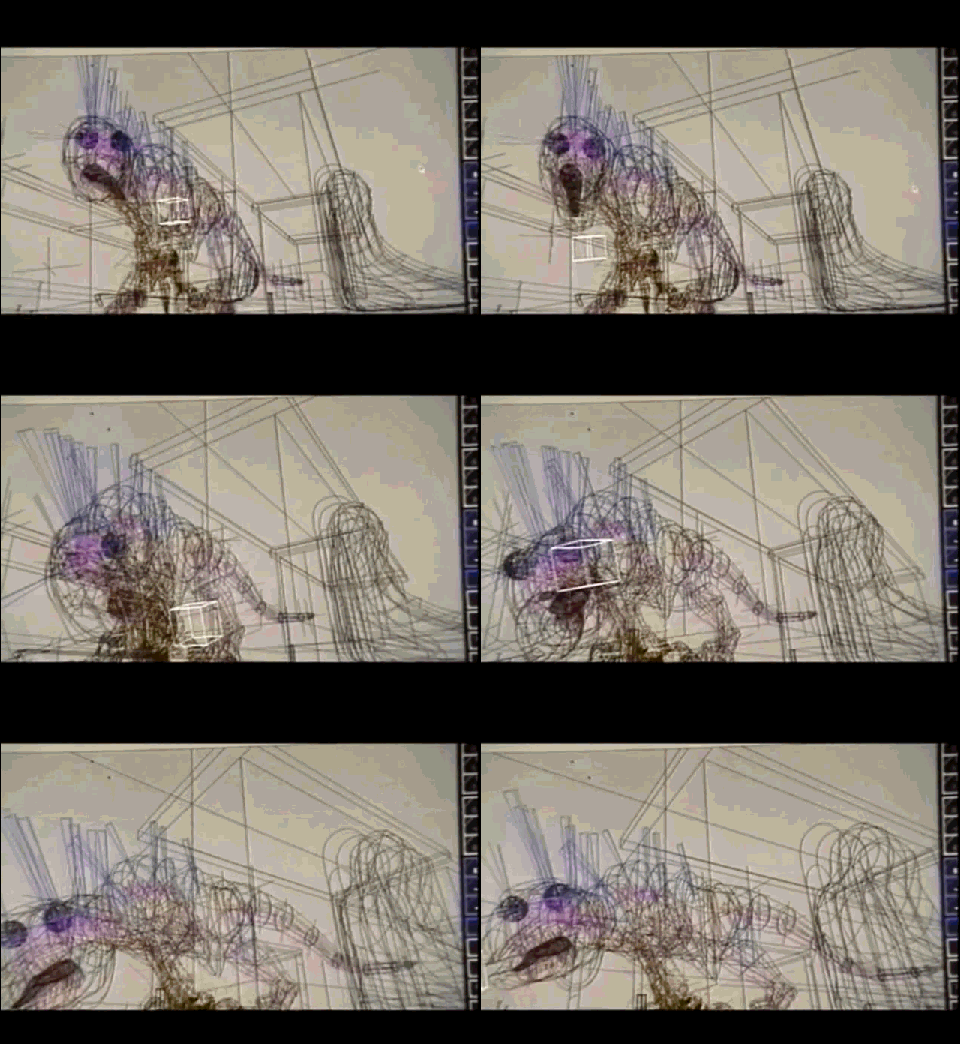
pulled from this “Jurassic Park – ILM – CGI before & after” video:
Thanks to Alan Fregtman for sending this in.
Basic troubleshooting for when you cannot start Softimage, or you get strange errors at startup, or you cannot perform basic tasks such as creating primitives or duplicating objects. Or for fixing Softimage after you run a registry cleaner.
Run runonce.bat to re-register the Softimage DLLs and SPDL files (SPDL files describe the parameters of objects and operators in Softimage).
runonce.bat does a lot of what happens during installation and it is a lot faster than removing and then reinstalling Softimage.
runonce.bat mentions on xsibase, si-community, the AREA, and the XSI list
or how I learned to love binary search…

In this case, a customer uploaded a scene that always crashed at a certain point in the playback.
After poking around the scene for awhile, I deleted a model and that fixed the crash. The only problem was that the model contained a thousand (1000) objects, so deleting the model wasn’t really a solution. So my next step was to isolate the problem use a “divide and conquer” approach. Sort of like a binary search:
In the end, I narrowed it down to a single mesh object. We weren’t able to save that mesh (it had to be deleted and then recreated), but we did save the scene.
A binary search halves the number of items to check with each iteration, so locating an item (or determining its absence) takes logarithmic time. A binary search is a dichotomic divide and conquer search algorithm.
Dividing and conquering the problem space:

Here’s a quick demo of the Post-Simulation region, and how it relates to an ICE simulation. In this video, I use a lattice deformation to demonstrate why you might put something in the Post-Simulation region.
 eX-SI
eX-SI 