Back in the old Softimage head offices on St Laurent, Manny had an original, circa-1980 ATARI-2600 on his desk. Notice of the Softimage “iconography” along the shelf above the Atari unit.


Back in the old Softimage head offices on St Laurent, Manny had an original, circa-1980 ATARI-2600 on his desk. Notice of the Softimage “iconography” along the shelf above the Atari unit.
Note: Autodesk store prices are always for Standalone licenses. Network licenses are usually about $750 USD more. Also, when comparing Subscription, make sure you are comparing the same levels of Subscription.
Softimage versus Maya. Softimage is cheaper, but if you go for Subscription, it always includes Advanced Support (which costs extra). The store offers only the slightly cheaper Basic Support for Maya Subscription (but you can buy Advanced Support for Maya).
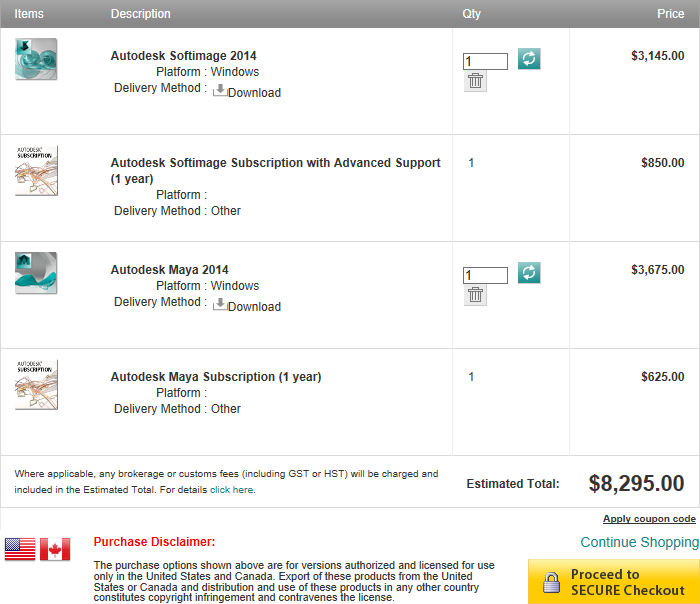
Suite pricing. For the Ultimate Suite, you have to take Advanced Support.

Current Softimage upgrade promotion:

Autodesk Quarterly Report, 31 July 2013

A few tidbits from the report…
For the six months ended July 31, 2013:
During the six months ended July 31, 2013, net revenue for M&E Animation decreased 10% primarily due to a 12% decrease in revenue from our flagship product, 3Ds Max, a 19% decrease in revenue from our M&E suites, which was driven by our Autodesk Entertainment Creation Suite and a 9% decrease in revenue from flagship product, Maya.
Flagship—Autodesk flagship products are our core design products. Flagship includes the following products: 3ds Max, AutoCAD, AutoCAD LT, AutoCAD vertical products (such as AutoCAD Architecture and AutoCAD Mechanical), Civil 3D, Maya, Plant 3D, Inventor products (standalone) and Revit products (standalone).
New and Adjacent—Autodesk new and adjacent products include Autodesk’s new product offerings as well as products that are not included in flagship or suites. New and adjacent includes the following services and products: Autodesk Alias Design products, Autodesk Consulting, Autodesk Buzzsaw, Autodesk Constructware, Autodesk consumer products, Autodesk Creative Finishing products, Autodesk Moldflow products, Autodesk Navisworks, Autodesk Simulation, Autodesk Vault products and all other products.
As you know, in Softimage all scalar (aka floating point) values are displayed with 3 (or sometimes 4) decimal places. For example: 0.333 instead of 0.33333333333…
One way to display the attribute value with greater precision is to use the Log Values node, and multiply the attribute value by some power of 10 (to get more digits). Hat tip to Leonard Koch for that suggestion.
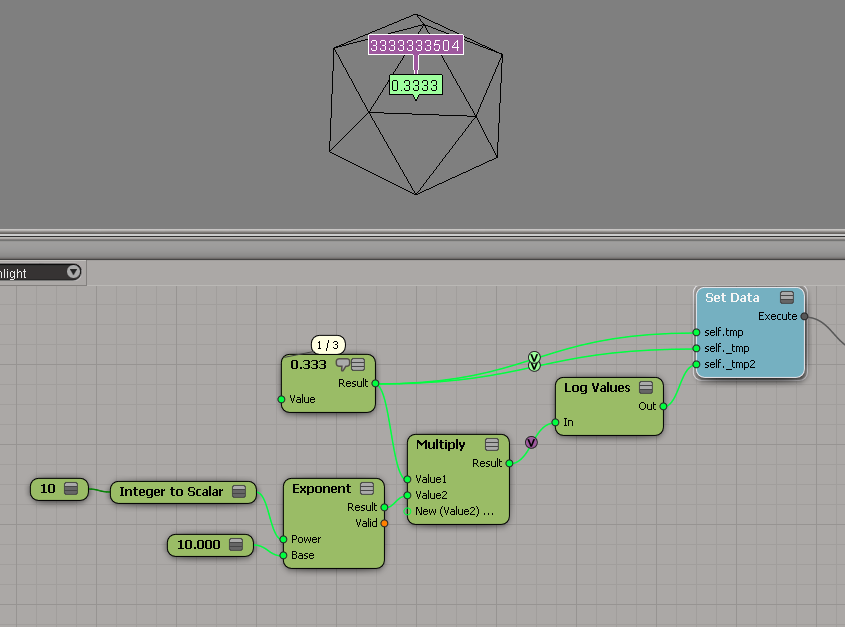
The above Log Values outputs this:
# INFO : 4000 - elt 0: 3333333504.000000
You could also use scripting. But note how I get 0 for the attribute named _tmp, even though it is clearly set to 0.3333333333333 in the ICE graph.
x = si.Selection(0)
y = x.ActivePrimitive.Geometry.ICEAttributes( "tmp" )
if y.IsDefined:
	print "tmp = %.10f" % y.DataArray[0]

y = x.ActivePrimitive.Geometry.ICEAttributes( "_tmp" )
if y.IsDefined:
	print "_tmp = %.10f" % y.DataArray[0]

# tmp = 0.3333333433
# _tmp = 0.0000000000
Finally, here’s a quick hack using a proxy parameter and the SDK explorer:

Softimage Creatives London user group
Gear Eyelids
More Making Of from RodeoFX
ICE used for the MGM ground crowds, the falling money (and some of the bills being sucked into the vents) and the fancy motiongraphic’y “projection” animated cubey stuff on the walls of the building shot.
https://vimeo.com/rodeofx/mgmgrandexplained
https://vimeo.com/rodeofx/nowyouseemesimulation
https://vimeo.com/rodeofx/nowyouseememotiondesign
Space Invaders
Icy Conditions
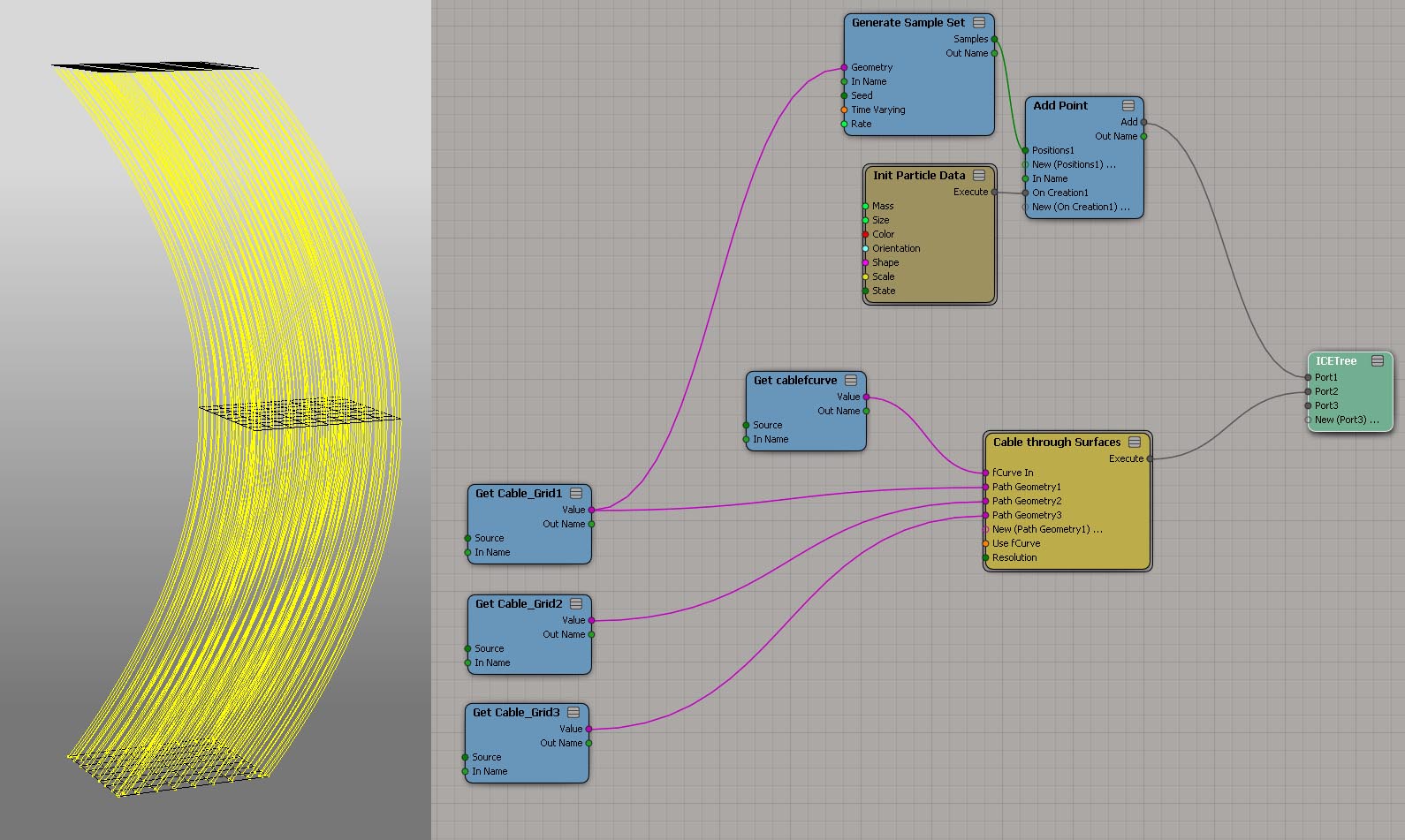
Strands through surfaces
by caledonian_tartan
Softimage back then
In fiscal years 1998, 1997 and 1996, one customer, two customers and one customer, respectively, accounted for 27%, 36% and 23% of total revenues. [source]
In fiscal years 1998, 1997 and 1996, one customer, two customers and one customer, respectively, accounted for 27%, 36% and 23% of total revenues.
Softimage markets its products worldwide. Revenues are grouped into three main geographic segments: North America, Asia Pacific and Latin America, and Europe. Financial data by geographic area for the fiscal years 1998, 1997 and 1996 is as follows (in thousands):
                                      1998      1997       1996
                                      -----     ------     ------
Net revenue:
   North America                     $9,754     $10,288    $8,471
   Asia Pacific and Latin America    17,931      18,111    11,280
   Europe                             9,175       9,356    10,218
                                     -------    -------    ------
      Total net revenues            $36,860     $37,755   $29,969
                                     =======    =======    ======

Operating income (loss):
   North America                   $(12,144)   $(20,334) $(30,962)
   Asia Pacific and Latin America       122         119       173
   Europe                               248         257       333
                                    -------     -------    ------
      Total operating loss         $(11,774)   $(19,958) $(30,456)
                                    =======     =======    ======
Identifiable assets:
   North America                   $ 19,724    $ 22,433  $ 23,241
   Asia Pacific and Latin America        53          75        62
   Europe                               910       3,075     5,868
                                    -------     -------    ------
      Total identifiable assets    $ 20,687    $ 25,583  $ 29,171
                                    =======     =======    ======
Autodesk today
Thirty percent of company revenues come from 1% of customers. [source]
As I wrote yesterday, there surely was a better way to get the neighbors of a specific point than messing around with a bunch of arrays. Here it is.
Hat tip to Eric Thivierge

There’s surely a better way, but this was a good little exercise in using ICE array nodes.

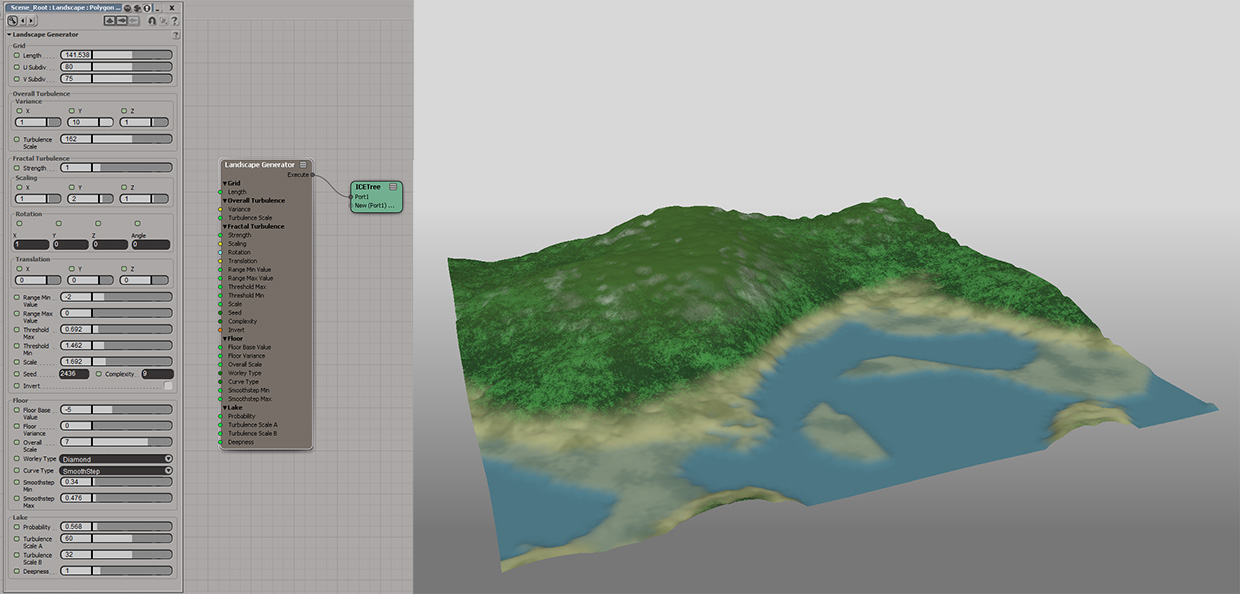
Landscape
by caledonian_tartan
Delete particles near boundary edge
UeberTage 2013 – Fabric Engine presentation (focus on Softimage)
https://vimeo.com/74638146
SOFTIMAGE|ÜberTage2013: Eric Mootz: “Current Developments”
Digital Duckroom by Luca Prasso from 1991
From a thread on renderglobal.org (excuse the Google translation from Italian):
Duckroom Digital and ‘had an idea in aerero to Montrealprima Siggraph 1990, then made in the offices of Softimage in Montreal in 9 days with the ‘equally legendary Olivier Ozoux. served to show the new features of Inverse Kinematics and Dynamics freshly baked from the R & D for the Soft version 1.63 or 1.65
Luca Prasso worked for Softimage Italy as a demo artist from 1990 to 1994, and then went on to work for PDI/Dreamworks for 17 years as a Character TD.
Bio from 2006:
I discovered that I was able to merge drawing and computer skills back in 1982, when the first personal computers appeared in Italy.
At the end of 1986 I joined Compgraf, a small studio in Verona, when I learned the fundamentals of Computer Graphics.
In 1989 I moved to Milan, working for Techex, as a demo artist of CG hardware and software solution. In 1990 I joined Softimage Italy as demo artist for their 3D software package.
With them I travelled the world demonstrating the products and helping to create animations. In 1994 I realized that the Italian CG market was not moving at the same pace of the rest of the world and I decided to seek a job in the US.
In January 1995 I joined PDI as Character Technical Supervisor. I worked on commercials, special effects, feature films and TV series (The Simpsons, Marvin the Martian). I was a Technical Director in charge of Crowd scenes for Antz.
I worked as Character Technical Director Supervisor for Shrek, that won in 2001 the Oscar™ as Best Animated Feature Film.
I then worked on Shrek 2 (released in 2004), Madagascar and Shrek 3 currently in production at PDI/DreamWorks. I’m currently part of a group in charge of designing and developing the next generation of proprietary software dedicated to character setup.
 eX-SI
eX-SI 