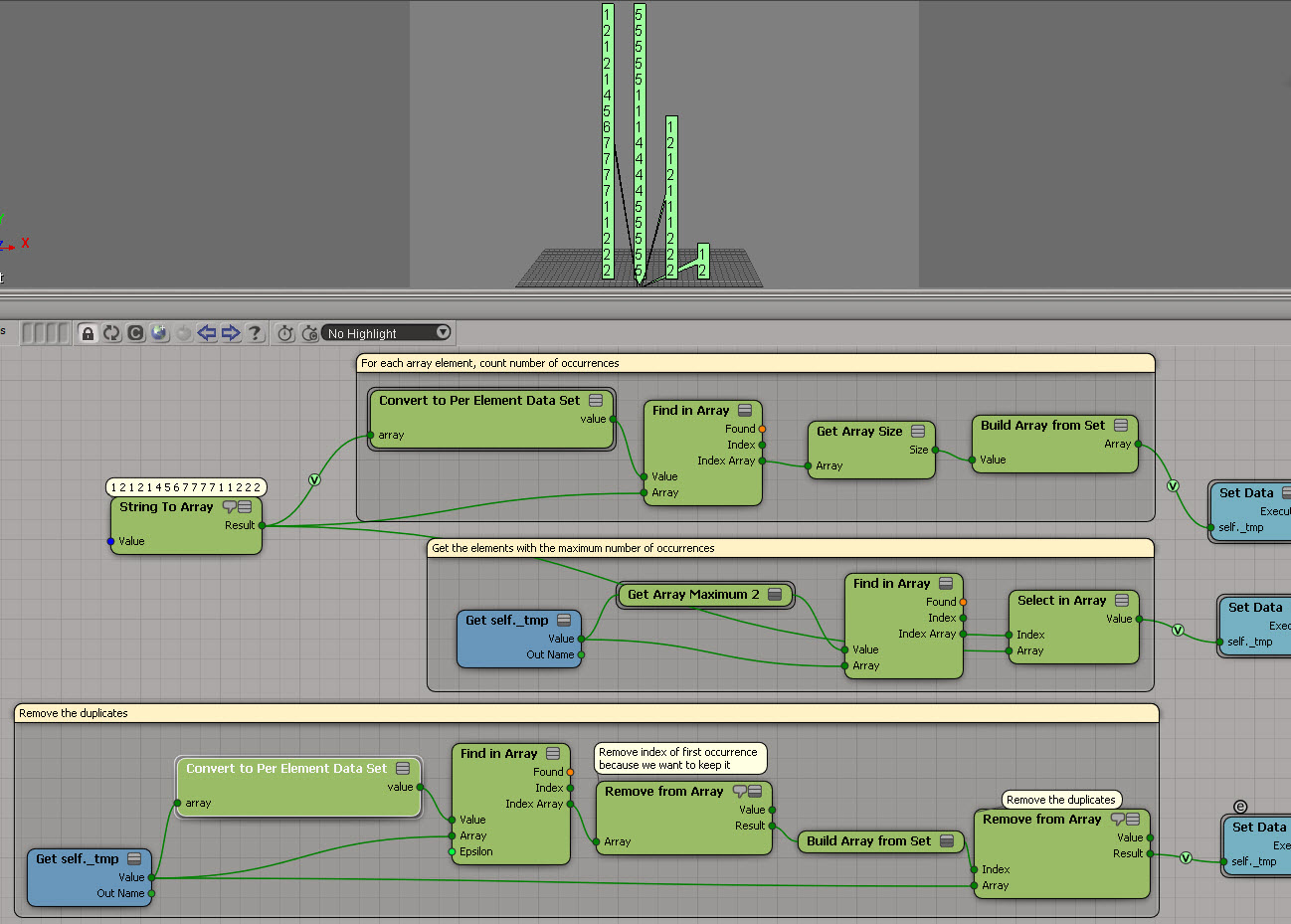
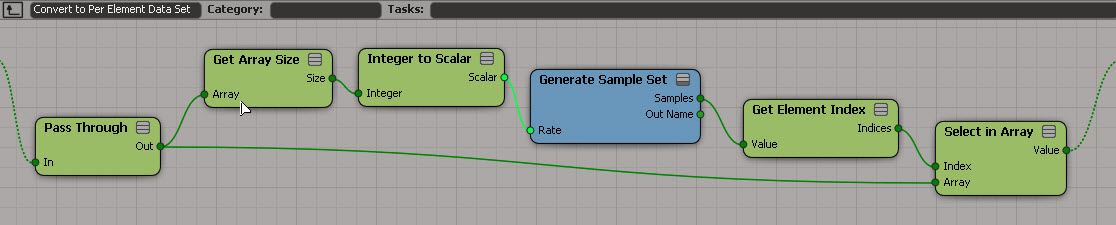
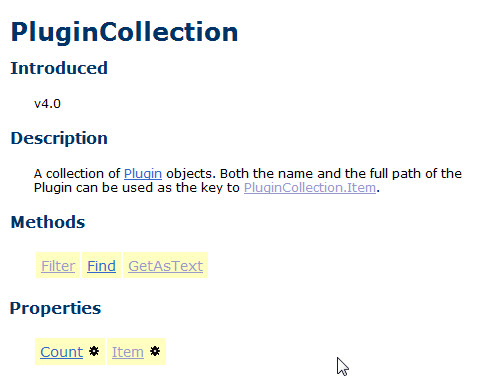
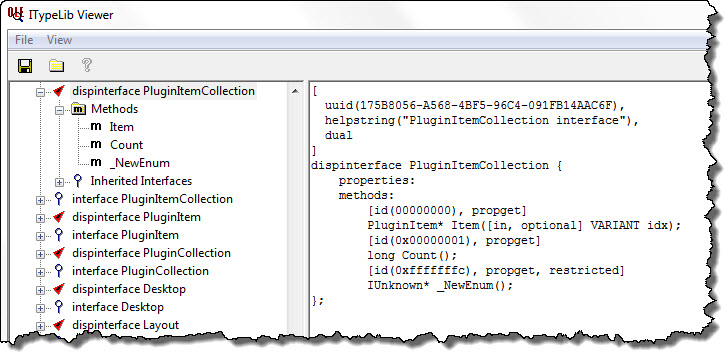
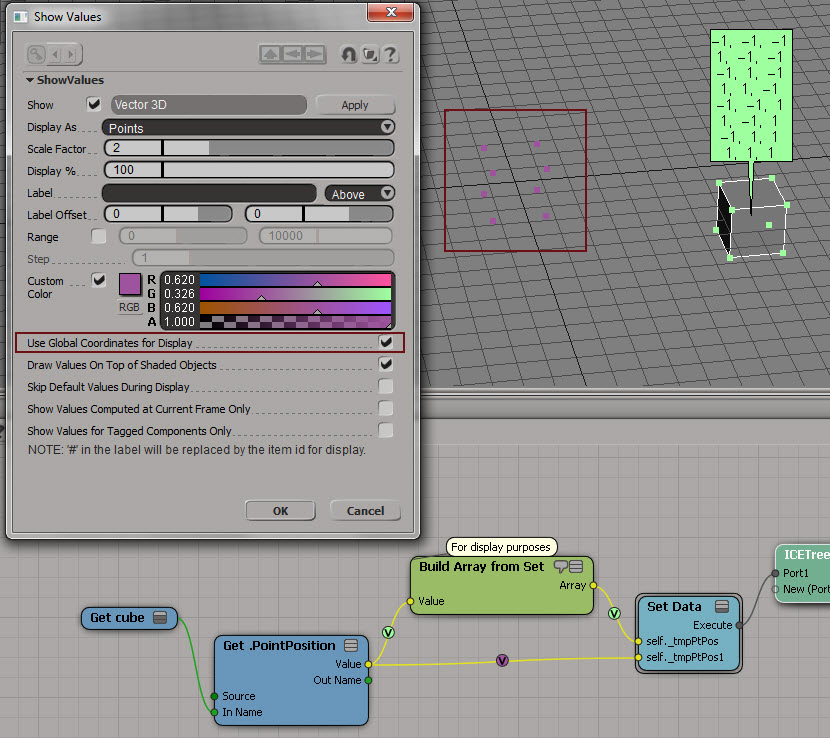
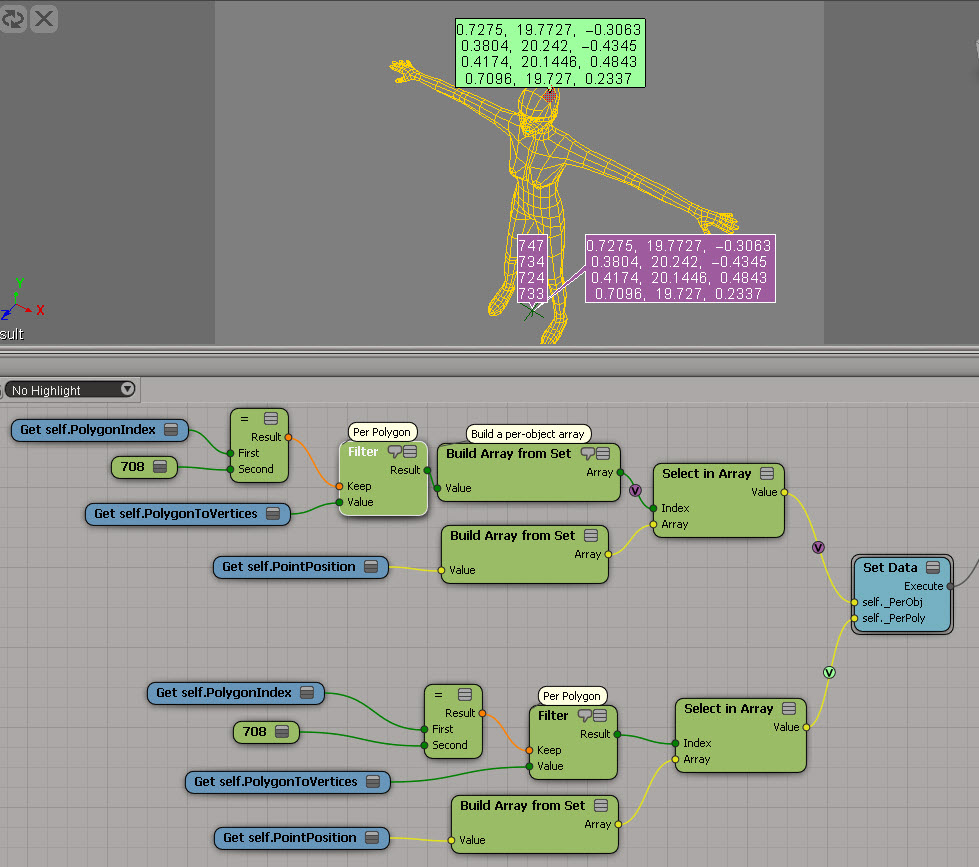
Here’s one way to take a PolygonIndex and get the corresponding point positions. I’m sure I’ve showed this in other ICE trees, but I always forget, so I’m posting this so I’ll be able to find it next time I want it 🙂

Screenshots of the week
Linkedin to me: “Picture yourself at Autodesk”
Ouch, linkedin…it’s only been six months. BTW, that picture of me? Taken at Autodesk, in the 90 Queen office.

Testing if a point is inside a cone
by Alok
One Thousand Ksoids Project
by myshli

Of you who do not use iron beams
(object selection using the material)
Saturday Snippet: Selecting a range of polygons by polygon index
Given a selected polygon, add the next 5 polygons to the selection. For example, if polygon 22 is selected, then add polygons 23,24,25,26, and 27 to the selection.
You can do this without using any loops, by using a string expression for the polygon components.
Here’s some JScript that shows two ways to do it. Method 1 uses a string expression. Method 2 is a loop, which can either use the Polygons collection or a string expression.
var o = Selection(0).SubComponent.Parent3DObject
var p = Selection(0).SubComponent.ComponentCollection(0)
var LAST = o.ActivePrimitive.Geometry.Polygons.Count;
// Method 1
// SelectGeometryComponents("grid.poly[22-27]", null, null);
var sPoly = ".poly["+p.Index+"-"+Math.min( p.Index+5,LAST-1 )+"]"
//SelectGeometryComponents( o.FullName + sPoly );
//Selection.SetAsText( o.FullName + sPoly );
// Method 2
//for ( var i = p.Index+1 ; i < Math.min( p.Index+5,LAST ) ; i++ )
//{
// ToggleSelection( o.ActivePrimitive.Geometry.Polygons(i) );
// -or-
// ToggleSelection( o.FullName + ".poly["+i+"]" )
//}
Here’s some Python that does something similar but different:
si = Application o = si.Selection(0).SubComponent.Parent3DObject p = si.Selection(0).SubComponent.ComponentCollection(0) LAST = o.ActivePrimitive.Geometry.Polygons.Count s = ".poly[%s-%s]" % ( p.Index, min( p.Index+5,LAST-1 ) ) si.SelectGeometryComponents( s )
Friday Flashback #108
Hmmm…last Friday was the 19th anniversary of the Microsoft purchase of Softimage (15 Feb 1994). I really missed it on that one. Now I’ll have to wait for the 20th anniversary; hopefully I’ll still be doing Friday Flashbacks this time next year.
Anyways, on to this week’s flashback…From Jurassic Park (1993) to Gladiator (2001), a “representative sample” of motion pictures created with Softimage products.
| TITLE | CUSTOMER | YEAR |
|---|---|---|
| Gladiator | Mill Film | 2001 |
| Jurassic Park 3 | Industrial Light & Magic | 2001 |
| Moulin Rouge | 2001 | |
| The Mummy Returns | 2001 | |
| Shadows | Mitch Levine Director | 2000 |
| Star Wars: Episode 1 The Phantom Menace | Industrial Light & Magic | 2000 |
| X-MEN | Pacific Ocean Post | 2000 |
| Fight Club | Pixel Liberation Front & BUF | 1999 |
| Forces of Nature | Dreamworks Pictures | 1999 |
| Galaxy Quest | Industrial Light & Magic | 1999 |
| Stuart Little | Centropolis FX | 1999 |
| The Mummy | 1999 | |
| Antz | Pacific Data Images & Dreamworks Pictures | 1998 |
| Babe: Pig in the City | Animal Logic | 1998 |
| Deep Impact | Industrial Light & Magic | 1998 |
| Deep Rising | Industrial Light & Magic | 1998 |
| Fear & Loathing in Las Vegas | Peerless Camera | 1998 |
| Flubber | Industrial Light & Magic | 1998 |
| Godzilla | Centropolis | 1998 |
| Jack Frost | Industrial Light & Magic and Warner Bros | 1998 |
| Jurassic Park 2 | Industrial Light & Magic | 1998 |
| Lost in Space | Framestore | 1998 |
| Matrix | Animal Logic | 1998 |
| Meet Joe Black | Industrial Light & Magic | 1998 |
| My Favorite Martian | Tippett Studio | 1998 |
| Prince of Egypt | Dreamworks Pictures | 1998 |
| Saving Private Ryan | Industrial Light & Magic | 1998 |
| Small Soldiers | Industrial Light & Magic | 1998 |
| Snake Eyes | Industrial Light & Magic | 1998 |
| Species II | Digital Magic & Transfer | 1998 |
| Sphere | Cinesite | 1998 |
| The Borrowers | Framestore | 1998 |
| The Thin Red Line | Animal Logic | 1998 |
| What Dreams May Come | Pacific Ocean Post | 1998 |
| A Simple Wish | Blue Sky | 1997 |
| Air Force One | Cinesite | 1997 |
| Alien Resurrection | Blue Sky – VIFX | 1997 |
| An American Werewolf in Paris | Santa Barbara Studios | 1997 |
| Anastasia | Fox Animation Studio | 1997 |
| Batman and Robin | BUF Compagnie | 1997 |
| Contact | Sony Pictures Imageworks and Weta Ltd. | 1997 |
| Men in Black | Industrial Light & Magic | 1997 |
| Mortal Kombat:Annihilation | The Digital Magic | 1997 |
| Spawn | Industrial Light & Magic | 1997 |
| Speed 2 | Industrial Light & Magic | 1997 |
| Starship Troopers | Tippett Studio | 1997 |
| Star Wars Trilogy | Industrial Light & Magic | 1997 |
| The Edge | Peerless Camera | 1997 |
| The Fifth Element | Digital Domain | 1997 |
| The Lost World | Industrial Light & Magic | 1997 |
| The Relic | VIFX | 1997 |
| Titanic | Digital Domain | 1997 |
| 101Dalmations | Industrial Light & Magic | 1996 |
| 12 Monkeys | Peerless Camera | 1996 |
| Dragonheart | Industrial Light & Magic | 1996 |
| Eraser | Mass Illusion | 1996 |
| Joe’s Apartment | Blue Sky | 1996 |
| Mars Attack! | Industrial Light & Magic | 1996 |
| Mission Impossible | Industrial Light & Magic | 1996 |
| Space Jam | Industrial Light & Magic | 1996 |
| Star Trek:First Contact | Industrial Light & Magic | 1996 |
| Surviving Picasso | Peerless Camera | 1996 |
| T2-3D | Digital Domain | 1996 |
| The Adventures ofPinocchio | MediaLab | 1996 |
| The Frighteners | Weta Ltd. | 1996 |
| The Island of Dr. Moreau | Digital Domain | 1996 |
| Balto | Amblimation | 1995 |
| Casper | Industrial Light & Magic | 1995 |
| Judge Dredd | 1995 | |
| Jumanji | Industrial Light & Magic | 1995 |
| La Cite des Enfants Perdus | BUF Compagnie | 1995 |
| Star Trek:Generations | Industrial Light & Magic | 1994 |
| The Flinstones | Industrial Light & Magic | 1994 |
| The Mask | Industrial Light & Magic | 1994 |
| The Shadow | R/Greenberg & Associates | 1994 |
| Death Becomes Her | Industrial Light & Magic | 1993 |
| Jurassic Park | Industrial Light & Magic | 1993 |
PolygonPosition is read-only
Too bad, I had such big plans for this 🙂

So, now that I’m at a dead end, let’s go over the different ways to figure out why a node is red…
Point to the node and wait for the tooltip to show the first error:

Right-click the node and click Show Messages.
(Log port type details can be useful sometimes, but not in this particular case.)

Read the documentation.

ICE: adding consecutive elements in an array
I was hoping to do something more complicated, but I ran out of time…
Here’s the exercise: Take an array and build a new array by adding consecutive elements in the original array.
For example, given this array:
1 3 2 4 7 5 6 9 11 1 3 9
construct this array:
1+3, 3+2, 2+4, 4+7, ..., 3+9
Summing up three consecutive elements will hopefully be more interesting…
Given vertex index get point position
Three different ways to get the point position coordinates for a given vertex index.
In terms of getting to a per-object context, Point Index to Location seemed the most straightforward.
Using Generate Sample Set to avoid the Repeat node
Hat tip to Oleg who posted this tip on the mailing list some time ago.
The basic ideas is that instead of looping over an array with a Repeat with Counter, you use Generate Sample Set to get a data set, and you do everything in a per-generated element context.
As an example, let’s revisit the problem of taking one array and creating a new array where each element is the sum of the elements before it.
The old way, with a Repeat with Counter node, looks like this:

Using Generate Sample Set, you can work with a data set and use that to access the array elements:

Generate Sample Set is set up to give an exact number of samples:

Screenshots of the week
Particle clumping
by Andy Moorer

MatCap (litsphere) shading in Softimage 2013
by Andy Moorer

Matcap render tree
by Gustavo E Boehs

MatCap Mirror ball/Map ball
by Gustavo E Boehs

Paint polygons by weightmap delete holes
by Tekano

Layers
by Maximus

How to convert weightmap to geometry in softimage ICE tutorial
Old school Quantum Teleportation
Saturday Snippet: Getting data from a DataArray2D ICE attribute
I wanted to do this JScript, but I had to do it in Python first, to establish that it was actually possible (with JScript, you’ve got to mess around with VBarrays and such).
# Using one of the CrowdFX sample scenes:
Application.SelectObj("Pedestrian_Mesh.Actor_Copies", None, None);
o = Application.Selection(0)
a = o.ActivePrimitive.Geometry.GetICEAttributeFromName("Materials")
print len(a.DataArray2D)
print len(a.DataArray2D[0] )
print a.DataArray2D[0][0]
for s in a.DataArray2D[0][0]:
print s
# 1
# 1
# (u'', u'Sources.Materials.PedestrianLib.Shoes', u'Sources.Materials.PedestrianLib.Hair', u'Sources.Materials.PedestrianLib.Legs', u'Sources.Materials.PedestrianLib.Skin', u'Sources.Materials.PedestrianLib.Shirt')
# Sources.Materials.PedestrianLib.Shoes
# Sources.Materials.PedestrianLib.Hair
# Sources.Materials.PedestrianLib.Legs
# Sources.Materials.PedestrianLib.Skin
# Sources.Materials.PedestrianLib.Shirt
After I had it working in Python, I was able to figure it out in JScript:
// Using one of the CrowdFX sample scenes:
SelectObj("Pedestrian_Mesh.Actor_Copies", null, null);
o = Selection(0);
a = o.ActivePrimitive.Geometry.GetICEAttributeFromName("Materials");
x = new VBArray( a.DataArray2D ).toArray();
y = new VBArray( x[0] ).toArray();
for ( var i = 0; i < y.length; i++ )
{
LogMessage( y[i] );
}