
Macross Zero:
The world of box art created by custom shaders



Macross, which has captivated many fans since its broadcast began in 1982 and celebrated its 20th anniversary last year, has introduced a new series. This momentous new series, Macross Zero, is said to be the first in the series to utilize full CG. This time, we would like to introduce how SOFTIMAGE|XSI was used in the production process of Macross Zero.
“Super Dimension Fortress Macross,” which aired approximately 20 years ago and garnered a huge response, remains vividly in people’s memories even now. The sense of realism in the battle scenes, in particular, is incredibly powerful. In the new series, these battle scenes are rendered in 3DCG, resulting in even faster-paced and more impactful visuals.
The first episode of the original video animation is currently on sale, but let me briefly introduce the story here. In 1999, the Earth Unification War erupts over the advanced technology brought by an alien warship that crashed to Earth. Eight years have passed since then, and the war continues. In this era, Shin Kudo (the protagonist), a young pilot of the United Nations Forces, sorties in his F-14 but makes an emergency landing on a remote island in the South Seas. However, an unusual energy signature is detected on the island, and both the United Nations Forces and the anti-United Nations Forces are preparing to invade. And so the story continues to the second episode.
“The opening scene of the OVA ‘Macross Zero,’ featuring the F-14 launch and the appearance of the variable fighter VF-0, including the aerial combat and transformation, was produced using SOFTIMAGE|XSI. We were fortunate to have Mr. Hiroyuki Kajima , Mr. Atsushi Sakiyama, and Mr. Tomisaburo Hashimoto (titles omitted below), who produced this part, cooperate with us for an interview despite their busy schedule working on the second episode of ‘Macross Zero.’ Mr. Kajima previously worked as a technical director at Avan Co., Ltd., involved in the production of CG images such as Thunder Bunny , but later became a freelancer and is currently active as a unit with Mr. Sakiyama and Mr. Hashimoto in various video production fields such as PVs and animations.”
The integrated design philosophy is well-suited for small-team productions.
“We’ve been using SOFTIMAGE|3D for a long time, and with SOFTIMAGE|XSI, we thought we could make full use of our data libraries and know-how, and create even higher quality products,” Kashima explained, describing his reasons for choosing SOFTIMAGE|XSI. “The design philosophy is to integrate all functions such as modeling, animation, and texture setting. For a small unit like ours, it’s necessary to perform these processes simultaneously rather than sequentially.”
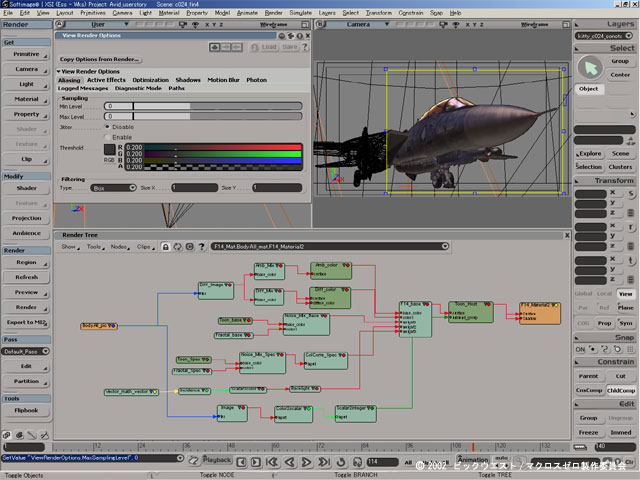
“We want to propose new forms of visual expression without being bound by existing methods such as texture and animation. When trying to create such unfamiliar expressions, relying on basic functions and plugins tends to result in generic images that look like they’ve been seen somewhere before. With XSI, you can create entirely new shaders by combining them, making it easier to create unique expressions that are unique to each individual. For ‘Macross Zero,’ the director wanted to create new visuals, so we decided to incorporate the style of model kit box art, and I think we were able to create something that can be considered the first step in that direction thanks to XSI’s flexible design,” he said, highlighting the high level of flexibility of SOFTIMAGE|XSI.
For “Macross Zero,” due to the production process with other groups, modeling was done in SOFTIMAGE|3D and not in XSI. However, Kashima commented on XSI modeling, saying, “Using subdivision surfaces allows you to model the desired shape with fewer vertices, which not only reduces the amount of data but also lessens the workload in all aspects, such as texture editing and envelope weight adjustments, ultimately leading to improved quality. It was a real shame that we didn’t use it this time.”
Posing as if drawing key frames for cel animation.
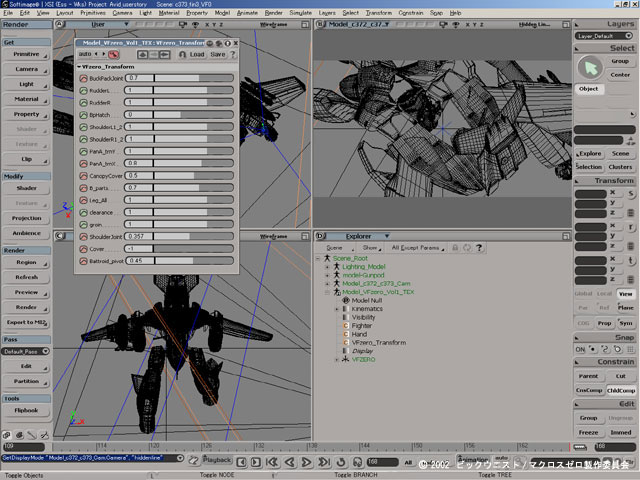
Regarding the animation features, he said: “In Macross Zero, there are scenes where the variable fighter VF-0 transforms from fighter to gerwalk to battroid, and the transformations needed to be perfectly consistent, not just a quick fix in each cut. To achieve this, we used the custom parameter function to create a setup specifically for transformations, allowing animators to create complex transformation animations simply by controlling sliders for each part. Furthermore, XSI’s key interpolation allows for fine-tuning, enabling various movements with fewer keyframes. We also created a script to ‘set animation keys’ for specific objects, allowing animators to focus on posing and creating silhouettes for characters and other elements. It was as if they were drawing key frames for traditional cel animation, refining the posing and silhouettes until they were satisfied, and once the pose was finalized, they could simply press a button on the script to ensure no keyframes were missed, resulting in high-quality animation.”
The appeal of render passes that enable unique expression
Regarding rendering, he says, “Unlike regular CG production, the shading results are completely different from the final image, so being able to work while checking with interactive rendering was very convenient.” He also mentions that the ability to create unique rendering passes is one of XSI’s strengths, saying, “Because of the unique style of box art, being able to separate various materials with render passes was extremely convenient.” When asked about XSI v3.0, he says, “The speed has increased significantly since version 2.0, which is great because it allows for a lot of trial and error.” He adds, “The pace of version updates is fast, and I’m surprised that features I wanted are supported without me even noticing. And strangely enough, for some reason, XSI version updates always include the features that we in the field need.”
In fact, SOFTIMAGE has development bases in major cities around the world besides Montreal (London, Paris, New York, Los Angeles, San Jose, and Tokyo). This development team directly gathers feedback from users, and the on-site staff implements it as a feature in the next version. This system allows SOFTIMAGE to proceed with the development of XSI based on user feedback.


