1 easy step to dealing with the e-mail flood – STOP ORGANIZING, START SEARCHING


I flirted briefly with some zero inbox schemes, but it’s too much work. I can’t be bothered with categorizing, labeling, and sorting my mail into folders, so I rely on Windows search.

So I’m totally down with this nytimes article, especially Step 1.

But the problem with a lot of organizational systems is that they replace one anxiety (“My stuff’s not organized”) with another (“My stuff’s not organized according to this specific system”).

Not to get too Zen here, but maybe the best system is no system. Or, put another way, the best system requires the least behavior modification.


1. STOP ORGANIZING, START SEARCHING I saw the best minds of my generation destroyed by e-mail folders and labels. Those tools held so much promise: they were rational ways to divide your e-mail into logical chunks.

But their upkeep could be their undoing. What if one message did not get placed in the right folder? What if a message was not archived properly and disappeared in a routine purge of e-mail data? Maintaining a label or folder regimen requires constant and furious vigilance. Fortunately, technology has rendered folders and labels, if not useless, severely diminished in their importance and promise.

When you are looking for something, you are often looking for one thing: A flight confirmation number, an invitation to dinner, a bank statement. Almost all e-mail programs and operating systems now have a powerful search feature that can pull up any message that contains the word, number or phrase you are looking for. Windows 7’s universal search will find any e-mail stored on your computer; so will Mac OS X’s Spotlight. All of the major Web mail services will allow you to find a message based on sender, subject or body text.

Keeping a folder may be a good idea when there’s more than one thing to look for — when you have e-mails related to a specific long-term project like family vacations or home renovations — but for the most part, you can leave your in-box messy.

Side note: Bear in mind that the search solution will not work as well for e-mail stored on your smartphone. If you are an iPhone user, for example, Apple’s mail app lets you search only what is in the “to,” “from” and “subject” fields. What is in the body of the e-mail remains unknown. If you are using a Web mail provider like Gmail, you can search for words in the body by using the Google app or navigating to the mobile site.

via 5 Easy Steps to Stanch the E-Mail Flood – NYTimes.com.

Softimage on Ubuntu in VMware Player


After a few false starts, I managed to get Ubuntu 10.04 running in VMware Player, and to get Softimage to start up.

To get Softimage to start, first I had to edit MentalRayOptions.spdl and removed the µ (mu) character. Softimage still crashed at startup, so next I tried a tip I got from La Maison: setenv LC_ALL POSIX, but I still crashed.

Finally, I edited $XSI_HOME/Application/layouts/Default.xsily and hid the OpenGL viewports, and then Softimage started up.

So, based on that, I’ve been trying to switch from the nouveau drivers to the real Nvidia drivers for my QuadroFX 4800. But it doesn’t seem to be possible in a VM. I’ve tried https://help.ubuntu.com/community/BinaryDriverHowto/Nvidia, but I end up with this:

I checked with QA, and they hadn’t had any luck either with nvidia drivers for Ubuntu in VMs.

Sigh, so close yet so far…

Friday Flashback #35


Customer story from IBC 2000 featuring Toonx, SOFTIMAGE 3D, and XSI.

FUNNY BUSINESS: ComicHouse Keeps Them Laughing
by Michael Abraham

I used to sneak comic books into class. That’s right, I admit it. More often than not, secreted behind my in-class copy of Lord of the Flies or The Decline and Fall of the Roman Empire would be the antics of Archie ‘n Jughead, the X-Men or, best of all, Mad Magazine. On occasion, while engrossed in my verboten reading, I would be discovered and scolded by teachers. It was worth it, of course, but I have to say that my regret today is more than palpable.

Don’t get me wrong. I feel no remorse for perusing comics when I was supposed to be studying the classics. No, my regret stems from the fact that, when my teachers told me comics wouldn’t pay the rent, I believed them. As it turns out, just as I was writing off all those panels of primary-colored excitement as the stuff of childhood, other people were planning a whole new world.

How’s this for timing? I graduated high school in 1984. In 1985, Hans Buying and Marcel Bosma – two aspiring comic strip artists living in Amsterdam – founded a cooperative especially for those underestimated and underappreciated comic strip artists and cartoonists. They called it ComicHouse.

Although Bosma elected to leave the company just a year after its inception, Buying worked hard to keep the dream alive. That faith has definitely paid off. Having recently moved to their new offices in Oosterbeek, ComicHouse is now the largest cartoon and animation agency in the Netherlands. Perhaps more importantly, however, is the fact that Buying and ComicHouse actively promote and protect the interests of over 30 prominent cartoon artists. In addition, the ComicHouse studio produces unrivaled traditional and digital animation for television and movie commercials, CD-ROMs, PSAs, computer games and Internet applications.

“We do somewhere around 10 commercials, 10 multimedia productions and 150 cartoon productions a year,” Buying says casually. “We also work a great deal with the art buying departments of all the major advertising agencies. We’ve been doing so much of that, in fact, that I seriously considered changing my first name to ‘Art.’ My wife wouldn’t let me though. She was too attached to Hans.”

Puns aside, the funny business of comic strips has changed since Buying set up shop a decade and a half ago: “

“In the beginning, using traditional animation for commercial purposes had some definite drawbacks,” Buying remembers. “Perhaps the biggest problem was establishing some sort of believable interaction between animated characters and the live-action product you were trying to sell. When SOFTIMAGE|3D was initially introduced to us, we saw that we could model, stage, light and animate products in a way that was completely unthinkable in a traditional environment. Keeping the dialectics of progress in mind, we came to a quick conclusion: ComicHouse had to invest in the best talent and state-of-the-art technology. As a result, our animation production process has changed dramatically in order to adapt both to new developments in the industry and to the heightened expectations of our clients. Working with Toonz and SOFTIMAGE|XSI, ComicHouse is better prepared than ever to compete with the world’s best-equipped studios. Both systems allow a company like ours to cut back on production time and budgets, keeping us competitive with similar European and Asian studios.”
In 1990, Buying partnered with Miriam van Velthoven, who now handles the agency’s daily production schedule. Recently, that schedule has included some striking work for well-known Pepsi Co. and Yazoo, a popular flavored milk kids’ drink in Europe. Both projects put ComicHouse and their technology to the test.


The Pepsi spot gave a new twist to an old theme. “Rudolph the Blue-Nosed Reindeer” offers a decidedly more hip version of the classic Christmas character. Forget all those reindeer games: this Rudolph finds his own fun, snowboarding to a grungy version of Jingle Bells, and using his boss’ house as a ski jump. This Rudolph is definitely the choice of a new generation.


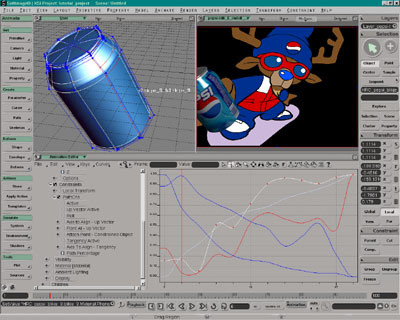
“As with most of our projects, all the animation on ‘Rudolph’ was first done by hand, then processed by cleanup and ink artists,” Buying explains. “The inked artwork was then scanned into Toonz and painted using the Ink and Paint module. All the Pepsi cans were created using SOFTIMAGE|3D. We used the rotoscope to load all the pencil tests into perspective view then, using the pencil animation frames as a reference, we positioned, rotated and scaled each can frame-by-frame. We rendered the cans and the packshot with the SOFTIMAGE cartoon renderer, matching the cartoon style as close as we could.”

While not as well-known as Rudolph – at least on this side of the ocean – the Yazoo character adorning bottles of the beverage was created by ComicHouse in 1988. When Campina, the company that produces Yazoo, wanted to repackage and remarket the product for the new millennium, they decided to go back to the source.
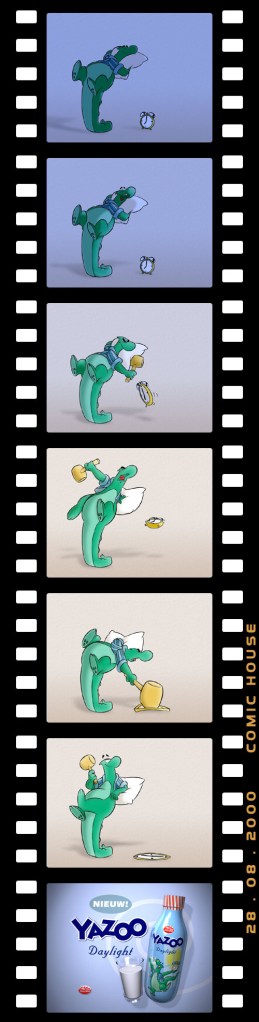
Aiming to make Yazoo a friendly and likable character, ComicHouse realized the unique nature of the task at hand: “It’s very unusual to shift the marketing focus away from the product to an animated character,” Buying admits readily. “Right from the very beginning, however, everybody wanted to make Yazoo a well-known and loved character. If we could do that, we figured that establishing a secondary link with the product would then be a logical and simple next step.”

To create a Yazoo for the next generation, ComicHouse used their substantial contacts to create a team of international animation talent. Top animators from the Netherlands, Great Britain and Canada all came to the ComicHouse studios in Amsterdam, where they worked on some fourteen Yazoo commercials.

According to Buying, the biggest challenge on the Yazoo spots turned out to be not with the character, but with the beverage itself. Faced with the seemingly innocuous task of modeling a glass filling with milk, the ComicHouse team worked for days without success. After numerous failed attempts – and more than one system crash – Buying and his team arrived at a novel solution:

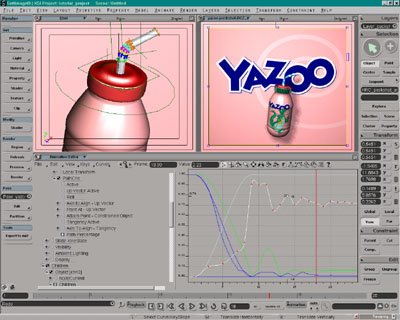
“In the end, it went something like this,” says Buying. “We started by modeling the milk itself, then split the model horizontally and applied some waves and animated the top half of the model. After creating a modeling relation, we extracted the top and bottom curves created and combined them into a believable milk flow. All other animation was done by keyframing and some minor tweaking of function curves. The character animation and all the inking of cells was done by hand. We then scanned all the artwork into Toonz and colored everything digitally. To get a good 3D look for the character, we animated an FX level for the shadows, then used the Toonz plug-in for the highlights.”

Whether it’s Rudolph or Yazoo, ComicHouse characters and animation have been delighting clients and garnering awards for many years now. The company is also a founding member of the Society of Artists Agents Holland (SAAH) and a member of the Dutch Designers Association (BnO). And the activity and adulation don’t seem destined to slow down anytime soon. ComicHouse seems ready to keep people laughing for many years to come.

The problem with Point Index to Location and deleted points


This is a gotcha that has cost people some time

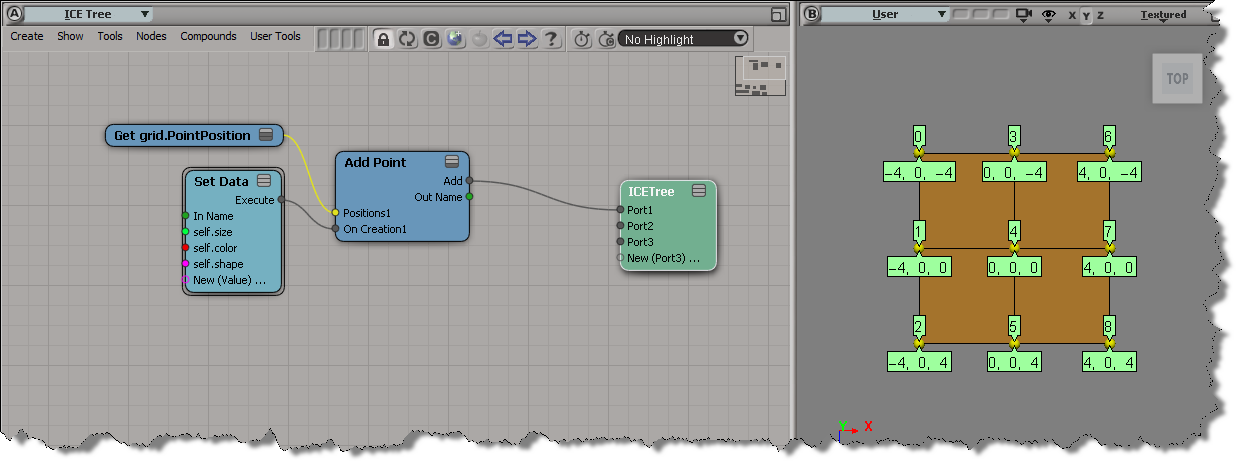
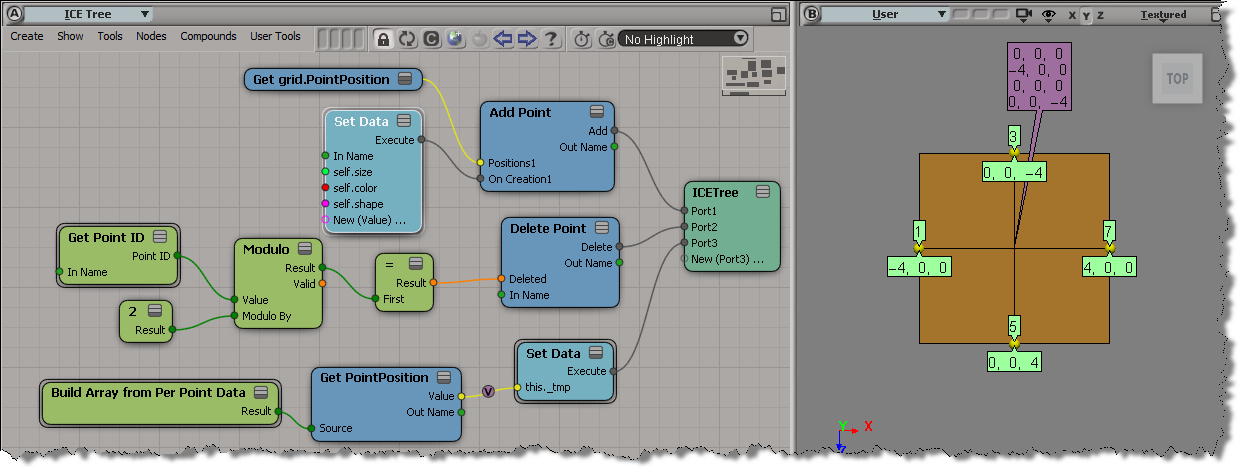
To demonstrate this, I’ve set up a simple point cloud where I Add Points using a grid primitive. I’ve added AttributeDisplay properties to the point cloud, to show the point IDs and PointPositions.

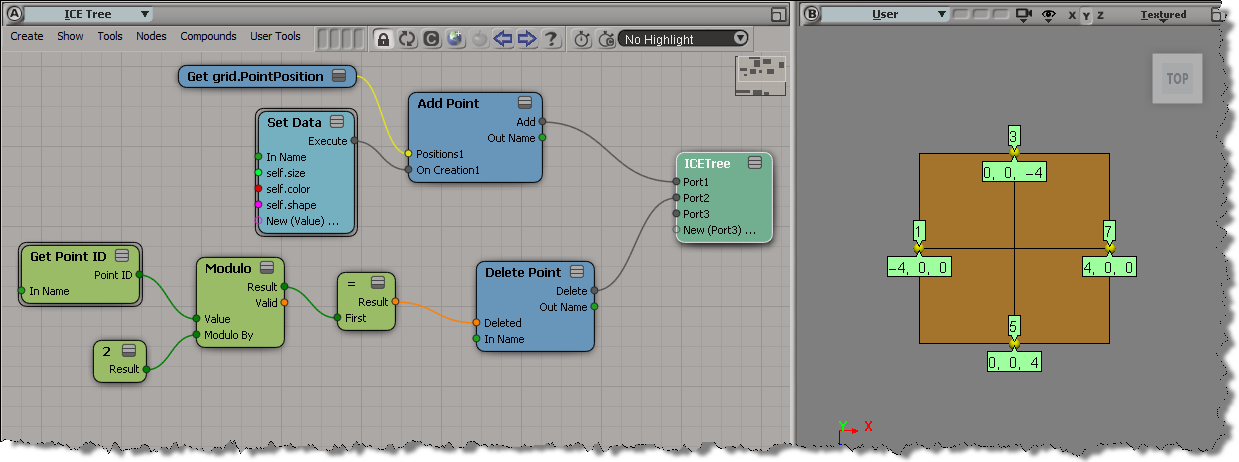
So far, so good. But if I now delete some points, notice how the point IDs don’t change (there’s none of that “reshuffling” of point IDs that the docs say will happen) because point IDs are unique. So after I delete every second point, my point IDs are 1, 3, 5, and 7, not 0, 1, 2, and 3.

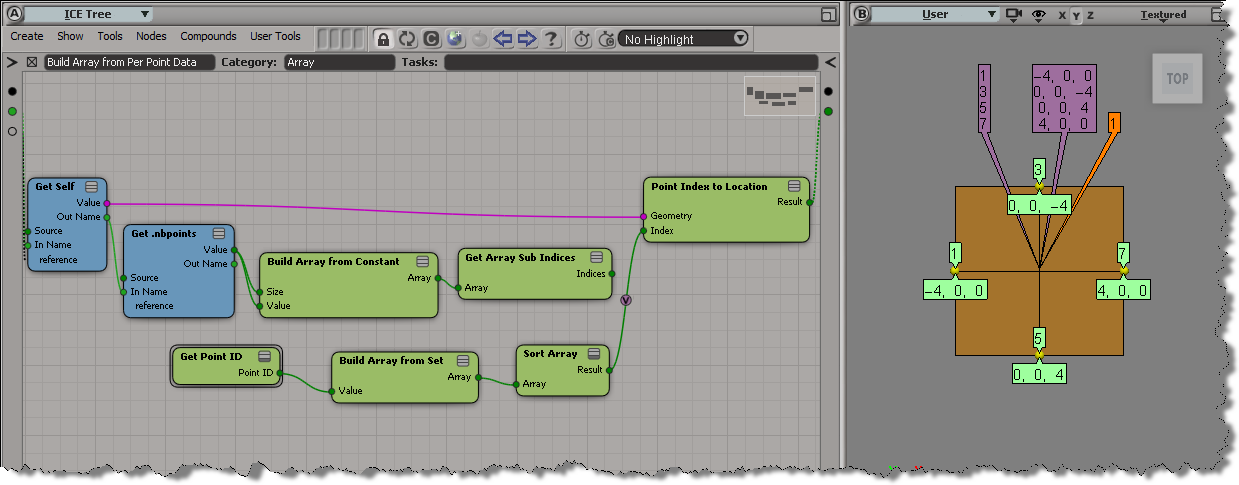
Consequently, if I use Build Array from Point Data to build an array of point positions, I get the positions for points 0, 1, 2, 3, which is incorrect. For point IDs 0 and 2, all I get is (0,0,0).

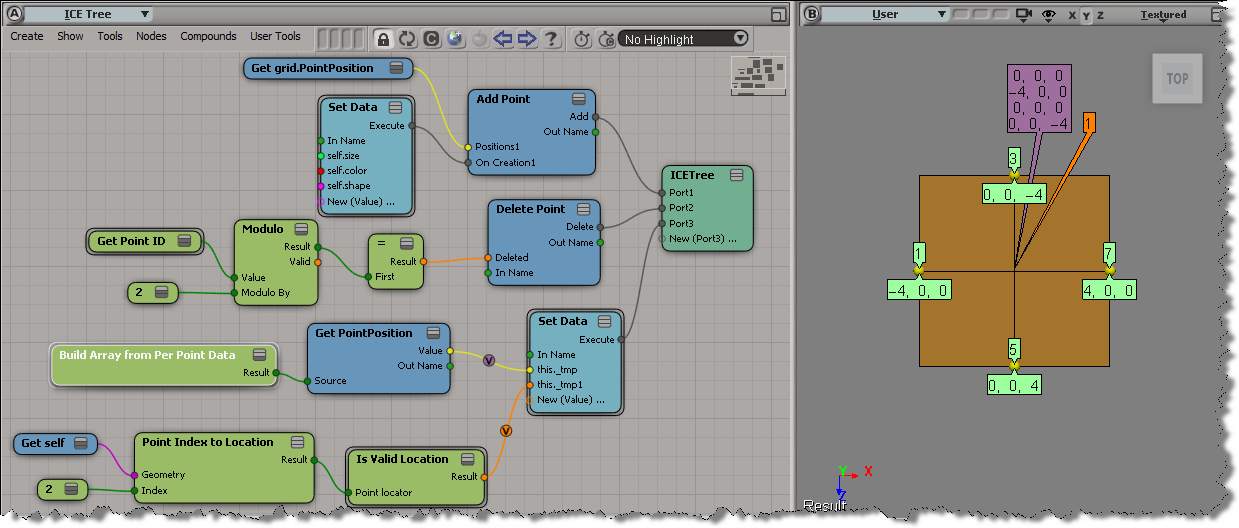
The problem is that Point Index to Location returns a valid location even when I give it the ID of a deleted point but that location doesn’t resolve to the correct point position (Build Array from Point Data uses Point Index to Location to build the array).

One workaround would be to do something like this in Point Index to Location:

hat tip: Grahame Fuller

Getting the image clips for a material


Given this render tree:

here’s a few snippets of JScript that show how to get the image clips for certain ports on the material (in this example, the diffuse and bump ports):

First, get the image clips from the sub-tree that’s plugged into the bump port:

SelectObj("Sources.Materials.DefaultLib.Material1.Lambert", null, null);

var s = Selection(0);
var sp = s.bump;

oEnum = new Enumerator( sp.Sources(0).Parent.ImageClips ) ;
for (;!oEnum.atEnd();oEnum.moveNext() )
{
	var oSelItem = oEnum.item() ;
	LogMessage( classname( oSelItem ) + " " + oSelItem.Name );
}

Second, how to get the image clips when a port uses texture layers:

SelectObj("Sources.Materials.DefaultLib.Material1.Lambert", null, null);

var s = Selection(0);
var sp = s.diffuse;

var tl = s.TextureLayers(0);
var d = tl.TextureLayerPorts("diffuse_port")
if  ( d != null )
{
	LogMessage("diffuse driven by a Texture Layer");
}


oEnum = new Enumerator( tl.Parameters("Color").Source.Parent.ImageClips ) ;
for (;!oEnum.atEnd();oEnum.moveNext() )
{
	var oSelItem = oEnum.item() ;
	LogMessage( classname( oSelItem ) + " " + oSelItem.Name );
}

The principles of support


The Autodesk support organization defines a set of “support principles” that establish a baseline for quality service. The principles are supposed to be straight-forward, common-sense guidelines such as:

  • Provide credible and timely responses
  • Make and honor commitments
  • Confirm resolution
  • Document cases
  • Communicate professionally
  • Escalate immediately

We do weekly review of randomly-selected cases for principle compliance, and the review scores are a lead measure of our success. They’re a lead measure because management considers principle compliance a predictor of success (where success is measured by the quarterly Net Promoter Score aka customer satisfaction).

In practice, you can go around in endless circles discussing what these principles actually mean. I’ve sat through whole meetings where we never got past the first definition of the first principle.

Based on my experience on the front-line, here’s my take on the principles. I’ve reduced the principles to single-sentence bullet points with [I think] plain English words.

  • Respond quickly with either a solution or some questions that clarify the problem.
  • Let the customer know when you’ll get back to them, and do what you promise.
  • Don’t let cases sit inactive for over 2 days: if you’re waiting for information, follow up with the customer; if you’re researching the problem, let the customer know what’s happening.
  • Document cases so that others can understand the problem and the solution.
  • Communicate like a pro: clear, concise, easy to understand, and with the same tone you would expect from others.
  • Don’t delay–when you tell a customer you’re going to escalate or transfer the case, do it right away.

Support case word cloud


Here’s a word cloud I generated from the summary and description fields of the Softimage support cases that came in so far this year. The word cloud shows the top 50 words (after I manually removed words like “Softimage”, “using”, “hello”, and others). I did about 30 search-and-replaces to get rid of words that weren’t feature-related, but there’s still some, like “attached”, left in the cloud.

Friday Flashback #34


From 2001, the XSI 2.0 launch ad.

Now where’s that Final Frontier?

SOFTIMAGE|XSI v.2.0 GETS YOU THERE
XSI v.2.0 takes you beyond your boundaries. Imaginary. Or real. The newest version of XSI allows you to explore advanced dynamics with the seamlessly integrated photo realistic hair/fur simulation system. Discover the industry’s only fully-interactive renderer, powered with mental ray® v.3.0. And broadcast artists will find the super sophisticated 3-D text and logo creation tools a dream come true.

Want to fly further still?
How about an awesome new integrated compositor to unite your 2-D and 3-D worlds with
unprecedented speed and elegance. And our revolutionary interactive real-time shaders give artists the power to control game effects. All with mind-numbing performance and stability. Not to mention accelerated ROI.

Want to impress aliens – or even your boss?
Visit http://www.sofitmage.com/v2 where you can order the very hot XSI demo CD, sign up for the XSI newsletter – even arrange for a hands-on demo. Suddenly, that final frontier seems a whole lot closer.