The future of 3d animation began 14 years ago on this day, Jan 17th. Was it worth the wait?

Teaser from http://www.3dwillneverbethesame.com
Friday Flashback #155
2

The future of 3d animation began 14 years ago on this day, Jan 17th. Was it worth the wait?
Teaser from http://www.3dwillneverbethesame.com
What was happening on the XSI list 13 years ago?
In the past few weeks, I’ve compiled annual summaries for five different lists, so here’s one more, this time for Jan 2001 on the XSI mailing list.
I pulled a listing of the Jan 2001 posts out of the wayback machine, and stuffed them into a word cloud. There were a lot of names I recognized; many of them still posting on the list. Do you see yours? 🙂

There were almost a thousand posts. Here’s the top topics of discussion:
XSI 1.5 inspired a lot of discussion, there were many small threads about that update:
Top posters
Sumatra splash screen

Possibly just a mock up.
Kaboom! “In SOFTIMAGE|3D, the Effects > Kaboom custom effect in the Motion module allows you to explode complete hierarchies using dynamics and collision detection. Now you too can create your own earth-shattering kabooms!”
1997 screenshot
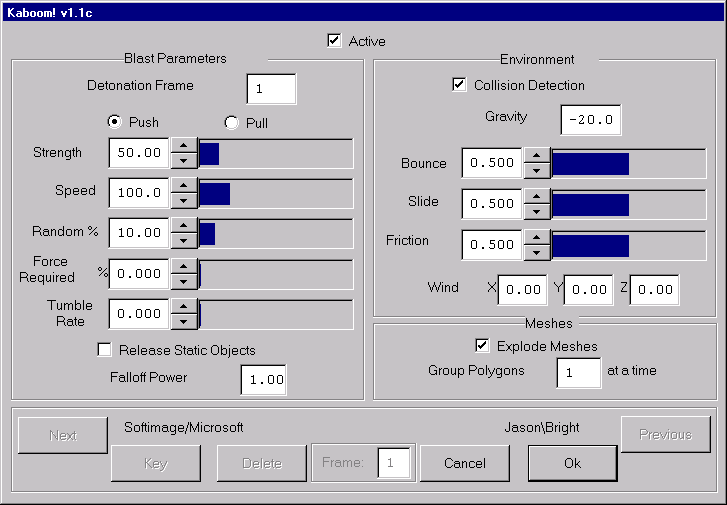
Exploding Hierarchies with Kaboom
The Effects > Kaboom custom effect in the Motion module allows you to explode complete hierarchies using dynamics and collision detection. Now you too can create your own earth-shattering kabooms!
Features include:
Using the Kaboom Effect
The Kaboom effect explodes the currently selected hierarchy. Dynamic calculations are done on the object, including gravity, wind, and collision detection with a ground plane. Objects can collide with the ground plane (from either side), bounce, and slide (continuous contact). Polygon mesh objects can be exploded into their constituent polygons.
Here’s an example of how to use the Kaboom effect:
For a full description of parameters, see this command’s description in the Reference Guide.
Tips for Using the Kaboom Effect
Things to Try
Xmas-style XSI logo from 2004

XSI v2.0 Special Competitive Trade in Program, valid till 31-December 2001


I wonder where they got the XSI Chinese Manual?
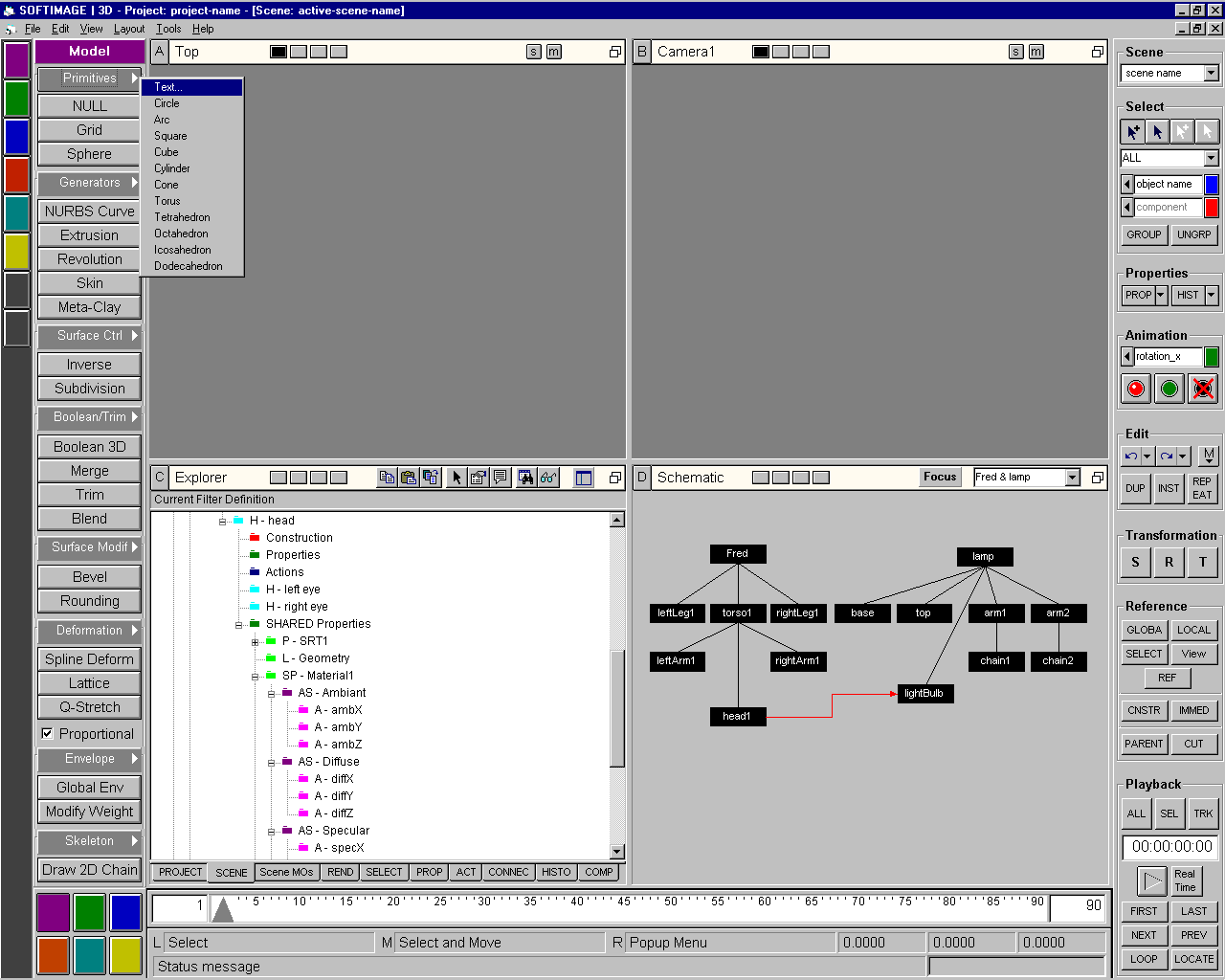
Here’s a 1996 mock up of what SOFTIMAGE|3D might have looked like in an alternate universe.
Faux Pas (1989) by Softimage, Daniel Langois, Georges Mauro and Char Davies.
When I was Six (1993) by Michelle Robinson
Some commentary from Algorithmic Video Art: an internship report
Exemplary for this stage is the use of the Softimage software in some of the ISEA videos. Softimage is the creator and publisher of software tools for artist whom work with computer generated imagery (CGI). Though Softimage mainly focuses itself on graphic tools for the creators of commercial films and video games, the company also supports educational and artistic projects23. During an early ISEA symposia one such project was Faux Pas (1989) created by artists Daniel Langois and Char Davies amongst others. This short animation of the anthropomorphism of a giant board of chess on which a rook (a chess tower) stumbles to his death, is surprisingly (hyper)realistic for the time it was made. One revels in the level of technological complexity, rather than in the tragedy which befall the chess pieces. Softimage is credited in both the animation itself and in most background information on the video. This means the technology used is flaunted explicitly and it becomes an important element of the work itself (almost to the point of it being an advertisement for Softimage).
The display of the capabilities of the current technology in Faux Pas, as if it were a technical experiment, seems to outweigh the artistic content. Through its derivation of conventions of realism, technology becomes the object of the work. The video When I was Six (1993) by Michelle Robinson uses Softimage software as well, but here the technology seems more secondary to Robinsons creative input. When I was Six is an animation filmed entirely from one perspective. Presumably it is the perspective of an imaginative six year old lying in bed and scared of the dark, for we see a dim room with bedchamber furniture which turns alive (much like the chess pieces in Faux Pas). The furniture, such as a closet and a chair, looms towards the “camera”, casting eerie shadows and threatening the viewer/six year old.
Although the software has undoubtedly improved since Faux Pas, it does not appear to be the main focus of Robinson. However, the film still derives conventions from other media forms such as animation and cinema. The graphic technology used in this work is no longer the object, but more of a means to an end and though the basic aesthetics are visibly different from the aesthetics of either animation or cinema, not much has changed in either form or content. These videos exemplify the critique Greenfield refers to on computer art which merely uses technology and software as a set of tools.
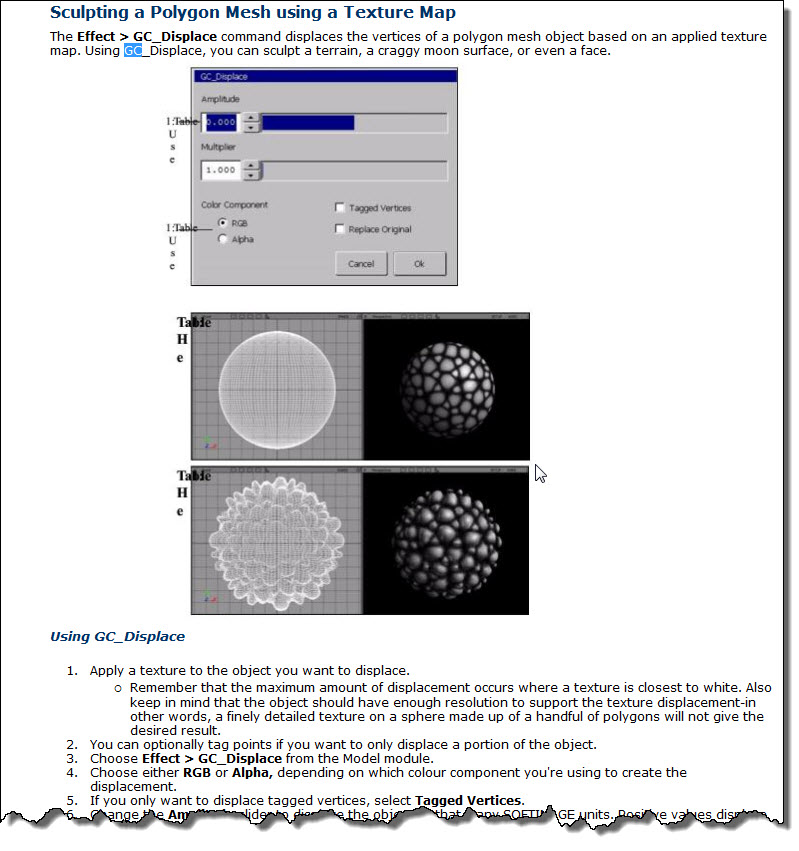
SOFTIMAGE|3D had a Effect > GC_Displace command (written with the C++ GDK) that displaced the vertices of a polygon mesh object based on an applied texture map. Using GC_Displace, you could “sculpt a terrain, a craggy moon surface, or even a face.”
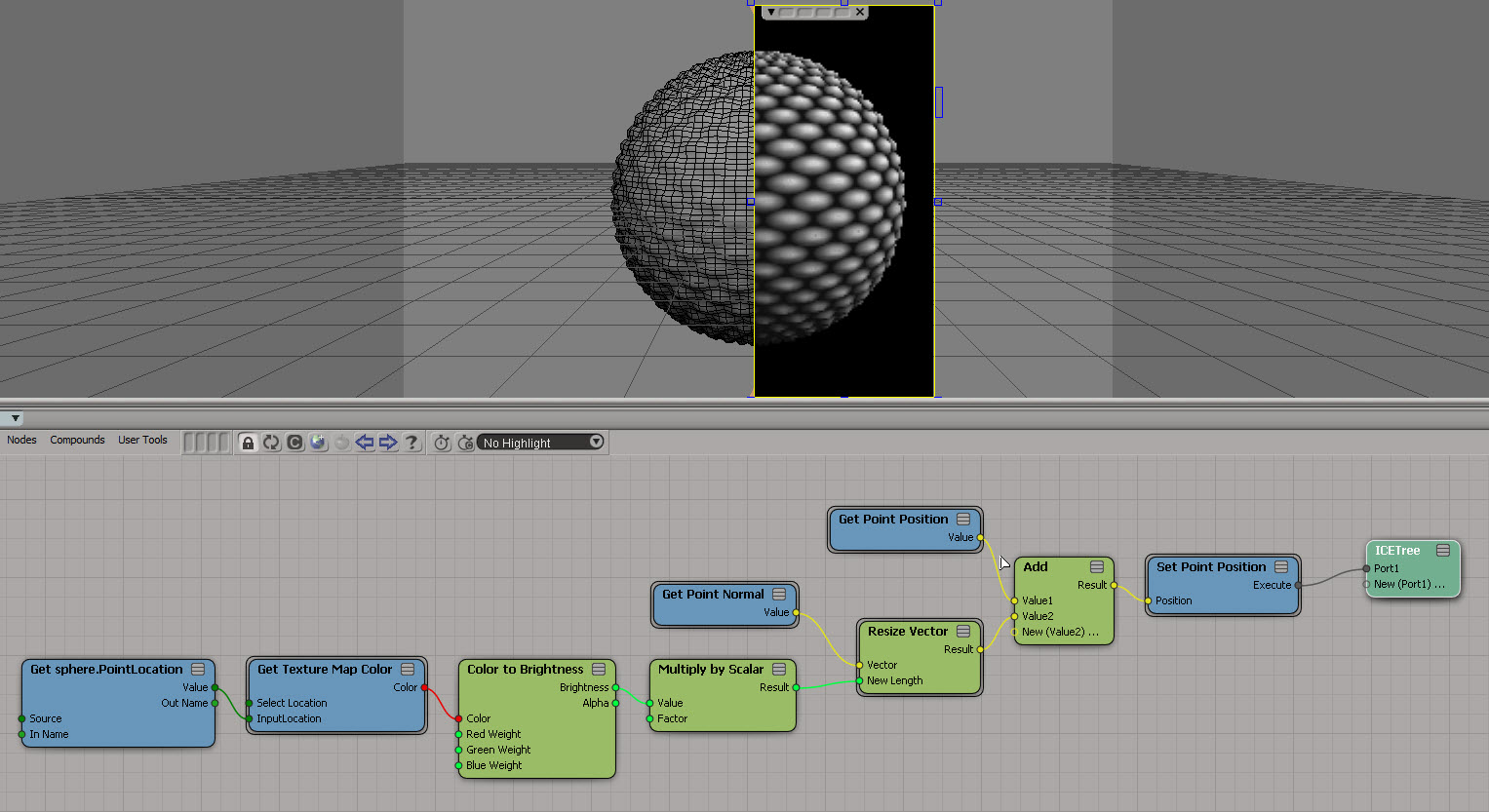
I came across a screenshot of GC_Displace the other day, so for fun I re-created the basic effect in ICE:
Screenshot of Wam!Net ROD Render in SOFTIMAGE|3D. From the Softimage web site back in 2000/2001.

Press release from April 2000:
Softimage Works With WAM!NET to Offer High-Speed Rendering to the Animation and 3-D Special Effects Industries
NAB2000
LAS VEGAS–(BUSINESS WIRE)–April 9, 2000
Softimage Co., a subsidiary of Avid Technology, Inc. (NASDAQ: AVID), and WAM!NET Inc. today announced that WAM!NET has joined the Softimage Developer program as a Gold Level Partner to provide its ROD!(TM)service (Render On Demand). ROD! is designed to give SOFTIMAGE(R)|3D and SOFTIMAGE(R)|XSI(TM) artists and animators a strong alternative to traditional rendering and asset management.
This relationship will give digital content creators an option to farm out the rendering process using the WAM!NET(R) ROD! service. Studios and small production facilities alike can reduce production costs and accurately estimate projects with the ROD! service, which provides the much-needed computing power for larger projects. This additional “as-needed” computing power allows animation and special effects studios to reduce overhead costs and accurately estimate project requirements, enabling them to remain competitive in the growing animation and special effects industry.
“Softimage is one of the top innovators in three-dimensional and two-dimensional graphics technology,” said Keith Elzia, vice president of strategic development at WAM!NET. “WAM!NET is an e-services company that believes in providing best-of-breed technology to its subscribers. Softimage is a technology leader in the animation and special effects industry. As a Gold Level Partner, our joint marketing and sales effort with Softimage will help build a stronger ROD! service for the animation industry with the two popular Softimage software applications available on ROD!.”
“WAM!NET has provided a powerful and cost-effective rendering service that is an excellent alternative for all of our customers regardless of size,” said David Miller, director of business development at Softimage. “The benefit of the WAM!NET ROD! service is that it is available on an ‘as-needed’ basis to provide added coverage and economic flexibility for the ebbs and flows of animation and special effects projects.”
WAM!NET’s ROD! service provides high-speed, wide-area rendering services and offers an effective way for all studios to do high-speed rendering and bid with confidence on large projects that require tremendous rendering power and asset management capabilities. WAM!NET’s services eliminate the need to upgrade or add to existing hardware and software to access high-speed, on-demand rendering.
The Benefits of WAM!NET
WAM!NET provides many benefits to SOFTIMAGE|3D, SOFTIMAGE|XSI and mental ray(R) customers, including:
–The ability to offload computer-intensive, time consuming rendering functions to WAM!NET’s high-speed, wide-area media network to save both money and time on projects;
–Asset management features and offsite archives provide an efficient method of storing and managing their rendering workflow;
–Access to WAM!NET’s distributed rendering on a high-speed, privately managed and secure network;
–The ability to utilize the WAM!NET ROD! service to outsource their computer-intensive rendering needs and enjoy increased profits and improved productivity as artists free up their workstations for more projects; and
–Most importantly, large or small studios alike will be able to enjoy WAM!NET’s ROD! service and confidently pursue larger projects with the processing power to meet tight deadlines on a pay-as-you-go basis.
About WAM!NET Inc.
WAM!NET Inc., with its digital media management service, sets the industry standard for electronic collaboration in the graphic arts, advertising, marketing and entertainment industries. WAM!NET’s Industry Smart(TM) high-speed transportation network, on-line archiving service and production workflow application software allow subscribers to digitally collaborate with thousands of global trading partners with one simple connection. Since its incorporation in the state of Minnesota in 1994, WAM!NET has attracted more than 1,900 users of direct services and over 6,800 users of its dial-up and Internet Gateway service. WAM!NET services are available throughout America, Europe and Japan.
WAM!NET is headquartered in Eagan, Minnesota, with offices throughout North America, Europe and Japan. The company has benefited from strategic relationships with SGI, MCI WorldCom and Winstar Communications. For more information about WAM!NET, call 800.611.9006, or visit WAM!NET’s Web site at http://www.wamnet.com.
WAM!NET(R) is a registered trademark and Industry Smart(TM) and ROD!(TM) are trademarks of WAM!NET Inc. All other trademarks and registered trademarks are the property of their respective companies.
About Avid Technology, Inc.
Avid Technology, Inc., of which Softimage Co. is a subsidiary, is an international, industry-leading provider of digital audio and video tools for information and entertainment applications. Avid’s products are used by a variety of customers worldwide including film, television and interactive content producers, TV news broadcasters, corporate communicators and consumers. For more information, visit the Softimage site at http://www.softimage.com or Avid’s Web site at http://www.avid.com.
(c)2000 Avid Technology, Inc. All rights reserved. Product specifications are subject to change without notice. Avid and Softimage are registered trademarks and XSI is a trademark of Avid Technology, Inc. WAM!NET is a registered trademark and Industry Smart and ROD! are trademarks of WAM!NET Inc. mental ray and mental images are registered trademarks of mental images GmbH & Co. KG in the USA and/or other countries. All other trademarks contained herein are the property of their respective owners.

